
Beyond Silicon: How India’s Entry into ‘Pax Silica’ Forges a New Blueprint for the 21st Century
India’s formal entry into the US-led Pax Silica alliance marks a strategic realignment that positions the nation at the core of a new, trust-based technological world order, moving beyond mere symbolism to address critical vulnerabilities in global AI and semiconductor supply chains. By joining this coalition of democracies—which includes Japan, South Korea, and the UK—India brings a unique and indispensable combination of a vast engineering talent pool, a burgeoning domestic market, and tangible progress in semiconductor manufacturing, including the domestic design of 2-nanometre chips and ten plants under establishment. The partnership is framed as a mutual rejection of “weaponized dependency,” with the US committing to share trusted AI technology and Indian leadership emphasizing that the one million additional skilled professionals the global industry requires will come from India. This alliance, grounded in shared democratic values and a vision for human-centric AI governance, signifies India’s transition from the periphery to the center of the global innovation economy, forging a resilient blueprint for the 21st century’s economic and technological order.
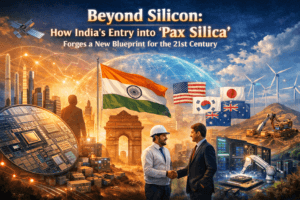
Beyond Silicon: How India’s Entry into ‘Pax Silica’ Forges a New Blueprint for the 21st Century
On a Friday in late February 2026, on the sidelines of the Global AI Impact Summit in New Delhi, a document was signed that signals a profound shift in the tectonic plates of global technology. India formally joined the Pax Silica alliance, a US-led coalition of nations committed to securing the future of artificial intelligence and the intricate supply chains that power it . While the ceremony was a quiet diplomatic affair, the reverberations are anything but. This is not merely another trade agreement; it is a strategic realignment that positions India at the heart of a new, trust-based technological world order.
The term “Pax Silica” is deliberate and evocative. It draws a direct line from the “Pax Romana,” the Roman peace enforced by military might, to a modern era where dominance is determined not by legions, but by the control of the “silicon stack”—from the mines that yield critical minerals to the fabs that etch nanometre-scale circuits and the data centers that run the world’s most advanced AI . As US Ambassador to India, Sergio Gor, put it, this is “a coalition of capabilities that replaces coercive dependencies with a positive sum alliance of trusted industrial bases” .
The Strategic Imperative: Saying ‘No’ to Weaponized Dependency
To understand the weight of this moment, one must look beyond the technical jargon and see the geopolitical philosophy driving it. At the signing, US Under Secretary of State for Economic Affairs, Jacob Helberg, reached back into ancient history to frame the stakes. He recalled the words attributed to Alexander the Great, who allegedly viewed the peoples of Asia as slaves because they had not learned to pronounce the word “No” .
Helberg drew a parallel to the present, stating that by signing the Pax Silica Declaration, both nations are finally learning to say that word together. “We say no to weaponised dependency, and we say no to blackmail,” he declared . This rhetoric cuts to the core of the alliance’s purpose. For decades, globalized supply chains prioritized efficiency above all else, leading to a precarious concentration of manufacturing and raw material processing in a single nation. The COVID-19 pandemic exposed this fragility, but the current geopolitical climate has turned that fragility into a national security crisis. Semiconductors are the new oil, and no free economy can afford to have its supply controlled by a potential adversary.
This is where India’s role becomes not just useful, but “strategic and essential,” in the words of Ambassador Gor . The alliance, which includes partners like Japan, South Korea, Australia, and the UK, is building a parallel, resilient ecosystem . India offers something no other member can: a unique combination of a vast, highly-skilled engineering talent pool, a burgeoning domestic market, a stable democratic framework, and a demonstrated commitment to respecting intellectual property . As the world seeks to de-risk from concentrated supply chains, India is emerging as the most viable and scalable alternative.
India’s Semiconductor Ascent: From Policy to 2-Nanometre Reality
For India, Pax Silica is not a handout; it is a launchpad. Union Minister for Electronics and IT, Ashwini Vaishnaw, provided a clear-eyed assessment of the country’s trajectory, emphasizing that the alliance will “greatly benefit India’s electronics and semiconductor industry” . This confidence is rooted in tangible progress. Vaishnaw revealed that ten semiconductor plants are already in various stages of establishment across the country, with the first one poised to begin commercial production imminently .
This momentum is not accidental. It is the result of a sustained policy push, most notably the India Semiconductor Mission (ISM). The recent Union Budget 2026-27 launched ISM 2.0 with a hefty allocation, shifting focus from initial setup to deepening the ecosystem by producing indigenous equipment, materials, and intellectual property . The numbers are telling: the domestic semiconductor market is projected to balloon from approximately $45-50 billion in 2025 to $100-110 billion by 2030 .
Perhaps the most striking revelation from Minister Vaishnaw was that India’s engineers are now designing the world’s most advanced 2-nanometre chips domestically . This is a monumental leap. Chip design is the high-value, high-intellect pinnacle of the semiconductor industry. By achieving this capability, India signals that it is no longer content to be just an assembly hub; it aims to be a creator of the world’s most complex technologies. This is further bolstered by indigenous microprocessor developments like DHRUV64 and the SHAKTI series under the Digital India RISC-V (DIR-V) programme, which are building a foundation of sovereign processor capability .
The Talent Dividend and the American Pivot
Underpinning all of this is demography. While much of the developed world faces aging workforces, India remains a young nation. Vaishnaw highlighted a critical statistic: the global semiconductor industry will require approximately one million additional skilled professionals in the coming years. His message was unambiguous: “Where will that talent come from? This will come from here” .
This talent pool is the ultimate magnet for US investment and collaboration, a central pillar of the Pax Silica vision. The alliance is designed to be a two-way street. The US, through its newly announced American AI Exports Program, aims to export “full-stack AI technology packages”—including hardware, models, and cybersecurity—to trusted partners like India . This is not about creating dependency but about building an integrated, trusted ecosystem.
The private sector is already voting with its dollars. The Indian Express reported that in the month leading up to the pact, US tech giants committed staggering sums to India’s AI infrastructure . Microsoft announced a $17.5 billion investment to expand its AI and cloud capacity, while Google unveiled plans to invest over $15 billion to establish a major AI data center in Andhra Pradesh . Google CEO Sundar Pichai, speaking at the summit, encapsulated the sentiment: “I believe India is going to have an extraordinary trajectory with AI… The US India partnership has a critical role to play” .
A Shared Vision for a Complex World
The Pax Silica Declaration itself outlines a grand vision, stating that “economic value and growth will flow through and across all levels of the global AI supply chain, driving historic opportunity and demand for energy, critical minerals, manufacturing, technological hardware, infrastructure, and new markets not yet invented” .
This forward-looking philosophy aligns remarkably well with the principles laid out by Prime Minister Narendra Modi at the same summit. He unveiled the MANAV vision for AI governance: Moral and Ethical Systems, Accountable Governance, National Sovereignty, Accessible and Inclusive, and Valid and Legitimate . This framework ensures that as India scales its technological heights, it does so with a human-centric approach, ensuring that AI is a “multiplier” and not a monopoly .
The partnership also represents a thaw and a reset. The signing comes on the heels of a resolved trade dispute where the US rolled back recent tariffs after India agreed to curb discounted Russian oil imports . This diplomatic choreography shows that while India maintains its strategic autonomy, its economic and technological future is increasingly intertwined with like-minded democracies. As Ambassador Gor optimistically noted, “From the trade deal to Pax Silica to defense cooperation, the potential for our two nations to work together is truly limitless” .
India’s entry into Pax Silica is more than a diplomatic milestone; it is a declaration of intent. It signifies a nation ready to move from the periphery to the center of the global innovation economy. By joining this coalition, India is not just securing its own supply chains but is helping to architect a new world—one where technology empowers free people, and where peace, as Helberg and Gor both emphasized, truly comes through strength . The 21st-century economic order is being written in silicon, and India has just secured a seat at the head of the table.
You must be logged in to post a comment.