
Beyond Quotas: How India’s Science Ministry is Rewiring Inclusion for Scheduled Castes in STEM
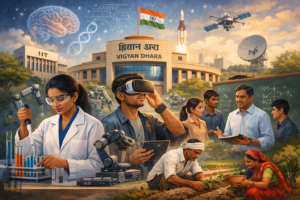
India’s Ministry of Science and Technology is undertaking a structural overhaul to boost Scheduled Caste (SC) participation in STEM, moving beyond quotas to targeted, high-value interventions. Key initiatives include the Vigyan Dhara scheme (merging three older programs to embed SC inclusion across R&D, capacity building, and innovation), the NM-ICPS mission (training SC students in deep-tech fields like AI and robotics), and ANRF’s Inclusivity Research Grant (funding frontier research for SC scholars). Data from Andhra Pradesh shows fluctuating but strategically shifting investments—from 4,828 beneficiaries in 2023-24 to 3,415 in 2025-26 but with per-capita funding jumping to ~₹2.29 lakh, indicating a focus on quality over quantity. Parallel efforts include Mission Mode recruitment (32 SC faculty posts filled in Andhra’s central institutions), Biotech-KISAN for grassroots agricultural solutions, and Dr. B.R. Ambedkar Study Circles offering free residential coaching. While gaps remain in outcome tracking and industry hiring, the overall direction is a deliberate, engineering-like approach to make Indian science genuinely inclusive—not as charity, but as a national innovation imperative.
Beyond Quotas: How India’s Science Ministry is Rewiring Inclusion for Scheduled Castes in STEM
New Delhi – For decades, the narrative around India’s scientific prowess has been one of stunning highs—from the Mars Orbiter to a booming startup ecosystem—shadowed by persistent lows: the systemic underrepresentation of marginalized communities, particularly Scheduled Castes (SCs), in the upper echelons of research and innovation.
But buried in a recent Lok Sabha reply by Dr. Jitendra Singh, Minister of State for Science and Technology, is a story that rarely makes headlines. It’s not just about reservation policies or scholarship disbursements. It’s about a quiet, structural overhaul of how the government is trying to democratize deep-tech, cyber-physical systems, and biotechnology.
The data reveals a mixed reality: a sharp rise in participation followed by a puzzling dip, alongside a new architectural blueprint for inclusion that moves from sympathy to engineering.
The Vigyan Dhara Pivot: Merging for Muscle
The most significant shift came in January 2025 with the launch of Vigyan Dhara. By merging three older umbrella schemes, the Department of Science and Technology (DST) didn’t just simplify paperwork; it created a unified funding juggernaut. For SC students and researchers, the critical keyword in the new scheme is “inclusive participation,” which appears repeatedly across its three pillars: human capacity building, R&D, and innovation deployment.
Unlike previous siloed efforts, Vigyan Dhara aims to embed SC inclusion into the lifecycle of a scientist. A young Dalit student can theoretically enter through a school-level innovation workshop, receive a fellowship for a PhD in sustainable energy, and later get deployment support for a startup—all under one policy roof.
What makes this human-centric is the shift from mere access to outcome. Historically, an SC student might get a tuition waiver but lack mentorship or lab access. The new framework explicitly mentions “special initiatives” to build capacity within SC communities, not just admit them.
The Enigma in the Numbers: A Closer Look at Andhra Pradesh
The Ministry provided a rare granular breakdown for the state of Andhra Pradesh—a microcosm of the national trend. The numbers tell a story of ambition, volatility, and perhaps, teething problems.
| Financial Year | No. of SC Beneficiaries | Funds Allocated/Utilized (₹) | Human Insight |
| 2022-23 | 849 | 3.91 Crore | Pilot phase: modest reach, high per-capita spend (~₹46k) |
| 2023-24 | 4,828 | 6.92 Crore | Explosive growth: 468% rise in beneficiaries, but per-capita drops (~₹14k) |
| 2024-25 | 4,000 | 3.03 Crore | The pullback: fewer beneficiaries, sharp 56% budget cut from previous year |
| 2025-26 | 3,415 | 7.83 Crore | The rebound: per-capita spend skyrockets to ~₹2.29 lakh—focus shifts to quality |
What explains the 2024-25 dip? While the Ministry attributes this to competitive, merit-based selection, a real-world insight emerges: 2024-25 was a transition year. Vigyan Dhara was brand new (launched Jan 2025), and old schemes were winding down. Bureaucratic recalibration likely led to a pause. The spectacular jump in 2025-26’s allocation—over ₹7.8 crore for just 3,415 beneficiaries—suggests a strategic shift toward high-value interventions: perhaps more research grants and PhD fellowships rather than short-term workshops.
For a Dalit student in Tirupati or Visakhapatnam, this means the competition is stiffer, but the prize is larger. It’s no longer about getting any support; it’s about getting transformative support.
The Deep-Tech Frontier: NM-ICPS and IRG
Two initiatives stand out for their audacity. First, the National Mission on Interdisciplinary Cyber-Physical Systems (NM-ICPS) . This isn’t about basic computer literacy. NM-ICPS is pushing SC students into AI, ML, Robotics, IoT, and Cybersecurity—fields traditionally dominated by privileged urban cohorts.
Through Technology Innovation Hubs (TIHs) at premier institutes, an SC student from a rural Andhra college can now access the same drone tech or robotics lab as an IIT student. The scheme explicitly funds “industry-relevant training” for underserved regions, bridging the gap between a degree and a job in the digital economy.
Second, the Anusandhan National Research Foundation (ANRF) has introduced the Inclusivity Research Grant (IRG) , replacing the older EMEQ scheme. The difference? IRG is not a pity grant. It funds “frontier areas of science and engineering” for SC/ST researchers. This means a Dalit post-doc working on quantum computing or synthetic biology can now compete for dedicated, substantial funding without being relegated to “social science” or “development” research ghettos.
The Faculty Wall: Mission Mode Recruitment
One of the most persistent bottlenecks has been the lack of SC professors. You cannot inspire young Dalit students if they never see anyone like them at the front of a lecture hall.
The Ministry’s reply reveals a concrete push: Mission Mode Recruitment. Since September 2022, all Central Higher Educational Institutions (CHEIs)—IITs, NITs, IISERs, Central Universities—have been on a hiring spree to clear backlog vacancies.
The national picture: 3,692 SC posts filled, including 2,216 faculty positions. The Andhra Pradesh picture (IIT Tirupati, IISER Tirupati, NIT Andhra, etc.): 336 total posts filled, of which 51 are SC. Within that, 32 are faculty roles.
While 32 SC professors might sound small, consider this: these are permanent, tenured or tenure-track positions at elite institutions. Each of those 32 individuals becomes a role model, a mentor, and a institutional memory for the next generation. The “special drive” is slowly normalizing the presence of SC scholars in spaces where they were once invisible.
Biotech for the Bottom of the Pyramid
The Department of Biotechnology (DBT) offers the most grounded, grassroots example of inclusion. Through Biotech-KISAN and the Biotech-based Societal Development Programme, the focus is not on creating PhDs but on solving problems.
For an SC farmer in the Rayalaseema region of Andhra Pradesh, biotechnology is not a scary lab coat—it’s a soil health card, a drought-resistant seed variety, or a low-cost method to test water purity. DBT’s programs train farmers, youth, and women in SC communities to use biotech, not just study it. This flips the script: inclusion becomes about application and economic empowerment, not just academic seats.
The Ambedkar Study Circles: Coaching with Dignity
The press release mentions a hyper-local, high-impact initiative from Andhra Pradesh’s Social Welfare Department: Dr. B.R. Ambedkar Study Circles in Vijayawada, Visakhapatnam, and Tirupati.
Why does this matter for a Science & Technology article? Because competitive exams for scientific services (like CSIR-NET, GATE, or even UPSC’s science optional) are notoriously biased toward English-medium, urban-coaching culture. These study circles offer free residential coaching for 100 SC candidates per center (with 33% women’s reservation) for exams like UPSC, SSC, and RRB—which include scientific roles.
This is structural empathy. It acknowledges that talent is universal, but opportunity is not. By providing housing, food, and mentorship, the state removes the “luxury” barrier that keeps brilliant SC students from competitive science careers.
Where the Gaps Remain
Despite these initiatives, a critical reader will spot the soft underbelly. The Ministry’s reply is silent on outcome tracking. How many of these 3,415 beneficiaries in 2025-26 will actually complete their PhD? How many will publish in top journals? How many will secure faculty positions?
Furthermore, while the supply side (fellowships, admissions) is well-funded, the demand side (industry hiring, startup funding for SC-led ventures) is still nascent. A fellowship gets you a degree; a bias-free hiring committee gets you a career.
The Ministry also relies heavily on “competitive mode” and “merit basis.” While necessary for quality, this risks recreating privilege unless accompanied by robust remedial coaching and mentorship—areas where the reply suggests progress but provides scant evidence.
The Verdict: A Blueprint in Progress
This is not a story of mission accomplished. It is a story of mission architected. For the first time, India’s science establishment is treating SC inclusion as a complex engineering problem, not a political checkbox.
- The Vigyan Dhara merger provides a unified pipeline.
- The NM-ICPS opens the deep-tech door.
- The IRG grants fund frontier research for SC scholars.
- Mission Mode recruitment is slowly diversifying faculty.
- Biotech-KISAN brings labs to the land.
For a young Dalit student in Kurnool or a research scholar in Tirupati, the message is finally clear: The government has built the ramps, the grants, and the guidance cells. The lab doors are open. The next move—to walk through, experiment fearlessly, and file patents—is yours.
The numbers will fluctuate, as they did between 2023 and 2026. But the direction is unmistakable. Indian science is slowly, messily, but irrevocably, becoming a more inclusive enterprise. And that is not just social justice—that is how you unlock a nation’s true innovative potential.
You must be logged in to post a comment.