
Beyond Profit: Decoding Mohan Bhagwat’s Call for a ‘Society-Centric’ Tech Ethos in India
In a recent address to young entrepreneurs, RSS chief Mohan Bhagwat articulated a vision for a “society-centric” approach to technology, warning against over-dependence and advocating for its conscious adaptation to India’s unique social and economic conditions. He reframed the concept of swadeshi not as rejection but as responsible integration, emphasizing that business and innovation must be guided by social responsibility alongside profit.
By highlighting the Indian farmer’s mindset—viewing work as a duty to community—Bhagwat proposed a moral framework where technology serves as a tool for societal welfare, augmenting rather than replacing human roles, and ensuring that advancement strengthens social bonds and employment rather than undermining them. This philosophy challenges prevailing market-centric models, urging India to forge a distinct path where technological progress is measured by its contribution to collective well-being and cultural resilience.
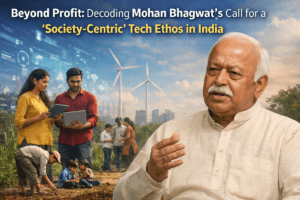
Beyond Profit: Decoding Mohan Bhagwat’s Call for a ‘Society-Centric’ Tech Ethos in India
Introduction: A Timely Warning in an Age of Algorithmic Overdrive
In an unassuming gathering in Mumbai, part of the Rashtriya Swayamsevak Sangh’s (RSS) centenary year celebrations, a message cutting against the grain of global tech evangelism was delivered. RSS chief Mohan Bhagwat, interacting with young entrepreneurs, didn’t champion disruption for disruption’s sake or valorize Silicon Valley’s “move fast and break things” mantra. Instead, he issued a nuanced, culturally-grounded plea: technology must be society-centric, and we must guard against becoming its slaves. This isn’t merely a conservative leader’s skepticism of the new; it is a profound intervention in a critical global debate about the soul of our technological future, seen through a distinctively Indian lens.
At its heart, Bhagwat’s argument challenges the fundamental driver of modern innovation: the profit motive. By urging that business and industry be guided by social responsibility, and by reframing the indigenous concept of swadeshi not as technological rejection but as contextual adaptation, he provides a framework for India to navigate its digital destiny. This is more than a speech; it is a philosophical roadmap for a nation poised to be both a massive consumer and a potential creator of alternative tech paradigms.
The Core Philosophy: Welfare Over Dependence
Bhagwat’s statement that “technology is unavoidable and it is not bad in itself” is a crucial starting point. It avoids the trap of outright technophobia, acknowledging the instrumentality of tools. The real danger, he cautions, lies in dependence “to the extent that it controls us.” This echoes ancient wisdom found across cultures—the Buddhist concept of attachment, the Aristotelian idea of the “golden mean”—but applies it to our digital lives. Our smartphones, algorithms, and platforms are designed to be habit-forming, to capture attention and monetize behavior. Becoming a “slave” to technology isn’t metaphorical; it’s a neurological and social reality where our cognitive capacities, social interactions, and even political opinions are shaped by opaque systems.
His call for a “society-centric” approach demands a fundamental reorientation. Currently, most tech is market-centric or individual-centric—optimized for engagement, sales, or personal convenience. A society-centric model would prioritize different outcomes: Does this tool strengthen community bonds? Does it preserve or create dignified employment? Does it align with our cultural and social values? This shifts the metric of success from valuation and user growth to societal well-being and resilience.
Swadeshi 2.0: Not Rejection, but Conscious Adaptation
One of the most significant clarifications Bhagwat offered was on swadeshi. Often misinterpreted as protectionist or anti-modern, he reframed it as a principle of intelligent integration. “Modern technology should be adapted to India’s social and economic conditions,” he stated. This is a call for appropriate technology—a concept championed by thinkers like E.F. Schumacher—but with a national-cultural character.
For instance, a society-centric, swadeshi-inspired approach to agricultural tech wouldn’t merely import large-scale automated tractors designed for American monocultures, potentially displacing labor. It might instead develop affordable, solar-powered micro-irrigation systems or AI-driven pest advisory services delivered via simple phones, augmenting the farmer’s knowledge rather than replacing it. It respects the sector as a “duty”—a noble vocation, as Bhagwat noted—not just an economic activity to be optimized by external tech solutions.
This adaptation requires indigenous R&D that understands local pain points, infrastructure constraints, and cultural nuances. It’s not about building a wall but about building a filter—assessing global technological flows through the prism of local welfare.
The Moral Compass for Business: Profit with Responsibility
Bhagwat’s direct appeal to young entrepreneurs to balance livelihood with social responsibility strikes at a core tension in the startup ecosystem. The glorification of the “unicorn” and the pressure for explosive growth often sideline ethical considerations. His assertion that “We work not just for our own benefit but for the good of society” reintroduces a Gandhian concept of trusteeship into the boardroom.
A society-centric tech business might ask:
- Data Ethics: Are we collecting and monetizing user data in a way that respects privacy and autonomy, or are we exploiting it?
- Employment Impact: Does our “disruptive” model create more dignified jobs than it destroys, or does it simply concentrate wealth?
- Digital Divides: Does our product serve only the affluent, urban early adopters, or is it designed to be accessible and beneficial across linguistic, economic, and literacy divides?
- Psychological Well-being: Have we considered the addictive potential of our product’s design?
This is not anti-profit; it’s pro-sustainable, community-embedded capitalism. It suggests that long-term business success in a country like India is inextricably linked to social trust and inclusive growth.
The Agricultural Analogy: A Beacon for Tech
Bhagwat’s reference to the Indian farmer’s mindset is perhaps the most insightful part of his address. Viewing farming as a duty to the land and community creates a fundamentally different relationship to work than viewing it as a mere transaction. Applying this “noble thought” to technology asks: Can developers and entrepreneurs see themselves as stewards of societal well-being? Can a coder writing an algorithm feel a sense of duty toward its social consequence?
This frames technology not as a external force but as a cultivation—a careful, responsible nurturing of tools for the common good. It promotes humility over hubris, seeing tech as part of a larger social ecosystem that it must nourish, not dominate.
Navigating the Pitfalls: Employment and Social Harmony
The RSS chief’s specific warning that technological advancement should not harm society or reduce employment is acutely relevant. As automation and AI advance, the risk of jobless growth is real. A society-centric model would prioritize “human-in-the-loop” systems, using tech to augment human skills rather than replace them entirely. It would invest in parallel sectors and reskilling at a national scale, viewing the workforce not as a cost to be minimized but as the very society technology is meant to serve.
Moreover, in a diverse society, technology must be a unifier, not a divider. Algorithmic biases that reinforce social prejudices or platform designs that fuel polarization are antithetical to a society-centric vision. Technology must be consciously architected to promote understanding and harmony.
Conclusion: Forging India’s Unique Path in the Digital Age
Mohan Bhagwat’s comments arrive at an inflection point globally. The West is grappling with the fallout of unchecked tech dominance—social media’s impact on mental health, democracy, and privacy. China has pursued a state-centric model of tech control. India now has the opportunity to articulate and pioneer a third way: a society-centric model.
This vision draws from India’s own philosophical strengths: the holistic thinking, the emphasis on duty (dharma), and the concept of the collective good. It is a challenge to India’s vibrant tech community to lead the world not just in the volume of its innovation, but in its values. It’s a call to build technology that reflects the Indian ethos—inclusive, resilient, and humane.
Ultimately, the question Bhagwat poses is not just for entrepreneurs or policymakers, but for every citizen: Will we be passive consumers of technological change, or will we actively shape it to serve our shared humanity? The answer will determine whether our future is one of digital serfdom or of empowered, community-focused progress. In aiming for the latter, the principle of putting society at the center is not a limitation, but the most profound source of inspiration.
You must be logged in to post a comment.