
Beyond Policy: The Human Blueprint for a Developed India
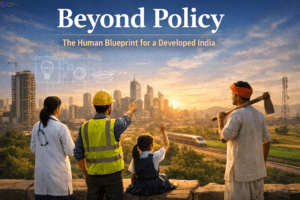
Beyond Policy: The Human Blueprint for a Developed India
For three days in the wintry heart of Delhi, an assembly less visible than a cabinet meeting but arguably more critical to India’s future unfolded. The Fifth National Conference of Chief Secretaries, held in Pusa, was not a political spectacle but a granular, operational war room. Its overarching theme, ‘Human Capital for Viksit Bharat’, signals a profound shift in India’s developmental narrative. When Prime Minister Narendra Modi addressed the conclave, his message moved beyond infrastructure and GDP figures to a more fundamental asset: the potential of 1.4 billion lives. This wasn’t just another government conference; it was a deliberate attempt to forge a unified human blueprint for a nation in transition.
The Demographic Dividend: From Buzzword to Battle Plan
The PM’s reference to India having boarded the “Reform Express” powered by its youth is a powerful metaphor, but one that carries an implicit warning. A fast-moving train must be on a precise track to reach its desired destination. With nearly 70% of the population in the working-age group, India’s demographic advantage is a “unique historical opportunity,” as noted, but also a ticking clock. The conference’s intense focus on education, skilling, and health underscores a critical realization: a large, young population is an economic threat if unskilled, unhealthy, and disengaged, but it becomes an unstoppable force if empowered.
The real insight from this emphasis is the move towards a “Whole-of-Government” approach to human capital. This means breaking the silos where the education ministry designs curricula disconnected from the industry’s needs, and where skill development happens in a vacuum. Mapping skill demand at state and global levels, as stressed, is about aligning supply chains of talent with the same precision as supply chains for manufacturing. It’s about a state like Tamil Nadu preparing its youth for global electronics manufacturing clusters, while Rajasthan might align skills with its burgeoning tourism and renewable energy sectors. This is federalism with a purpose—a nationwide mission with localized battle plans.
“Zero Defect, Zero Effect”: The New Mantra for Indian Aspiration
Perhaps the most resonant phrase for the common citizen is the renewed commitment to ‘Zero Effect, Zero Defect’ in manufacturing. For years, “Made in India” evoked images of utilitarian, sometimes unreliable goods. The PM’s push to transform this into a “symbol of global excellence and competitiveness” speaks to a deeper national psychology. It’s about instilling a culture of pride, precision, and sustainability.
The directive to identify 100 products for domestic manufacturing to cut imports is a strategic masterstroke in economic resilience. It moves self-reliance from a vague ideal to a tangible project list. Imagine the impact if states, in collaboration with the centre, champion specific products—Gujarat for precision engineering components, Uttar Pradesh for textile machinery, or Karnataka for medical devices. This creates focused ecosystems, attracts targeted investment, and builds expertise. The soon-to-be-launched National Manufacturing Mission will fail if states see it as just another central scheme. Its success hinges on states competing not for political points, but to create the most conducive ecosystems for quality manufacturing, where ease of doing business is felt on the ground, not just in rankings.
From Monuments to Experiences: Reimagining India’s Soft Power
The directive for each state to create a roadmap for at least one global-level tourist destination is a call to rethink tourism entirely. India doesn’t suffer from a lack of heritage; it suffers from a surplus of poorly presented heritage. A global-level destination isn’t just about cleaning up a monument; it’s about creating an entire experiential ecosystem—seamless connectivity, world-class hospitality, curated narratives, safety, and sustainability.
This has a direct human capital link. Tourism is a massive job creator, from guides and hotel staff to artisans and transport providers. It decentralizes economic opportunity, bringing prosperity to India’s cultural heartlands, from the temples of Tamil Nadu to the valleys of Himachal. Nourishing this ecosystem means skilling youth in hospitality management, conservation techniques, digital marketing, and language services. It’s about transforming a visitor’s encounter with India from merely memorable to truly transformative.
The Unconventional Pillars: Sports, Manuscripts, and Cyber Vigilance
The conference revealed a fascinating expansion of what constitutes human capital development. Aligning India’s sports calendar with the global one and the ambition to host the 2036 Olympics is a long-game strategy of monumental scale. It’s not just about building stadiums; it’s about creating a pipeline. Identifying and nurturing children today for an event a decade away is an exercise in national patience and long-term investment in human potential, fostering discipline, health, and global camaraderie.
Similarly, the push for the Gyan Bharatam Mission to digitize manuscripts is often seen as an academic exercise. But when the PM suggests using AI to synthesize this ancient wisdom, it opens a revolutionary frontier. India’s manuscripts are not just historical records; they are repositories of knowledge in astronomy, medicine, ecology, and philosophy. Digitizing and analyzing them could spark innovation in fields like holistic wellness (linking to the ‘Ayush for All’ focus), sustainable agriculture, and even modern governance principles. It’s about turning heritage into a living, breathing source of future intellectual capital.
Crucially, the emphasis on cyber security awareness is a stark acknowledgment of 21st-century vulnerability. As governance and lives migrate online, protecting citizens’ data and financial assets is as fundamental as providing physical security. Building human capital now includes digital literacy and cyber hygiene—a non-negotiable skill for a Viksit Bharat.
The Bottom Line: From Deliberation to Decadal Action
The true test of this conference lies in the final directive: for every state to create a 10-year actionable plan with 1, 2, 5, and 10-year milestones, monitored through technology. This is the antithesis of short-termism. It binds the centre and states in a contract of accountable co-creation.
The value for the reader—the citizen, the entrepreneur, the student—lies in understanding this shift. Viksit Bharat is being framed not as a top-down decree, but as a collaborative project where state-level innovation is crucial. It’s about a future where the quality of a product from Indore, the skill of a graduate from Coimbatore, the experience of a tourist in Kohima, and the safety of a digital transaction in a village in Odisha are all held to a new standard of excellence.
The Fifth Conference of Chief Secretaries has laid down a challenging, holistic blueprint. It recognizes that a developed India will be built not just on steel and concrete, but on the quality of its human spirit, the precision of its work, the richness of its culture, and the security of its digital footprint. The “Reform Express” is leaving the station; its fuel is the empowered Indian, and its destination is a future built by, and for, every citizen. The journey has unequivocally begun.
You must be logged in to post a comment.