
Beyond “Made in India”: A Blueprint for Becoming a Global Economic Powerhouse
Prime Minister Narendra Modi, addressing the National Conference of Chief Secretaries, articulated a comprehensive blueprint for India to become a global economic powerhouse, leveraging its demographic dividend and moving beyond average outcomes. He urged states to simultaneously strengthen manufacturing—through the forthcoming National Manufacturing Mission and creating infrastructure to attract global companies—and elevate India into a global services giant, all underpinned by a relentless focus on enhancing Ease of Doing Business.
Central to this vision is transforming “Made in India” into a symbol of quality and sustainability, aligned with a “Zero Effect, Zero Defect” philosophy. The plan demands a holistic upgrade of human capital, including demand-driven skill mapping, developing global tourist destinations, and a decade-long strategic investment in sports aiming for the 2036 Olympics. Furthermore, it calls for integrating ancient wisdom through digitization of manuscripts and applying AI, with states mandated to create detailed, technology-monitored 10-year action plans to ensure accountability and turn the vision of a resilient, inclusive Viksit Bharat into reality.
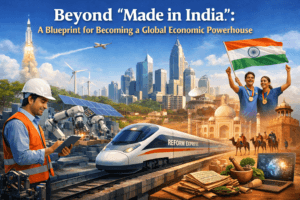
Beyond “Made in India”: A Blueprint for Becoming a Global Economic Powerhouse
Prime Minister Narendra Modi’s recent address to the nation’s Chief Secretaries was more than a routine governmental meeting. It was a strategic blueprint, a clarion call to fundamentally reshape India’s economic identity. Moving beyond catchy slogans, the conference outlined a multi-pronged mission that hinges on a critical realization: to become a true “Viksit Bharat” (Developed India), the nation must excel simultaneously in making things, delivering services, and empowering its people.
At the heart of this vision lies a powerful, yet often underutilized, asset: India’s demographic dividend. With nearly 70% of its population in the working-age group, India is not just a country with many people; it is a nation bursting with potential energy. PM Modi’s metaphor of India boarding the “Reform Express” is apt. This train’s engine is the ambition of its youth, but for it to reach its destination at full speed, the tracks of policy, infrastructure, and skill must be perfectly aligned. The government’s focus on empowering this demographic isn’t just social policy—it is the core of India’s economic strategy.
The Twin Engines: Manufacturing Excellence and Service Supremacy
A key takeaway is the rejection of a siloed approach. The goal is not to choose between being a manufacturing hub or a services giant, but to become both. The imminent launch of the National Manufacturing Mission (NMM) signals a renewed, state-driven push. But this isn’t a call for outdated industrial parks. The directive to states is to create infrastructure to attract global companies. This implies next-generation logistics, reliable power, streamlined land acquisition, and robust digital connectivity—the foundational elements of a modern global supply chain.
This aligns with the bold ambition of making “Made in India” a global synonym for quality and excellence. The Prime Minister’s emphasis on “zero defect” products with “zero effect” on the environment is a profound shift. It moves the narrative from cost-competitiveness to value-competitiveness. In a world increasingly conscious of sustainability and durability, an Indian product must be seen as reliable, innovative, and environmentally responsible. The joint identification of 100 products for domestic manufacturing is a targeted, pragmatic step to reduce import dependence and build economic resilience, turning vulnerabilities into strengths.
Simultaneously, the call to become a “Global Services Giant” acknowledges India’s existing prowess while demanding its evolution. The services sector must ascend the value chain. It’s no longer just about IT support and back-office operations; it’s about exporting high-end legal, financial, engineering, educational, and healthcare services. The “Ease of Doing Business” is the critical enabler here, not just for factories, but for consulting firms, design studios, and tech startups. A seamless regulatory environment at the state level is what will convince global corporations to place their regional headquarters, R&D centers, and advanced service delivery units in India.
Human Capital: The Bedrock of the Vision
The conference’s theme, “Human Capital for Viksit Bharat,” underscores that infrastructure and policy are futile without capable people. The insights here were particularly nuanced:
- Demand-Driven Skilling: The instruction to map skill demand at state and global levels is a game-changer. It moves skill development from a supply-driven, generic model to a targeted, future-oriented system. If a state like Tamil Nadu aims for electronics manufacturing, its ITIs should produce precision mechanics. If Gujarat is building a green hydrogen ecosystem, its polytechnics need courses in renewable energy management. This alignment ensures that skilling leads directly to employability.
- The Tourism Catalyst: Recognizing tourism as a major livelihood engine for youth is astute. The directive for each state to develop at least one global-caliber tourist destination isn’t about building a lone attraction. It’s about nurturing an entire ecosystem—heritage conservation, hospitality training, local crafts, cuisine, transportation, and digital storytelling. A thriving tourist circuit can create millions of micro-entrepreneurs and service jobs, decentralizing economic growth.
- The Long Game in Sports: The perspective on sports is strikingly strategic. Aligning India’s sports calendar with the global one and the ambition to host the 2036 Olympics is not just about prestige. It’s a long-term human capital project. Identifying and nurturing young talent today for an event 12 years away requires a systemic overhaul—from grassroots coaching and scientific training to world-class facilities. This investment yields dividends beyond medals: it fosters discipline, health, and national pride, creating role models who inspire generations.
Synergizing Heritage with the Future
One of the most visionary suggestions was the use of the Gyan Bharatam Mission to digitize India’s vast repository of manuscripts. This is not mere archival work. By digitizing ancient texts on medicine, mathematics, ecology, and philosophy, India is building a unique cultural and intellectual database. The subsequent application of AI to synthesize this wisdom can lead to groundbreaking innovations—ancient Ayurvedic principles informing modern pharmacology, traditional agricultural knowledge addressing climate resilience. This fusion of heritage and cutting-edge technology creates a form of soft power and innovation that no other nation can replicate.
The Path Forward: Accountability and Action
The conclusion of the conference moved from vision to mechanics. The directive for states to create 10-year actionable plans with 1, 2, 5, and 10-year milestones, monitored using technology, introduces a crucial framework of accountability and continuous assessment. It recognizes that transformative goals like “Viksit Bharat” are marathons, not sprints, requiring consistent, measurable effort.
The Stakes: A Resilient, Inclusive, and Future-Ready India
The three-day discussion, spanning early childhood education to higher education and sports, revealed a holistic understanding of human capital. It’s about creating a resilient workforce that can adapt to technological change, an inclusive workforce that leverages the potential of every citizen, and a future-ready workforce that anticipates global trends.
PM Modi’s address was ultimately a call for collaborative federalism with a shared national purpose. The states are not mere implementers but co-architects of India’s economic future. The challenge is immense, but the blueprint is clear: integrate world-class manufacturing with top-tier services, fuel them with a precisely skilled and healthy population, and ground it all in a unique blend of ancient wisdom and modern innovation. If executed with the focus on quality, sustainability, and long-term planning that was advocated, India’s journey on the “Reform Express” could indeed lead it to a destination of unprecedented global stature. The next decade will be a testament to how well this blueprint is translated from conference halls into the ground reality of factories, offices, classrooms, and playing fields across the nation.
You must be logged in to post a comment.