
Beyond Machinery & Trade: Why the Indo-German Partnership is Becoming a Geopolitical Anchor
The deepening Indo-German partnership, recently highlighted during high-level meetings in Ahmedabad, is evolving from a strong economic relationship into a comprehensive strategic alliance anchored in shared democratic values and mutual trust. This synergy leverages Germany’s engineering excellence and deep-tech prowess with India’s vast scale, skilled talent, and innovative digital ecosystem, creating potent opportunities for co-creation in sustainable mobility, aerospace, defence, and advanced manufacturing. India’s pragmatic, multi-path approach to green energy transition offers a global template, while growing bilateral trade and German investment signal confidence in India’s rise as a key manufacturing and export hub. Ultimately, this collaboration represents a conscious alignment of two major democracies aiming to foster a stable, rules-based multipolar world order through resilient economic and strategic cooperation.
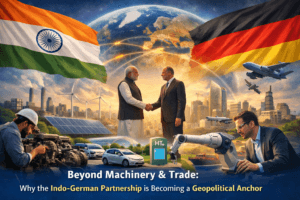
Beyond Machinery & Trade: Why the Indo-German Partnership is Becoming a Geopolitical Anchor
In an era defined by economic uncertainty and shifting alliances, the deepening bond between India and Germany stands out not just as a tale of growing trade figures, but as a compelling story of strategic convergence. Recent high-level meetings in Ahmedabad, underscored by a robust CEOs Forum, reveal a partnership maturing from transactional exchanges into a multifaceted alliance built on shared democratic values, complementary economies, and a joint vision for a stable global order.
A Foundation of Trust in a Fractured World
At the heart of this evolving relationship is a resource increasingly scarce in international diplomacy: trust. As Airbus CEO Michael Schoellhorn aptly noted, the two nations are “natural partners.” This natural affinity stems from a foundational alignment as large, consensus-driven democracies where rule of law, institutional checks, and transparent governance are paramount. In a global environment where businesses are keenly assessing geopolitical risk, this shared democratic principle isn’t just political rhetoric; it’s a critical risk-mitigation strategy that provides a predictable and reliable framework for long-term investment.
This trust is translating into tangible economic gravity. With bilateral trade in goods and services reaching a significant $51.23 billion in 2024-25, Germany has cemented its role as India’s most crucial European Union partner, accounting for nearly a quarter of India’s total EU trade. Perhaps more telling is the 12.5% growth in services trade, hitting a record $16.65 billion. This shift highlights a move beyond commodity and goods exchange into sophisticated domains like IT, engineering services, and R&D—a sign of deeply intertwined expertise.
Complementary Strengths: Engineering Meets Scale and Innovation
The synergy lies in a powerful, almost textbook, economic complementarity. Dr. Ralf Wintergerst of Giesecke+Devrient pinpointed it: “German engineering excellence” meets “India’s scale and skilled talent pool.” Germany’s prowess in deep-tech, advanced manufacturing, and precision engineering (Vorsprung durch Technik) finds its perfect counterpart in India’s massive domestic market, its agile software and digital ecosystem, and its formidable, cost-competitive talent base for research, development, and production.
This is not a one-way street of technology transfer. It’s increasingly a collaboration for co-creation. Bertram Kawlath of the VDMA envisions German machinery manufacturers and Indian equipment makers collaborating to capture global market share. Imagine a German-engineered industrial machine, with its software and control systems developed in Bengaluru, manufactured at scale in Pune, and serviced by a global network managed from Chennai. This model leverages the best of both worlds to create globally competitive, innovative solutions.
India’s Green Leap: A Blueprint for Pragmatic Transition
One of the most insightful observations came from Arnd Franz of MAHLE, who highlighted India’s “practical and diversified approach to the green transition.” While many large economies have debated a single perfect path to decarbonization—be it all-electric or hydrogen—India is executing a multi-pronged strategy with notable speed.
The rapid nationwide rollout of E20 fuel blends (20% ethanol), aggressive biofuel pushes, alongside ambitious electric vehicle (EV) adoption goals and hydrogen exploration, showcases a pragmatic, energy-agnostic approach. This “all-of-the-above” strategy acknowledges diverse use cases—from long-haul trucking to urban scooters—and the complex realities of a developing economy. As Franz noted, this balanced template offers valuable lessons for global decarbonization, proving that the transition can be inclusive, adaptive, and technologically diverse. Germany, with its own advanced clean-tech and mobility solutions, sees not just a market here, but a living lab and a potent co-development partner.
From “Make in India” to “Innovate and Export from India”
The confidence in India’s manufacturing metamorphosis is palpable. Franz’s prediction of India emerging as a major auto and auto-component exporter reflects a broader trend. The combination of Production Linked Incentive (PLI) schemes, improved infrastructure, and a growing supplier ecosystem is altering global supply chain calculus. German FDI, a cumulative $15.40 billion since 2000, is a vote of confidence in this transformation. Investments are increasingly geared toward creating export-oriented hubs, positioning India as a strategic base not just for its own 1.4-billion-strong market, but for the wider Indo-Pacific and global markets.
The Leadership Dimension: A Catalyst for Confidence
The personal leadership dynamic, often an intangible yet crucial element in statecraft, has also played a role. As noted by several business leaders, including Susanne Renate Kunschert and Bertram Kawlath, Prime Minister Narendra Modi’s proactive engagement has been a catalyst. From a business perspective, a leader’s clear articulation of a national vision—like “Make in India” or the green transition—reduces policy ambiguity. Chancellor Friedrich Merz’s presence in Ahmedabad signals a reciprocal high-level commitment from Berlin, assuring businesses that this corridor has top-level political wind in its sails.
The Road Ahead: Navigating Challenges Toward a Strategic Future
The path forward is promising but not without its contours. To truly unlock the next decade of potential, focus must extend beyond traditional sectors.
- Defence & Aerospace: As Schoellhorn mentioned, this is a key avenue. Moving from buyer-seller relationships to joint research, development, and manufacturing of defence platforms is the logical, though complex, next step. It requires navigating export controls and building even deeper strategic trust.
- Skilling and Mittelstand Integration: A grand challenge is connecting Germany’s famed Mittelstand—its small and medium-sized, often family-owned, world-market leaders—with India’s MSME ecosystem. This requires targeted skilling initiatives to align Indian talent with German vocational standards and digital matchmaking platforms.
- Digital and Sovereignty: Collaboration on digital infrastructure, cyber-security, and data governance—areas where both nations seek a “third way” between dominant global models—holds immense potential.
Conclusion: An Alliance for a New World Order
Ultimately, the growing Indo-German partnership transcends economics. It represents a conscious alignment of two major democratic powers seeking to shape a multipolar world order that is rules-based, inclusive, and resilient. It’s a partnership built not against any other nation, but for the principles of open societies, sustainable development, and technological progress that benefits all.
As the world grapples with supply chain reconfiguration, climate imperatives, and technological disruption, the collaboration between the world’s largest democracy and Europe’s largest economy offers a template. It is a template of pragmatic cooperation, where engineering precision meets scalable innovation, where environmental responsibility meets developmental pragmatism, and where strategic trust paves the way for shared prosperity. This isn’t just a business story; it’s the forging of a critical 21st-century alliance.
You must be logged in to post a comment.