
Beyond Headlines: How India’s Digital Justice System is Rewiring Real Lives
India’s criminal justice system is undergoing a profound digital transformation, moving beyond hardware upgrades to fundamentally reshape citizen safety and legal efficiency. Central to this shift is a nationwide network of 33 Cyber Forensic-cum-Training Labs, empowering over 24,600 personnel to combat cybercrimes, particularly against vulnerable groups. Critical tools like e-Sakshya standardize tamper-proof digital evidence handling, while MedLeaPR accelerates vital medical report sharing electronically.
Virtual participation via Nyaya-Shruti and electronic e-Summons drastically cut logistical delays and backlogs. Crucially, the Bhartiya Nyaya Sanhita (2023) provides the legal bedrock, explicitly validating digital evidence and virtual procedures. Enhanced coordination through the Indian Cyber Crime Coordination Centre (I4C) and international partnerships like NCMEC strengthens responses, especially for child exploitation.
Supported by accessible legal resources like the NCRB Sankalan app, this integrated approach aims for swifter, more transparent justice – reducing victim trauma and rebuilding public trust through tangible, tech-enabled outcomes.
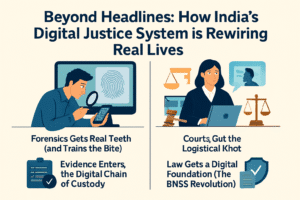
Beyond Headlines: How India’s Digital Justice System is Rewiring Real Lives
India’s criminal justice system is undergoing a profound, tech-driven metamorphosis – not just upgrading hardware, but fundamentally rewiring how safety, evidence, and justice flow. Forget sterile announcements; this transformation is about tangible human impact. Here’s how digital innovation is translating into real-world security and swifter resolution:
- Forensics Gets Real Teeth (and Trains the Bite):
- The Labs: The 33 Cyber Forensic-cum-Training Labs (supported by ₹132 Cr+ via CCPWC) aren’t just fancy rooms. They’re becoming regional nerve centers. Beyond analyzing devices in complex cybercrimes (especially those targeting women and children), they’re crucibles for skill-building.
- The Human Shift: Training over 24,600 police, prosecutors, and judges isn’t a checkbox exercise. It’s creating a critical mass of professionals who understand digital evidence – how to collect it legally, interpret it accurately, and present it convincingly in court. This bridges the dangerous gap between crime and courtroom competence.
- Evidence Enters the Digital Chain of Custody:
- e-Sakshya’s Power: This isn’t just an “app.” It’s a systemic solution to evidence tampering and degradation. By standardizing the capture, preservation, and submission of digital evidence (photos, videos, messages, documents) in a legally admissible format from the outset, it drastically reduces challenges to authenticity later. Think fewer cases derailed by “the file was edited” claims.
- MedLeaPR’s Lifesaving Speed: Electronic sharing of medico-legal and post-mortem reports between hospitals and courts isn’t just about saving paper. It’s about eliminating dangerous delays and physical transit risks. Critical forensic findings reach investigators and prosecutors faster, accelerating cases and reducing opportunities for interference.
- Courts Cut the Logistical Knot:
- e-Summon’s Efficiency: Electronic delivery of court summons isn’t just “modern.” It means fewer people miss court dates because a physical notice got lost or arrived late. It saves immense police resources previously spent on manual delivery and tracking.
- Nyaya-Shruti’s Reach: Virtual appearances via video conferencing are a lifeline. An expert witness in Delhi testifies in a trial in Kerala without days of travel. A vulnerable victim provides testimony from a safe location. An accused in custody attends routine hearings without complex, costly, and risky prisoner transport. This directly tackles the crippling backlog by removing physical barriers.
- Law Gets a Digital Foundation (The BNSS Revolution):
- Beyond Recognition to Empowerment: The Bhartiya Nyaya Sanhita (BNS), 2023, isn’t just acknowledging digital tools – it’s mandating their space (Sections 254, 265, 266, 530). This legal bedrock is crucial. It empowers police to confidently use digital evidence collection methods and authorizes courts to accept electronic records and virtual testimony as standard procedure. This legitimizes the entire digital evidence ecosystem.
- Future-Proofing: By embedding digital admissibility in law, the BNS opens the door for authorities to responsibly adopt next-gen tools like blockchain for immutable evidence logs or AI for pattern recognition in massive datasets, knowing the legal framework supports them.
- Coordination Creates a Safety Net:
- I4C: The National Glue: Formally establishing the Indian Cyber Crime Coordination Centre (I4C) under MHA provides the essential backbone. It forces collaboration, standardizes practices, and enables intelligence sharing between states and national agencies – critical for tackling borderless cybercrime.
- Global Vigilance (NCMEC): The systematic collaboration with the US National Center for Missing & Exploited Children ensures tips on child exploitation originating anywhere are rapidly acted upon in India. This global net is vital protection for the most vulnerable.
- NCRB Sankalan App: Law in Your Pocket: Providing updated legal codes, especially complex digital laws, via a mobile app empowers every police officer, lawyer, and judge to apply the law correctly, consistently, and instantly – a massive step towards uniform justice.
The Human Impact: Beyond Bytes and Bandwidth
This isn’t a tech showcase; it’s a societal shift with profound human consequences:
- Reduced Trauma: Faster trials and virtual testimony options mean victims, especially of sensitive crimes, spend less time entangled in the system’s gears.
- Stronger Cases: Tamper-resistant digital evidence and trained professionals lead to more convictions based on solid proof and fewer miscarriages of justice.
- Accessible Justice: Virtual tools break down geographical barriers, making the system more accessible to citizens in remote areas.
- Deterrence: A robust, tech-savvy system capable of swift investigation and conviction is a powerful deterrent against cybercrime and exploitation.
- Trust: Increased transparency and efficiency have the potential to slowly rebuild public trust in the justice delivery mechanism.
The Road Ahead: Integration is Key
The vision is clear, but success hinges on seamless integration. Training must be continuous as tech evolves. Digital literacy within the legal fraternity needs constant nurturing. Infrastructure gaps, especially in remote police stations, must be bridged. Cybersecurity of these critical systems themselves is paramount.
India’s journey towards a digital justice system is a bold experiment on a massive scale. It’s blending cutting-edge tools with legal reform and human capacity building. The goal isn’t just efficiency; it’s creating a justice ecosystem that is demonstrably more responsive, resilient, and protective in the digital age. The real measure of success will be in the lived experiences of citizens seeking safety and resolution.
You must be logged in to post a comment.