
Beyond Handshakes: Decoding the Strategic Depth of India-Japan Trade in a Shifting Global Order
The recent meeting between Union Minister Piyush Goyal and JIBCC Chairman Tatsuo Yasunaga represents a strategic push to deepen the India-Japan economic partnership beyond its current state, moving from a traditional trade relationship focused on capital goods and commodities toward a collaborative, innovation-driven alliance.
While FY25 bilateral trade of $25.17 billion shows a significant imbalance in Japan’s favor, this largely reflects Japan’s role in supplying high-value machinery and technology essential for India’s infrastructure development. The core objective now is to leverage this foundation and shared strategic vision to foster co-creation in critical future sectors like semiconductors, green energy, digital infrastructure, and defense manufacturing, thereby transforming the dynamic from a buyer-seller model into a synergistic partnership built for mutual resilience and growth in a shifting global order.
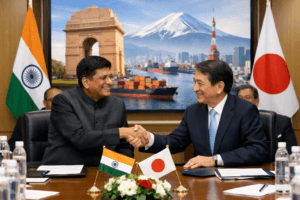
Beyond Handshakes: Decoding the Strategic Depth of India-Japan Trade in a Shifting Global Order
Headline: Beyond Bullet Trains & Bilateral Summits: How the Goyal-Yasunaga Meet Charts a New Course for India-Japan Economic Synergy
The meeting between Union Minister Piyush Goyal and Tatsuo Yasunaga, Chairman of the Japan-India Business Cooperation Committee (JIBCC), in New Delhi might appear as another diplomatic entry in the ledger of international engagements. Yet, to view it merely as a routine discussion is to miss the forest for the trees. This dialogue, set against a backdrop of recent high-level summits and a decade of deepening ties, represents a critical pivot point—a concerted effort to move from a historically strong partnership to a dynamically innovative and strategically autonomous economic alliance. In a world grappling with supply chain reassessments and geopolitical recalibrations, the India-Japan equation is being recalibrated for mutual resilience and growth.
The Meeting in Context: More Than a Courtesy Call
The engagement, following closely on the heels of Prime Minister Narendra Modi’s visit to Japan for the 15th Annual Summit in August 2025, signals continuity and actionable follow-through. High-level political vision is being channeled into granular, business-led execution. The JIBCC, comprising top Japanese corporations with interests in India, acts as the vital conduit between policy and ground reality. When its chairman meets India’s commerce minister, the agenda shifts from diplomatic communiqués to market access, regulatory frameworks, and joint venture specifics. Goyal’s emphasis on “innovation in key sectors” points to a desire to evolve the relationship beyond traditional capital and goods exchange into a knowledge and technology-sharing paradigm.
Deciphering the Trade Numbers: Asymmetry and Opportunity
The FY25 bilateral trade figure of USD 25.17 billion, while substantial, reveals a telling narrative. The trade balance, with India importing USD 18.92 billion from Japan and exporting USD 6.25 billion, highlights a significant asymmetry. This isn’t inherently negative; it reflects the current structure of the economic relationship. Japan exports high-value capital goods, machinery, and technology-intensive products (like the USD 3.31 billion in nuclear reactors and USD 2.01 billion in electrical machinery), which are crucial for building India’s industrial and infrastructure base.
India’s exports, though half in value, tell a story of impressive diversity—nearly 3,900 commodities. The leading segments are:
- Engineering Goods (USD 2.44 billion): This is the cornerstone, indicating India’s growing capability as a reliable supplier of auto components, machinery parts, and finished goods.
- Chemicals & Pharmaceuticals (USD 1.06 billion + USD 231.52 million): Showcasing strength in generic drugs and specialty chemicals, a sector with immense potential for expansion given Japan’s aging demographics.
- Marine Products (USD 408.45 million) and Gems & Jewellery (USD 239.51 million): These represent classic export strengths finding a quality-conscious market.
The real insight lies not in bemoaning the deficit, but in understanding its nature. It is largely a developmental deficit. Japan finances and equips India’s infrastructure and manufacturing growth through its exports. The strategic goal, as hinted in the discussions, is to use this foundation to climb the value chain together.
The “Innovation in Key Sectors” Blueprint: Where Synergy Meets Strategy
The ministers’ focus on fostering innovation pinpoints sectors where Japanese prowess and Indian potential can create global winners.
- Semiconductors and Electronics: While India imported over USD 658 million in electronic goods from Japan, the future lies in co-development and manufacturing. Japan’s strengths in materials, equipment (like those from Tokyo Electron), and precision manufacturing can mesh with India’s design talent, production-linked incentive (PLI) schemes, and massive domestic market. Moving from trade to collaborative R&D in chip design and packaging is a logical next step.
- Green Technology and Clean Energy: This is a powerhouse domain for collaboration. Japan’s technology in hydrogen fuel cells, ammonia co-firing, and energy storage can be deployed in India, which aims to be a green hydrogen hub and has vast renewable energy targets. Joint ventures in electrolyzer manufacturing or offshore wind technology could redefine energy security for both nations.
- Digital Infrastructure and ICT: From 5G/6G technologies to undersea cables, and from cybersecurity to digital payments, there is vast scope. Japanese tech firms seek scalable markets, while India needs secure, cutting-edge digital infrastructure. Partnerships here would also carry significant strategic weight in offering alternatives in the global digital ecosystem.
- Food Processing and Agri-Tech: Japan’s demand for high-quality, processed marine and agricultural products aligns with India’s food security and export goals. Japanese technology in cold chains, packaging, and automated processing can help minimize India’s massive post-harvest losses, creating a more efficient export pipeline.
- Deepening Defence & Aerospace Manufacturing: While primarily under strategic dialogues, the commercial spin-offs are enormous. Moving from procurement to co-production and co-development of subsystems, sensors, and materials (like carbon composites) can feed into both countries’ industrial ecosystems, creating high-skilled jobs and technological spillovers.
The Bigger Picture: A Partnership Forged in Strategic Trust
The India-Japan relationship is uniquely fortified by shared democratic values and a convergent vision for a free, open, and inclusive Indo-Pacific. This provides an unparalleled layer of strategic trust often absent in purely transactional trade relationships. Initiatives like the Asia-Africa Growth Corridor (AAGC), joint infrastructure development in third countries (like in Sri Lanka or Bangladesh), and maritime security cooperation create an enabling environment for business. This trust reduces perceived investment risks and encourages long-term bets.
The Road Ahead: Addressing Frictions to Unlock Potential
For this dynamic partnership to reach its full potential, persistent friction points require attention:
- Trade Balance Concerns: While structurally understood, efforts to boost Indian exports through greater market access for agriculture, pharmaceuticals, and IT/ITES in Japan are crucial.
- Regulatory Harmonization: Streamlining approvals, recognizing standards, and simplifying compliance can accelerate Japanese SMEs’ entry into India.
- Skills and Mobility: Facilitating the movement of Indian skilled professionals and Japanese managers/technical experts is key to managing joint ventures and fostering cultural integration at the workplace.
Conclusion: Building a Shared Economic Destiny
The Goyal-Yasunaga meeting, therefore, was not just about reviewing trade figures. It was a strategic workshop aimed at designing the next phase of economic interdependence. It’s about leveraging Japan’s capital, technology, and quality ethos with India’s scale, digital innovation, and youthful workforce to build resilient supply chains less vulnerable to global shocks.
The goal is to transform the relationship from a ‘buyer-seller’ dynamic to a ‘co-creator’ consortium. As both nations navigate the complexities of the 21st century, their partnership stands as a testament to the fact that the most durable economic alliances are those built on a foundation of shared strategic interests, mutual respect, and a commitment to pioneering innovation for global good. The discussions in New Delhi have effectively laid the groundwork for this ambitious blueprint, making the India-Japan partnership one to watch closely in the coming decade.
You must be logged in to post a comment.