
Beyond Groceries and Banking: How a Tiny Cooperative in Sikkim Just Redefined Rural Enterprise with a First-of-its-Kind Beauty Salon
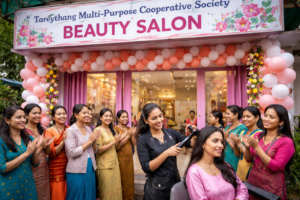
Beyond Groceries and Banking: How a Tiny Cooperative in Sikkim Just Redefined Rural Enterprise with a First-of-its-Kind Beauty Salon
Pakyong, Sikkim – March 30, 2026 – In the verdant hills of Pakyong district, a quiet revolution is taking place, and it smells faintly of shampoo and ambition. While the term “cooperative society” often conjures images of agricultural collectives, grain storage, or basic consumer goods, the Tareythang Multi-Purpose Cooperative Society (MPCS) has just shattered that stereotype with a bold, glittering statement.
On March 30, the Society inaugurated a state-of-the-art beauty salon—marking the first time in Sikkim’s history that a cooperative society has ventured into the beauty and wellness sector. This is not merely a new business line; it is a masterclass in adaptive strategy, a lifeline for local women, and a compelling case study for rural economies across the Northeast.
The Cooperative That Does It All
To understand the magnitude of this launch, one must first appreciate the evolution of the Tareythang MPCS. Long before the salon’s scissors started snipping, this society was already an anomaly in the cooperative landscape. In an era where many rural societies struggle to stay afloat, Tareythang MPCS has built a sprawling ecosystem of services that rivals urban convenience.
It operates a bustling consumer retail business, ensuring that daily essentials are available to locals without the need to travel to district headquarters. It functions as a Cash Kendra (Banking Correspondent), bringing formal banking to doorsteps in a region where the last mile of financial inclusion is often the hardest to traverse. It manages the Public Distribution System (PDS), acting as the backbone for food security in the region. Most recently, it embraced digital governance by running a Common Service Centre (CSC), offering everything from certificate applications to bill payments.
With this infrastructure already in place, the addition of a beauty salon isn’t just diversification—it is the logical next step in a strategy of total community service.
Why a Salon? A Deep Dive into Grassroots Economics
During the inaugural event, which saw the presence of senior officers from the Cooperation Department alongside the women members of Tareythang, one question hung in the air: Why beauty?
The answer lies in a nuanced understanding of shifting rural aspirations. For years, grooming and wellness services in the region have been either absent or relegated to informal, often unregulated setups. Women in areas like Tareythang, Rangpo, and Pakyong who desired professional beauty services—be it bridal makeup, skincare, or haircare—faced a logistical nightmare. The closest reliable salons were often located in Gangtok, requiring a costly and time-consuming journey down winding mountain roads.
The MPCS recognized this gap not just as a business opportunity, but as a quality-of-life imperative. By launching this facility, the society has effectively “localized” luxury. What was once a luxury reserved for urban excursions is now available within walking distance.
Moreover, this move aligns perfectly with the cooperative model’s core philosophy: self-reliance. Instead of watching revenue flow out of the community to urban centers, the salon ensures that the money circulates within the local economy. It is a closed-loop system of empowerment where members serve members.
Empowerment in Every Strand: The Women-Centric Impact
Perhaps the most profound aspect of this initiative is its gender lens. In rural Sikkim, women often juggle the triple burden of domestic work, agricultural labor, and caregiving. Economic opportunities outside the home are frequently limited to government schemes or seasonal labor.
The Tareythang MPCS Beauty Salon is deliberately positioned as a vehicle for women’s economic empowerment. The facility is expected to serve as a hub for skill development. By partnering with the Cooperation Department and likely the State’s skill development missions, the society plans to train local youth—particularly young women—in professional cosmetology and salon management.
This transforms the narrative from one of mere consumption to one of creation. Local women are not just intended to be customers; they are being positioned as entrepreneurs, technicians, and managers. For a young woman in Tareythang, the salon represents a viable career path that does not require migrating to a city, leaving her family behind, or navigating the insecurity of informal employment.
During the inauguration, women members of the society expressed palpable excitement. For them, this is more than a place to get a haircut. It is a safe, cooperative-owned space where they can network, access services, and see their daughters gain employable skills. In a society where “cooperative” often means a male-dominated board meeting, this salon flips the script, placing women’s needs and aspirations at the center of the business model.
A Blueprint for the Future of Cooperatives
The launch of the beauty salon by Tareythang MPCS sends a clear signal to the cooperative movement across India: adaptability is survival.
For decades, cooperative societies in the Himalayan region have stuck to a rigid template—agriculture, ration, and retail. While these remain vital, the Tareythang model demonstrates that the cooperative structure is robust enough to accommodate the evolving aspirations of modern India. Whether it is a banking correspondent (Cash Kendra), a digital access point (CSC), or a wellness center, the underlying principle remains the same: service to members.
The Cooperation Department’s presence at the event underscores the government’s support for such innovative models. As the department looks to replicate successful initiatives, Tareythang MPCS could very well become a beacon for other societies looking to diversify. If a cooperative in Pakyong can successfully run a beauty salon, there is no reason why a similar society in West Bengal, Assam, or even the northern hills of Uttarakhand cannot do the same—tailored to the specific needs of their communities.
More Than a Business: A Social Equalizer
Beyond economics, the salon serves as a subtle but powerful social equalizer. In many rural settings, access to grooming services is stratified by class and geography. Those with means travel to the city; those without, go without.
By placing professional services within the cooperative framework, Tareythang MPCS democratizes beauty and self-care. The pricing model, governed by a cooperative’s non-profit ethos (or at least a member-first profit distribution), is likely to be more accessible than private urban competitors. Furthermore, the cooperative structure ensures accountability. Members have a say in how the business is run, ensuring that the services remain relevant, affordable, and high-quality.
A Step Towards “Atmanirbhar” Villages
The initiative resonates deeply with the broader national vision of Atmanirbhar Bharat (Self-reliant India), particularly at the village level. True self-reliance is not achieved merely by producing food; it is achieved when a village can provide for all the needs of its residents—from banking to groceries to wellness.
Tareythang MPCS is building an ecosystem where the resident doesn’t need to leave the panchayat to access essential and aspirational services. This retention of economic activity within the village strengthens the local economy, creates local jobs, and reduces urban migration.
Looking Ahead
As the scissors were cut at the inaugural ceremony, it marked the beginning of a new chapter not just for Tareythang, but for the cooperative movement in Sikkim. The officers from the Cooperation Department present witnessed a prototype that could soon be scaled.
The path forward involves upskilling. The initial phase will likely focus on establishing service standards and training the first batch of local beauticians. If successful, the next phases could see the salon expanding its services to include bridal wear, tailoring, or even a wellness spa—all under the cooperative’s umbrella.
In a world obsessed with unicorns and billion-dollar startups, it is easy to overlook the quiet, steady innovations happening in rural India. But the Tareythang MPCS Beauty Salon is a reminder that the most sustainable businesses are often those rooted in community, trust, and a genuine desire to solve local problems.
Today, the women of Tareythang and the surrounding areas of Pakyong have a new reason to feel proud. Their cooperative society didn’t just open a salon; it opened a door to dignity, opportunity, and self-determination.
You must be logged in to post a comment.