
Beyond Faith: How Anti-Conversion Laws Trap Dalits and Adivasis in Caste’s Shadow
Beyond Faith: How Anti-Conversion Laws Trap Dalits and Adivasis in Caste’s Shadow
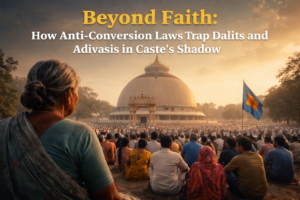
The December morning air carried a chill through the narrow lanes of Nagpur’s Dikshabhoomi, where thousands had gathered to mark the anniversary of Babasaheb Ambedkar’s historic conversion to Buddhism. Among them sat Meera, a 54-year-old Dalit woman who had traveled from a village in Madhya Pradesh. Her eyes, fixed on the golden stupa, held the weight of generations—and the uncertainty of her own children’s future.
“I want my grandchildren to know what dignity feels like,” she told me quietly, adjusting her saree. “But in our state now, even thinking about changing your religion feels like planning a crime.”
Meera’s anxiety speaks to a reality that extends far beyond theology or personal belief. Across India, a patchwork of anti-conversion laws in states like Uttar Pradesh, Madhya Pradesh, Himachal Pradesh, and Odisha has transformed what was once a path toward liberation for oppressed communities into a bureaucratic minefield. And from an Ambedkarite perspective—one that centers the experience of those crushed by caste—these laws represent something far more insidious than religious regulation.
They represent the reassertion of a hierarchy that conversion was meant to escape.
The Weight of a Name: Why Conversion Was Never Just About God
To understand why anti-conversion laws strike at the heart of Dalit and Adivasi existence, one must first understand what religion has meant for those condemned to untouchability. This is not a story about abstract spirituality. It is a story about water.
For centuries, Dalits could not draw water from the same wells as caste Hindus. They could not enter temples, could not recite the same prayers, could not wear sandals in the presence of upper castes. The religion into which they were born did not simply assign them a lowly position—it sanctified that position as divine will, as karma, as cosmic order.
Ambedkar understood this with painful clarity. He had experienced it himself as a child in Satara, where even as a brilliant student, he was made to sit on a burlap sack that no touch would defile. He watched his father, a military school graduate, treated as less than human by those who considered themselves pure.
This is why his declaration—”I was born a Hindu, but I will not die a Hindu”—was never merely a statement of personal faith. It was a political manifesto, a declaration of war against a system that used religion to justify the most brutal forms of human degradation.
When Ambedkar led half a million followers into Buddhism on October 14, 1956, each person who took refuge in the Buddha, the Dhamma, and the Sangha was performing an act of rebellion. They were not simply adopting new prayers. They were rejecting the very framework that had declared them polluted, unworthy, untouchable.
This history transforms how we must understand religious conversion among oppressed communities. For a Brahmin to convert, it might be a matter of theological conviction or philosophical exploration. For a Dalit to convert, it has always been a matter of survival, of dignity, of reclaiming humanity from a system designed to deny it.
The Machinery of Suspicion
Anti-conversion laws present themselves as neutral protections. Their stated purpose—preventing conversions achieved through force, fraud, or inducement—sounds reasonable enough. Who could object to protecting vulnerable people from coercion?
But the machinery of these laws tells a different story.
In Uttar Pradesh, the Prohibition of Unlawful Conversion of Religion Act requires anyone wishing to convert to submit notice to the District Magistrate sixty days in advance. The magistrate may then conduct an inquiry into the “real intention” of the convert. In Madhya Pradesh, similar provisions require police verification before conversion can be recognized.
Imagine what this means for a Dalit woman in a village where caste hierarchies remain brutally intact. She must approach the District Magistrate—almost certainly from a dominant caste background—and explain her desire to leave the religion of her birth. She must submit herself to questioning about whether she truly understands her decision. She must wait, publicly, while the state investigates her spiritual intentions.
The very process transforms a private matter of conscience into a public spectacle. And in villages where caste panchayats still dictate social norms, where Dalits are still beaten for wearing fine clothes or riding horses at weddings, such visibility can be dangerous.
“I’ve seen what happens,” Meera told me, her voice dropping. “In our village, two families converted to Christianity twenty years ago. Everyone knew, but it was accepted quietly. Now, if someone even visits a church, the village head calls a meeting. They say, ‘The government will investigate. The police will come.’ People are afraid.”
This fear is not irrational. Reports from various states document cases where conversions have been invalidated, where missionaries have been arrested, where communities have been subjected to harassment simply because they sought to worship differently. The laws, ostensibly designed to protect the vulnerable, have become tools for policing their choices.
The Irony of Inducement
Perhaps no aspect of anti-conversion legislation is more fraught than the prohibition of “inducement” or “allurement.” These terms, defined broadly in most laws, can encompass the offer of material benefits, educational opportunities, or social services.
This is where the irony becomes almost unbearable.
Missionary institutions—whether Christian, Islamic, or Buddhist—have historically filled gaps that the Indian state failed to address. In remote tribal regions, in Dalit bastis neglected by government schools, in villages without healthcare, these institutions provided education, treated diseases, and offered pathways to literacy and employment.
To call this “inducement” is to misunderstand both poverty and dignity. When a community that has been denied education for centuries suddenly gains access to schools, when a people without healthcare receive treatment, when those excluded from development find opportunities—this is not manipulation. It is justice delayed, finally arriving.
Yet anti-conversion laws treat these services with suspicion. The underlying assumption is that Dalits and Adivasis cannot make genuine religious choices—that their decisions must be purchased, coerced, or manufactured. This assumption echoes the very caste ideology that denied these communities the capacity for reason, for self-determination, for spiritual autonomy.
Ambedkar would have recognized this immediately. The Brahminical tradition had always claimed that Shudras and untouchables were incapable of learning the Vedas, of understanding dharma, of making spiritual decisions. Anti-conversion laws, in their suspicion of Dalit religious agency, perpetuate this ancient prejudice in modern, bureaucratic form.
The Kandhamal Shadow
The violence that erupted in Odisha’s Kandhamal district in 2008 remains a haunting reminder of where anti-conversion rhetoric can lead. What began as tensions between religious communities escalated into coordinated attacks that killed dozens, destroyed hundreds of churches, and displaced thousands of tribal Christians.
Walking through the burned villages months later, one could still smell the destruction. Families who had lived in the region for generations, whose ancestors had converted to Christianity decades earlier, found themselves reduced to refugees in their own land. The accusation against them was simple: they had abandoned the religion of their forefathers.
Never mind that those forefathers had practiced indigenous tribal religions, not Hinduism. Never mind that the very concept of “Hinduism” as a unified faith was largely a colonial and post-colonial construction. In the logic of anti-conversion politics, any deviation from an imagined monolithic identity becomes betrayal.
Kandhamal demonstrates what happens when the state’s suspicion of conversion filters down into society. Laws create atmospheres. When the legal framework treats religious change as potentially criminal, it legitimizes those who would enforce conformity through violence.
For Adivasi communities, this threat is particularly acute. Tribal societies have historically practiced fluid, syncretic forms of worship—incorporating elements from multiple traditions, adapting to changing circumstances, maintaining indigenous practices alongside newer faiths. Anti-conversion laws impose rigid categories on this fluidity, forcing communities to declare fixed identities and inviting scrutiny when they do not.
The Reservation Paradox
Perhaps the cruelest aspect of the anti-conversion regime is its interaction with affirmative action policies.
Under the Constitution (Scheduled Castes) Order 1950, only Dalits who belong to Hindu, Sikh, or Buddhist communities are eligible for Scheduled Caste status and the reservations that accompany it. Dalits who convert to Christianity or Islam lose these protections—not just for themselves, but for their descendants.
This creates an impossible choice.
On one hand, conversion offers escape from the ritual degradation of caste. It provides access to religious communities that, whatever their practical failures, at least doctrinally reject untouchability. It allows Dalits to pray without being told they are polluting the deity, to draw water without contaminating the well, to exist without being reminded of their supposed impurity.
On the other hand, conversion means surrendering the material protections that enable education, employment, and political representation. It means telling your children that they will have to compete without the safeguards that might have helped them overcome centuries of accumulated disadvantage.
Ambedkar himself wrestled with this dilemma. He chose Buddhism precisely because it offered both spiritual liberation and continued access to reservations. But not every Dalit community has this option. In regions where Buddhist institutions are weak, where Christian or Muslim communities provide stronger support networks, the choice becomes agonizing.
Anti-conversion laws compound this agony by making the already difficult process of religious change even more burdensome. They add bureaucratic obstacles to social obstacles, legal scrutiny to communal pressure. And they do so while claiming to protect the very people they are trapping.
The Question of Genuineness
Underlying all anti-conversion legislation is a troubling question: who decides what constitutes genuine religious belief?
The laws presume that state officials can distinguish between authentic conversion and conversion motivated by improper considerations. They empower district magistrates, police officers, and revenue officials to probe the hearts and minds of those seeking to change their faith.
But what qualifies a bureaucratic functionary to make such judgments? What training equips a police officer to assess the sincerity of another person’s spiritual journey? And what happens when those officials come from caste backgrounds that have historically denied Dalits any spiritual agency whatsoever?
The assumption that conversion requires state validation is itself profoundly anti-democratic. It treats religion not as a matter of individual conscience protected by fundamental rights, but as a status to be regulated, monitored, and controlled.
This was precisely the kind of state intrusion into personal liberty that Ambedkar and the Constitution’s framers sought to prevent. Article 25 guarantees not merely the right to practice one’s religion, but the freedom of conscience—the internal freedom to believe or not believe, to change or not change, without state interference.
Anti-conversion laws, whatever their stated intentions, inevitably breach this freedom. They make the state the arbiter of religious sincerity, the judge of spiritual authenticity. And in a society structured by caste, that state will inevitably reflect caste prejudices.
Toward an Ambedkarite Understanding
From an Ambedkarite perspective, the debate over anti-conversion laws cannot be reduced to simple binaries of religious freedom versus social harmony. It must be understood within the specific historical context of caste oppression and Dalit liberation.
Ambedkar taught that religion is not merely private belief but social fact. It shapes access to resources, determines social standing, and legitimizes or challenges systems of power. When the state restricts the ability to change religion, it is not neutrally regulating belief—it is reinforcing the religious framework within which caste hierarchy operates.
This does not mean that all conversions are beyond critique. Coercion, deception, and manipulation are real possibilities that deserve serious attention. But the response to these possibilities cannot be blanket restrictions that disproportionately burden the very communities most in need of religious alternatives.
A genuinely Ambedkarite approach would begin from different premises. It would recognize that for Dalits and Adivasis, religious change has historically been a pathway to dignity, not a deviation from tradition. It would acknowledge that the state’s suspicion of conversion often mirrors caste society’s suspicion of Dalit autonomy. And it would insist that the solution to coercive practices lies not in restricting freedom, but in empowering communities to make genuine choices.
This means strengthening Dalit and Adivasi agency rather than policing it. It means ensuring that education, healthcare, and economic opportunity reach marginalized communities through state institutions, reducing dependency on any single religious source. It means addressing the material conditions that might make people vulnerable to exploitation, rather than treating their religious choices as inherently suspect.
Most fundamentally, it means taking seriously Ambedkar’s insight that dignity cannot be granted—it must be claimed. And the claiming of dignity sometimes requires leaving behind the religious frameworks that have denied it.
The Unfinished Journey
As dusk fell over Dikshabhoomi, Meera prepared for the journey back to her village. She would return to a state where anti-conversion laws cast suspicion on every religious choice, where district magistrates could probe the sincerity of her faith, where the path Ambedkar walked in 1956 had become littered with bureaucratic obstacles.
But she would also return carrying something the laws cannot touch—the memory of that October day when half a million people proved that another way of being was possible. The memory that conversion, whatever its costs, remains an assertion of human freedom against systems that would deny it.
“I will tell my grandchildren about this place,” she said, gesturing toward the stupa. “I will tell them that their grandmother once stood where Ambedkar stood. And that no law can take that away.”
Her words capture something essential about the Ambedkarite vision. Laws can restrict, intimidate, and punish. But they cannot fully extinguish the human longing for dignity. And as long as that longing exists, Dalits and Adivasis will continue seeking paths toward liberation—whether through conversion, through resistance, or through the quiet courage of simply refusing to accept the place assigned to them.
The anti-conversion laws will continue to shape this struggle, making it harder, more dangerous, more costly. But they cannot resolve the fundamental contradiction at their heart: you cannot protect people by denying them the freedom to choose who they will become.
In that contradiction lies both the tragedy and the enduring hope of the Ambedkarite project. The tragedy is that liberation remains obstructed, sixty-nine years after Ambedkar’s great refusal to die a Hindu. The hope is that the refusal continues—in every Dalit and Adivasi who dares to imagine a different relationship with the divine, with the community, with themselves.
And no law, however cleverly designed, can legislate that imagination out of existence.
You must be logged in to post a comment.