
Beyond Emotion: Jitesh Sharma’s Blunt Truth Exposes the New India-Pakistan Cricket Equation
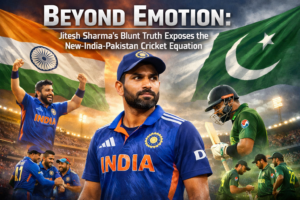
Beyond Emotion: Jitesh Sharma’s Blunt Truth Exposes the New India-Pakistan Cricket Equation
For decades, the India-Pakistan cricket rivalry was defined by a singular, overwhelming emotion: pressure. It was a contest where the weight of a billion hopes collided with geopolitical tension, often leaving players paralyzed by the magnitude of the moment. A dropped catch wasn’t just a mistake; it was a national trauma. A winning six wasn’t just a boundary; it was a declaration.
But if the latest remarks from India wicketkeeper-batter Jitesh Sharma are anything to go by, that era is officially over. In a candid podcast appearance ahead of IPL 2026, Sharma delivered a blunt assessment that has sent ripples through the cricketing world, not for its animosity, but for its startling indifference.
“Nahi, itna dete hi nahi importance unko,” Sharma stated, drawing laughter from the host. “We don’t give them so much importance. Itna dil pe aur dimaag pe lagate hi nahi hai.”
For a generation raised on the notion that India-Pakistan clashes are the pinnacle of sporting drama, these words are jarring. But for a new breed of Indian cricketers—products of the IPL machine and a decade of global dominance—they represent a fundamental truth about the shifting power dynamics in world cricket.
The Deconstruction of a Rivalry
To understand the weight of Jitesh’s words, one must first understand the history they dismantle. The India-Pakistan cricket rivalry has always existed in a space far larger than sport. For players from the 90s and 2000s, facing Pakistan was a test of nerve that began weeks before the first ball. It was about “controlling the nerves,” as Jitesh put it, but the underlying emotion was often fear—fear of failure, fear of the backlash, fear of losing to the arch-rival.
Jitesh’s comments strip away that mystique. By explicitly stating that teams like South Africa and Australia pose a bigger challenge because “Yeh log [Pakistan] cricket nahi khel rahe hai achcha” (These guys aren’t playing good cricket), he reframes the rivalry. It is no longer about the badge on the shirt; it is about the quality of cricket being played.
This isn’t mere trash talk. It is a reflection of a professional reality. In the last decade, India’s cricket structure has produced a conveyor belt of talent that treats international cricket with a clinical professionalism. The IPL has normalized high-pressure environments. For players like Jitesh Sharma, a high-leverage situation is a Tuesday night in front of 60,000 screaming fans at the Chinnaswamy Stadium. The “marquee encounter” has lost its unique terror because they live in a perpetual state of high-stakes competition.
The Gambhir Doctrine: Removing Emotion
Perhaps the most revealing part of Jitesh’s interview was the insight into the team’s current psychological framework, credited to head coach Gautam Gambhir. Gambhir, known for his own combative past on the field, has seemingly instilled a paradox: to win the big game, you must treat it like any other.
“We don’t have to play with emotion,” Jitesh reiterated. “Emotion se khelenge toh we might lose too. So, let’s win the game and phir uske baat jo expression karna hai karenge” (If we play with emotion, we might lose. So, let’s win the game, and then we can express ourselves).
This is a radical shift from the past. Earlier generations often fed on the emotion, using the crowd’s energy or the perceived hostility to fuel performance. Gambhir’s approach, as relayed by Jitesh, is one of stoic pragmatism. It suggests a coaching philosophy that views emotional volatility as a liability. In a game decided by millimeters and milliseconds, clarity of thought is the ultimate weapon. By relegating passion to the post-match celebrations, the team is essentially neutralizing the one variable that has historically made the Pakistan clash so unpredictable.
A Story of Celebrations and Consequences
Jitesh’s remarks weren’t purely philosophical; they were rooted in lived experience. He recounted a specific incident during an Asia Cup clash involving Pakistan spinner Abrar Ahmed. After dismissing Indian batter Sanju Samson, Abrar produced a theatrical celebration. It was a moment designed to assert dominance, a flash of emotion that crossed a line in the Indian dressing room.
“Isne Sanju bhai ko out karke aisa kiya. Toh woh cheez hum logon ko pasand nahi aayi toh, humne woh kiya,” Jitesh explained, revealing how he, along with Arshdeep Singh and Harshit Rana, mimicked the celebration later in the game to “give it back.”
This anecdote is crucial. It illustrates that the “no emotion” policy isn’t about being passive or meek. It’s about controlled aggression. It’s about letting the scoreboard do the talking first. The celebration mimicry wasn’t an emotional outburst; it was a calculated response delivered after the game was already in India’s control. It was the “expression” Gambhir allows—but only after the job is done.
The South Africa and Australia Benchmark
Jitesh’s elevation of Australia and South Africa as more challenging opponents is a masterstroke in psychological warfare, but it’s also an honest assessment of the modern cricketing landscape.
For a team that has consistently topped Test and ODI rankings, the ultimate validation comes from beating the best in the world in their own conditions. Australia, with their ruthless winning culture, and South Africa, with their pace-bowling firepower, represent hurdles that test a team’s technical and mental ceiling.
By suggesting that Pakistan no longer fits that category, Jitesh is articulating a sentiment long held in cricket analytics circles: that the rivalry, in terms of pure cricketing quality, has become lopsided. India’s robust domestic system and IPL exposure have created a depth that Pakistan’s inconsistent structure has struggled to match. For the modern Indian cricketer, beating Pakistan is expected; beating Australia in a Test series is the legacy-defining achievement.
A New Era of Mind Games
As IPL 2026 kicks off, with Jitesh representing the Royal Challengers Bengaluru, these comments will undoubtedly add fuel to the fire. Pakistani fans and former players will likely react with indignation, arguing that form is temporary and class is permanent. They will point to the unpredictability of their team, which can beat anyone on their day.
But Jitesh’s comments aren’t really about Pakistan’s talent. They are about India’s mindset. They signal a team that has moved past the emotional baggage of a historic rivalry and now views it purely through the lens of performance metrics.
It is a shift from rivalry to routine. It is the sound of a team so confident in its own processes that it no longer needs the adrenaline of animosity to perform. In the high-pressure cauldron of cricket, Jitesh Sharma has delivered the most damning verdict of all: indifference.
For Indian cricket fans, it’s a reassuring sign of maturity. For Pakistan, it’s a challenge. If the rivalry is to regain its former edge, it won’t be through fiery press conferences or theatrical celebrations. It will be by forcing the Indian team to put them back on the same pedestal as Australia and South Africa—through sheer, undeniable quality on the field. Until then, Jitesh’s candid words will stand as a testament to how far Indian cricket has come: to a place where the ultimate goal isn’t just to beat the arch-rival, but to view them as just another opponent on the schedule.
You must be logged in to post a comment.