
Beyond Duty: The Unwavering Courage of Tyson, the Army Dog Who Took a Bullet and Kept Fighting
In a remarkable display of courage and dedication, Tyson, a sniffer dog from the Indian Army’s elite 2 Para unit, sustained the first bullet injury during a February 2026 encounter in Kishtwar’s Chatroo area but refused to retreat, continuing to alert security forces to the precise location of three hidden Jaish-e-Mohammad terrorists who had been evading capture for over a month—an act that proved instrumental in the subsequent gunfight that neutralized all three militants, after which the wounded canine was immediately airlifted for medical treatment and is now safely recovering, exemplifying the extraordinary bond and unwavering commitment of the military’s four-legged soldiers in the nation’s counter-terrorism operations.
Beyond Duty: The Unwavering Courage of Tyson, the Army Dog Who Took a Bullet and Kept Fighting
The dense forests of Kishtwar district in Jammu and Kashmir have long been a challenging terrain for security forces conducting counter-terrorism operations. But on a Sunday morning in February 2026, a four-legged soldier proved that courage knows no species. Tyson, a sniffer dog from the elite 2 Para unit of the Indian Army, became the unlikely hero of an encounter that would end a month-long manhunt for three hiding terrorists.
When the first bullet pierced Tyson’s leg inside a modest mud house in the Chatroo area, the dog could have retreated. It could have whimpered and withdrawn from the danger. Instead, Tyson did what every soldier is trained to do—it pressed forward, completing its mission despite the searing pain, and in doing so, helped the joint security forces pinpoint the exact location of three Jaish-e-Mohammad terrorists who had been evading capture for over 30 days.
The Silent Warrior: Understanding Tyson’s Role
To understand what Tyson accomplished that morning, one must first understand the extraordinary training and bond that defines the relationship between army dogs and their handlers. Tyson, a specially bred and trained sniffer dog from 2 Para, represents a lineage of canine warriors who have served in some of the most dangerous conflict zones across the country.
These are not ordinary pets randomly assigned to military duty. Each army dog undergoes rigorous selection and training that spans months, sometimes years. They are trained to detect explosives, track human scent over challenging terrain, and alert their handlers to hidden dangers. More importantly, they are conditioned to remain focused even in the chaos of gunfire and explosions—a feat that requires extraordinary nerve, even for humans.
Tyson’s breed, carefully chosen for its intelligence, stamina, and temperament, makes it particularly suited for operations in mountainous regions like Kishtwar. The ability to navigate rocky terrain, withstand cold temperatures, and maintain scent detection capabilities under stress are qualities that human soldiers rely upon when they enter an operation with a canine companion.
The Encounter That Ended a Month-Long Hunt
The operation that brought Tyson into that mud house began over a month earlier, following a deadly encounter in the Singhpora area of Chatroo. On the intervening night of January 18 and 19, a search party had come under heavy fire from terrorists hiding in dense forests. The attack claimed the life of Army Havildar Gajendra Singh and left seven other soldiers injured—a painful reminder of the risks these men face daily.
In the weeks that followed, joint teams comprising the Jammu and Kashmir Police, the Central Reserve Police Force (CRPF), and the Army had scoured the area relentlessly. They had discovered a meticulously constructed underground hideout stocked with rations sufficient for a prolonged stay—evidence that the terrorists were prepared for a long game of cat and mouse.
Three times during that month-long pursuit, security forces had managed to establish contact with the fleeing terrorists. Three times, the militants had slipped away, using their knowledge of the terrain and the cover of darkness to evade capture. Each escape added to the frustration and determination of the forces involved.
Then came the breakthrough on February 22. Intelligence inputs suggested the terrorists were holed up in the Chatroo area once again, but this time in a location with a critical disadvantage—almost no vegetation to provide natural cover. It was the kind of tactical vulnerability that seasoned operators know how to exploit.
The Moment of Contact: Tyson’s Critical Discovery
As the search teams moved through the area in the early morning hours, Tyson was doing what it had been trained to do since its earliest days in service—following scent trails, investigating structures, and alerting its handler to anything unusual. When they approached a mud house typical of the region’s rural architecture, no one could have known what waited inside.
The terrorists, believing themselves still undetected, had chosen this structure as their temporary refuge. Perhaps they thought the mud walls would mask their presence. Perhaps they were simply exhausted after weeks of running. Whatever their reasoning, they had not accounted for Tyson.
The dog entered the house and immediately detected the presence of the hidden men. Before Tyson could alert its handler in the usual manner, the terrorists opened fire. The first shot struck Tyson in the leg—a wound that would have caused any ordinary animal to retreat in pain and fear.
But Tyson was not an ordinary animal.
Despite the bullet wound, despite the shock and the blood loss, the dog did not break its focus. It continued to indicate the terrorists’ position, giving the joint team the crucial seconds they needed to establish contact and begin the engagement. In military operations, those seconds can mean the difference between success and failure, between life and death.
What followed was a gunfight that would end with all three terrorists neutralized. Among them, sources believe, was a self-styled Jaish commander known as Saifullah—a significant operational loss for the terror group in the region.
The Bond Between Handler and Dog
Behind every army dog like Tyson stands a handler whose bond with the animal transcends the typical human-pet relationship. These handlers eat with their dogs, sleep near them, train with them daily, and ultimately trust them with their lives in combat situations. The handler reads the dog’s subtle signals—a change in breathing, a slight turn of the head, a tension in the muscles—and interprets them as vital intelligence.
When Tyson was hit, its handler would have felt that bullet as surely as if it had struck his own body. The instinct to rush to the dog’s aid would have been overwhelming. Yet both handler and dog understood their mission: locate the terrorists, fix their position, and enable the team to complete the operation. Tyson’s continued alerting, even after being wounded, speaks to the profound trust and training that allows a dog to override its survival instincts in favor of mission accomplishment.
In the aftermath of the encounter, as the firing ceased and the area was secured, Tyson’s handler could finally attend to his wounded partner. The dog that had just helped eliminate a terrorist threat was now himself a casualty in need of evacuation.
Medical Evacuation and Recovery
The Indian Army’s commitment to its canine soldiers extends well beyond the battlefield. When Tyson was wounded, the military’s medical evacuation system swung into action with the same urgency it would apply to any wounded soldier.
Recognizing the seriousness of the leg injury and the need for prompt veterinary care, Tyson was airlifted from the remote encounter site to a facility equipped to handle such trauma. The decision to use air evacuation—a resource-intensive process—underscores the value the army places on these four-legged warriors.
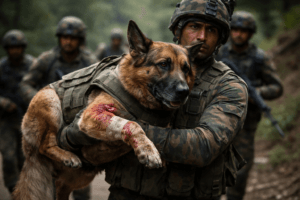
As of the latest reports, Tyson is safe and recovering from its injuries. The bullet wound, while serious, is not life-threatening, and the dog is expected to return to duty once rehabilitation is complete. The image of Tyson being carried to medical care, wounded but alive, serves as a powerful reminder that heroism in the armed forces takes many forms.
The Larger War: Counter-Infiltration and Counter-Terrorism Operations
The Kishtwar encounter did not happen in isolation. It is part of a sustained campaign by security forces to eliminate terrorist presence in the Jammu region, an area that has seen increased infiltration attempts in recent years. The successful neutralization of three terrorists, including a likely commander, represents a significant blow to Jaish-e-Mohammad’s operational capabilities in the area.
For the local population, operations like this bring both relief and anxiety. Relief that terrorists are being removed from their midst, and anxiety about the violence that such operations necessarily entail. The discovery of the underground hideout stocked with rations weeks earlier had demonstrated that these terrorists were preparing for a long stay, potentially using the area as a base for future attacks. Their elimination prevents those attacks from materializing.
The month-long pursuit also demonstrates the persistence and patience required in modern counter-terrorism operations. Unlike conventional warfare, where battles are often decided in hours or days, the fight against terrorism is measured in weeks and months of patient tracking, intelligence gathering, and carefully timed strikes. Every operation builds on the lessons of previous ones, and every success like this one contributes to the gradual restoration of normalcy in affected areas.
The Legacy of Military Dogs in India
Tyson joins a distinguished lineage of military dogs who have served the nation with distinction. From detecting explosives in urban counter-terrorism operations to tracking infiltrators along the borders, these canine soldiers have saved countless human lives through their service.
The Army’s canine breeding and training program has evolved significantly over the years, with a focus on selecting breeds suited to India’s diverse operational environments. Labradors, German Shepherds, and specialized sniffer breeds are trained at facilities like the Remount and Veterinary Corps Centre in Meerut, where they learn the skills that would make Tyson a hero in Kishtwar.
These dogs serve for approximately 8-10 years before retirement, after which they are often adopted by their handlers or placed in loving homes. Their service, while less celebrated than that of their human counterparts, is no less valuable to the nation’s security.
Human Cost of Conflict
While Tyson’s heroism rightfully captures attention, the encounter also carries somber reminders of the human cost of terrorism and counter-terrorism operations. Havildar Gajendra Singh, killed in the January encounter that began this month-long pursuit, made the ultimate sacrifice. His family, like countless others who have lost loved ones to terrorism and military operations, must now live with the void left by his absence.
The seven soldiers wounded in that same January operation carry both physical and psychological scars. Some will return to duty; others may face medical discharge and a lifetime of rehabilitation. Their service, like Tyson’s, deserves recognition and gratitude.
On the other side of the conflict, three families in Pakistan—if that is indeed where the terrorists originated—will receive news of their loved ones’ deaths. They too will grieve, manipulated by forces that send young men across borders to die in someone else’s war. The tragedy of terrorism is that it creates victims on all sides, even among those who choose to take up arms.
Looking Forward: The Road Ahead
For Tyson, the road ahead involves recovery and rehabilitation. Physical therapy for the bullet wound, gradual reintroduction to training, and ultimately a return to duty if the leg heals properly. The bond with its handler will only strengthen through this shared experience of combat and survival.
For the security forces in Kishtwar, the operation continues. While three terrorists have been eliminated, the conditions that allow terrorism to flourish—porous borders, external support, local grievances—remain. Each successful operation is a battle won, not the war ended.
For the local population, the hope is that operations like this will gradually reduce the terrorist presence in their areas, allowing children to attend school without fear, farmers to work their fields without looking over their shoulders, and families to sleep through the night without the sound of gunfire.
A Hero’s Welcome
When Tyson is fully recovered, it will likely return to its unit and resume its duties. There will be no parade, no medal ceremony, no public recognition beyond the news reports that briefly captured its story. But among the soldiers of 2 Para and the broader army community, Tyson’s actions on that February morning will be remembered and honored.
In the mud house in Chatroo, where three terrorists met their end thanks in part to a wounded dog that refused to quit, the bloodstains will fade. The terrorists will be buried or disposed of according to procedure. The security forces will move on to the next operation, the next pursuit, the next encounter.
But the story of Tyson—the army dog that took a bullet and kept going—will join the lore of military heroism that sustains soldiers through difficult times. It reminds us that courage is not limited by species, that duty transcends form, and that in the fight against terrorism, every soldier matters, whether on two legs or four.
As Tyson rests and recovers, somewhere in the mountains of Kishtwar, another team of soldiers and their canine companions continues the watch. The mission never ends. The danger never fully recedes. But for one dog and its handler, there is at least the satisfaction of a job completed, a threat eliminated, and a partner saved.
In the annals of military history, Tyson’s name may not appear alongside famous generals or historic battles. But in the hearts of those who understand what it means to serve, to sacrifice, and to keep going despite the pain, Tyson is already a legend.
You must be logged in to post a comment.