
Beyond Diplomacy: When an Ambassador’s “Biblical Borders” Ignite a Firestorm
U.S. Ambassador to Israel Mike Huckabee has ignited a diplomatic firestorm by suggesting in a recent interview that Israel has a biblical right to claim vast swaths of the Middle East, a region he described as stretching from the Nile to the Euphrates—encompassing modern-day Israel, Palestine, Jordan, Lebanon, Syria, and parts of Saudi Arabia and Iraq. The remarks, made to commentator Tucker Carlson, drew immediate and fierce condemnation from Arab nations like Egypt and bodies such as the Arab League, which denounced them as an extremist violation of international law and a dangerous provocation that ignores the historical realities and millions of lives in the occupied territories. While Huckabee noted Israel is not actively seeking expansion, his theological framing of the conflict lays bare the powerful role of religious ideology in U.S. foreign policy and threatens to inflame tensions on the ground by validating maximalist settler ambitions, all while contradicting official U.S. statements opposing annexation and highlighting the impossibility of realizing such a vision without catastrophic human cost.
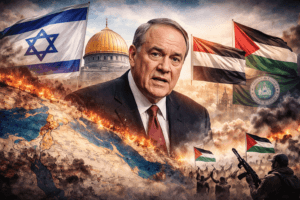
Beyond Diplomacy: When an Ambassador’s “Biblical Borders” Ignite a Firestorm
The U.S. Ambassador to Israel’s recent claim that Israel has a right to a vast swath of the Middle East has done more than just upset diplomatic norms—it has laid bare the explosive collision of theology, politics, and human reality in the region.
It was a moment that transcended the usual careful platitudes of diplomatic discourse. Seated across from conservative commentator Tucker Carlson, U.S. Ambassador to Israel Mike Huckabee was asked a question that cut to the very heart of one of the world’s most intractable conflicts. Citing the Book of Genesis, Carlson framed a divine promise: that the descendants of Abraham were bequeathed a territory stretching from the Nile River in Egypt to the Euphrates in modern-day Iraq. Did Israel, Carlson asked, have a right to this land?
Huckabee’s reply was as direct as it was incendiary: “It would be fine if they took it all.”
In a few words, the sitting ambassador of the United States appeared to endorse a maximalist vision of Israeli sovereignty over a region that includes not only Israel itself, but all of Palestine, Jordan, Lebanon, Syria, and large parts of Saudi Arabia and Iraq. While Huckabee added that Israel is “not looking to expand its territory,” the damage was done. His comments, aired on Friday, have sent a shockwave through the Middle East, drawing swift and severe condemnation from key U.S. allies and adversaries alike, and reigniting a debate about the role of faith in foreign policy and the very real human consequences of such rhetoric.
The Genesis of a Controversy
To understand the uproar, one must first understand the weight of the words used. The concept of “Greater Israel” (Eretz Yisrael Ha-shlema) is not a fringe idea. For some religious Zionist and ultra-nationalist groups, it is a foundational belief. It posits that the biblical boundaries promised to Abraham, Isaac, and Jacob are the rightful and inalienable heritage of the Jewish people. The verses in question, primarily Genesis 15:18, describe a covenant: “Unto thy seed have I given this land, from the river of Egypt unto the great river, the river Euphrates.”
For decades, mainstream Israeli politics has largely distanced itself from such irredentist dreams, focusing instead on securing defensible borders and, at times, pursuing a land-for-peace formula. However, the belief has remained a potent force on the settler movement’s ideological right, providing a divine justification for the establishment of Jewish settlements in the West Bank and beyond.
Huckabee, a former governor of Arkansas and a two-time Republican presidential candidate, is not a newcomer to this line of thinking. A devout Baptist, he has long been a staunch supporter of Israel, often framing his support in explicitly theological terms. Long before his ambassadorial appointment, he led tours to Israel, participated in settlement events, and consistently opposed the creation of a Palestinian state. In a 2008 speech to the Israeli lobbying group AIPAC, he famously declared, “There are certain things that ought to be settled law, and one of them is that Jerusalem is and will remain the eternal, undivided capital of Israel. Period.”
His latest comments, however, carry a different weight. He is no longer just a visiting firebrand; he is the official representative of the United States government. When he speaks, the world listens, parsing his words for shifts in American policy.
A Diplomatic Earthquake
The reaction from the Arab and Muslim world was swift and unambiguous. It was as if a dam of diplomatic restraint had broken.
Cairo, a linchpin of regional stability and the first Arab state to make peace with Israel, led the charge. The Egyptian Foreign Ministry did not mince words, calling Huckabee’s statements a “blatant violation of international law.” In a pointed rebuke, it asserted that “Israel has no sovereignty over the occupied Palestinian territory or other Arab lands.” For Egypt, which lost the Sinai Peninsula in the 1967 war and only regained it through the landmark 1979 peace treaty, the mention of the Nile as a boundary for Israel touches a raw, unhealed national wound.
The rhetoric only intensified from there. The Jeddah-based Organisation of Islamic Cooperation (OIC), representing 57 member states, condemned the remarks as “extremist and provocative.” The League of Arab States followed suit, warning that such “extremist and lacking any sound basis” statements serve only to “inflame sentiments and stir religious and national emotions.” The subtext was clear: this was not just a diplomatic gaffe; it was viewed as a dangerous provocation that could destabilize an already volatile region.
Notably absent from the immediate response was any official comment from the Israeli government or the U.S. State Department. That silence was, in itself, telling. For the Israeli government, the ambassador’s words, while perhaps privately welcomed by its more right-wing factions, present a diplomatic headache. They undermine Israel’s own carefully managed messaging, which often seeks to portray itself as a seeker of security and peace, not territorial expansion. For the Biden administration—or whatever administration is in power in this future timeline—Huckabee’s comments undercut its own stated positions and force allies in the region to question America’s reliability and intentions.
The Historical Context: Borders Forged by War
The land between the Jordan River and the Mediterranean Sea is one of the most contested pieces of territory on Earth. The modern state of Israel was established in 1948 on land defined by U.N. Resolution 181, but its borders have never been final or fully recognized. They are, instead, a palimpsest of war, armistice, and unilateral action.
The 1967 Six-Day War was the pivotal event. In six days, Israel’s borders were dramatically redrawn. It captured the West Bank and East Jerusalem from Jordan, the Gaza Strip and the Sinai Peninsula from Egypt, and the Golan Heights from Syria. U.N. Security Council Resolution 242, passed shortly after, established the “land for peace” formula that has underpinned all subsequent peace negotiations. It called for the “withdrawal of Israeli armed forces from territories occupied in the recent conflict” in exchange for the termination of belligerency and respect for the sovereignty of every state in the area.
Since then, the map has continued to shift. Israel returned the Sinai to Egypt as part of their 1979 peace deal. It unilaterally withdrew from Gaza in 2005, dismantling settlements but maintaining tight control over its borders, airspace, and coastline. The Golan Heights was effectively annexed in 1981, a move never recognized by the international community. And the West Bank remains a patchwork of Palestinian-populated areas (Areas A and B) and full Israeli military and civilian control (Area C), which is now dotted with over 130 government-sanctioned settlements and nearly 100 outposts considered illegal even under Israeli law.
It is against this complex, fragile tapestry that Huckabee’s words land. To speak of “biblical borders” from the Nile to the Euphrates is to completely erase this history, the legal frameworks built upon it, and the lives of the millions of people—Palestinians, Jordanians, Lebanese, Syrians, Egyptians—who call that land home.
The Human Cost of Maximalist Claims
Beyond the geopolitical shockwaves, the most profound impact of such rhetoric is on the ground, in the lives of ordinary people. For Palestinians in the West Bank, Huckabee’s words are a terrifying validation of their worst fears.
Imagine being a Palestinian farmer in the Jordan Valley. For generations, your family has tended olive groves that have been the lifeblood of your community. But since 1967, your land has been under military occupation. You need permits from the Israeli military to access your own fields. You watch as new settlements are built on nearby hilltops, their red-roofed houses connected by a network of bypass roads that you are forbidden to use. You see your water resources being diverted to fill the swimming pools and irrigate the lawns of those settlements, while your own village faces chronic shortages. You live with the constant threat of home demolitions and the daily friction at military checkpoints.
When a sitting U.S. ambassador says it would be “fine” if Israel took “all” of the land promised in an ancient text, it doesn’t sound like abstract theology. It sounds like the final seal of approval for the slow-motion erasure of your world. It tells the most extreme elements of the settler movement that their dream is not a fantasy, but a destiny waiting to be fulfilled.
This reality is not limited to the West Bank. In Syria, Israel’s recent seizure of a demilitarized buffer zone on the Golan Heights following the ouster of Bashar Assad was explained as a temporary security measure. But in the context of Huckabee’s Greater Israel rhetoric, it looks like the first step in a new land grab. In Lebanon, the continued occupation of five hilltop posts serves as a constant reminder of the 2024 war with Hezbollah and the fragility of the border.
Faith, Power, and the American Role
Huckabee’s comments force a difficult question about the role of religion in American foreign policy. While the United States has a long history of supporting Israel, the rationale has shifted over time. It was once primarily a strategic alliance during the Cold War. Later, it was framed as a shared commitment to democratic values. In recent decades, particularly within the Republican Party and the evangelical Christian base, it has become increasingly theological.
Many American evangelicals support Israel based on a dispensationalist theology, which views the ingathering of the Jewish people in the Holy Land as a prerequisite for the Second Coming of Christ. This belief system often leads to unwavering political support for Israel’s most right-wing governments, with little regard for the national aspirations of the Palestinians.
When a figure like Huckabee, steeped in this tradition, is made ambassador, it signals to the world that these theological currents are not just a voting bloc to be courted, but are now shaping the highest levels of U.S. policy. It conflates a specific religious interpretation of ancient scripture with modern international law and statecraft, a move that is deeply destabilizing in a region of immense religious diversity.
President Donald Trump’s stated position—that he would block any Israeli attempt to annex the West Bank—now stands in stark contrast to the words of his own ambassador. This dissonance creates confusion and cynicism. Which voice speaks for America? Is it the president who talks of deals and stability, or the ambassador who speaks of prophecy and divine inheritance?
The Mirage of “Taking It All”
Ambassador Huckabee’s hypothetical—”if they took it all”—ignores a fundamental reality. What would “taking it all” actually mean? The territory he alluded to is not an empty land awaiting its rightful owners. It is home to tens of millions of people. To “take” Jordan would mean absorbing a country of over 11 million, the majority of whom are Palestinian in origin. To “take” Lebanon would mean subsuming a fractured state of sects and militias. To “take” parts of Saudi Arabia would mean swallowing the holy cities of Mecca and Medina.
Such a scenario is not a political solution; it is the recipe for an apocalyptic, never-ending war. It would require either the mass expulsion of the indigenous populations—an act of ethnic cleansing that would shatter international order—or the creation of a single, binational state from the Nile to the Euphrates, in which Jews would quickly become a minority. This is the paradox of the “Greater Israel” dream: it can only be realized by destroying the very thing it seeks to preserve—a Jewish, democratic state.
Conclusion: The Power of Words
In the tinderbox of the Middle East, words are never just words. They are actions. They can give comfort to extremists and despair to moderates. They can be interpreted by a settler in Hebron as a green light to expand his outpost, and by a militant in Damascus as proof that peaceful coexistence is a fool’s errand.
Mike Huckabee’s comments to Tucker Carlson were a stark reminder that diplomacy is not just conducted in formal meetings and carefully drafted U.N. resolutions. It is also shaped by deeply held beliefs, by the books people read, and by the histories they choose to remember or forget. By invoking a divine deed to land that millions call home, the U.S. ambassador did not just breach diplomatic protocol. He poured fuel on a fire that the world has been trying to extinguish for generations. And the smoke from that fire will be seen and felt far beyond the corridors of power, in the homes, farms, and lives of ordinary people caught in the crossfire of history and faith.
You must be logged in to post a comment.