
Beyond Diplomacy: How the India-Oman CEPA Rewrites a Millennia-Old Partnership for the 21st Century
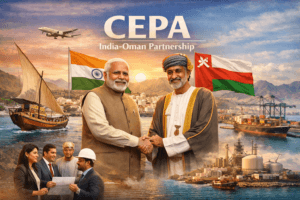
Beyond Diplomacy: How the India-Oman CEPA Rewrites a Millennia-Old Partnership for the 21st Century
Meta Description: PM Modi’s Oman visit culminates in a landmark trade pact. We analyze the strategic, economic, and human story behind the deal that marks a shift in India’s economic DNA and the Gulf’s geopolitical landscape.
The ancient dhows that once plied the monsoon winds between the Malabar Coast and the ports of Oman carried more than just spices, textiles, and gems. They carried a legacy of trust—a quiet, resilient understanding forged over centuries of cultural and commercial exchange. Last week, as Prime Minister Narendra Modi stood in Muscat, conferred with the Order of Oman and addressing a business forum, that ancient legacy was being consciously repurposed for a new age. The centerpiece: a Comprehensive Economic Partnership Agreement (CEPA), a modern covenant set to redefine one of India’s most steadfast relationships in the Arab world.
At first glance, this might seem like another diplomatic entry in a busy calendar. Yet, to view it merely as such is to miss the profound strategic recalibration at play. This agreement is not an isolated event but a deliberate stitch in the larger tapestry of India’s transformed foreign economic policy. As PM Modi declared, “India has changed its economic DNA.” The Oman CEPA is perhaps one of the clearest manifestations of what that new DNA looks like in action.
The Foundation: A Partnership Built on Trust, Not Just Transaction
Unlike relationships marked by volatility or purely resource-based dependency, the India-Oman bond is uniquely organic. An estimated 700,000-strong Indian community forms the vibrant social and economic backbone of Oman, contributing seamlessly from healthcare to entrepreneurship. Remittances flow, but so does a deeper social capital. This people-to-people bridge, spanning from the coastal mandvis of Gujarat to the souqs of Muscat, provides a resilience that pure geopolitics often lacks.
Oman, under the late Sultan Qaboos and now Sultan Haitham bin Tarik, has long pursued a foreign policy of delicate neutrality and strategic balancing. In this context, India has consistently emerged as a trusted, non-intrusive partner. The CEPA, notably Oman’s first such pact in nearly two decades and only its second with any nation, is a testament to that trust. It signals Oman’s confidence in India not just as a market, but as a reliable pillar in its “Vision 2040” diversification away from oil dependence.
Decoding the “New Economic DNA”
PM Modi’s reference to a changed economic DNA is more than rhetorical flourish. It’s a direct allusion to a decade of structural reforms that have fundamentally altered how India engages with the global economy. The Oman CEPA leverages this new architecture:
- The GST & IBC Effect: The Goods and Services Tax (GST) created, as Modi noted, “one integrated, unified market.” For an Omani investor or exporter, this simplifies logistics and reduces internal trade barriers dramatically. The Insolvency and Bankruptcy Code (IBC) instilled financial discipline and transparency, directly addressing a perennial concern of foreign investors. These aren’t just domestic policies; they are enablers for international agreements, giving partners like Oman the confidence that contracts will be honored and disputes resolved within a robust legal framework.
- From Defensive to Offensive Trade Policy: India’s historical caution towards FTAs has given way to a proactive, calculated strategy. The UAE CEPA (2022) was the trailblazer, demonstrating speed and tangible results. The Oman deal follows this template, focusing on strategic complementarity. Oman offers India energy security (it is a critical partner for India’s West Asian FALCON oil pipeline project), gateway access to the wider Gulf Cooperation Council (GCC), and opportunities in mining, logistics, and tourism. India offers Oman a massive consumer market, expertise in technology, digital infrastructure, fintech, and a manufacturing alternative as global supply chains rethink their China-centric model.
- The Geopolitical Undercurrents: The deal is sealed against a complex regional backdrop. Oman maintains balanced relations with Iran, Saudi Arabia, and the West. India, meanwhile, is deepening ties across the Gulf, from Saudi Arabia and the UAE to Qatar, while navigating its own relationship with Iran. Strengthening the Oman anchor provides India with a stable, discreet partner in a turbulent neighborhood, crucial for its maritime security in the Western Arabian Sea. Furthermore, as China deepens its Belt and Road investments in the region, India’s CEPA model offers a transparent, rules-based, and less debt-heavy alternative for economic partnership.
The Human Insight: Why This Matters Beyond Headlines
The real value of this agreement lies in its potential to translate high diplomacy into tangible human and business outcomes.
- For the Indian Diaspora: The CEPA could catalyze a shift. The community, traditionally employed in mid-tier sectors, may see a surge in entrepreneurial opportunities. Easier regulations and market access can turn successful Indian managers in Oman into business owners, creating a new class of investor-bridge-builders.
- For Indian SMEs: Sectors like pharmaceuticals, medical devices, automotive components, and textiles gain preferential access. A small manufacturer in Coimbatore or Rajkot can now compete more effectively in the Omani market against goods from other countries, fostering job creation and innovation at home.
- The Strategic Synergy: Oman’s Duqm Port, a massive industrial and logistical hub, presents a compelling opportunity. Indian investment here can create a strategic Indian Ocean node for manufacturing, repair, and transshipment, marrying India’s “SAGAR” (Security and Growth for All in the Region) doctrine with Oman’s logistical ambitions.
A Contrast in Narratives
It’s instructive to contrast the forward-looking, economic-statecraft narrative from Muscat with the political tumult back in Delhi’s Parliament over the Vice President’s Bill. This duality captures modern India: an increasingly confident global actor pursuing complex international agreements, while its vibrant democracy engages in fierce domestic debate. The Oman visit, alongside the inauguration of a school project in Nepal and strategic dialogues in the Indo-Pacific, underscores an administration focused on leveraging foreign policy for concrete economic outcomes.
The Road Ahead: CEPA as a Blueprint, Not a Destination
The signing of the CEPA is not the finish line but the starting grid. Its success will be measured by utilization rates, the growth of cross-border investments, and the deepening of supply chain integration. The “IKIGAI” framework for Indo-Pacific cooperation, outlined by India’s Chief of Defence Staff, finds its economic parallel here: a partnership that answers what the region needs, what both nations are good at, what they can be paid for, and crucially, what they love—a shared history and a mutual respect.
As the world fixates on the loud protests and grand tours, the quiet, persistent work of building trust-based economic bridges continues. The waves of the Arabian Sea, as PM Modi poetically noted, do change. But the India-Oman CEPA is a deliberate effort to ensure that with each changing wave and season, this ancient friendship doesn’t just endure but ascends, built now on the solid pilings of shared economic destiny and a newly coded, confident Indian economic DNA.
You must be logged in to post a comment.