
Beyond Curry at 35,000 Feet: How Qatar Airways and Garima Arora Are Redefining Luxury Indian In-Flight Dining
Beyond Curry at 35,000 Feet: How Qatar Airways and Garima Arora Are Redefining Luxury Indian In-Flight Dining
For decades, “Indian food” on an airplane meant one thing: a choice between butter chicken or palak paneer, often homogenised to suit a global palate. That era has officially ended. In a landmark move for culinary aviation, Qatar Airways has partnered with two-Michelin-star chef Garima Arora to launch an exclusively vegetarian, Ayurvedic-inspired business class menu on its Doha-India routes. This isn’t just a menu change; it’s a philosophical shift, signalling a new chapter where inflight dining embraces nuance, wellness, and the profound depth of regional Indian gastronomy.
The Confluence of Stars: Michelin Meets the Skies
The collaboration is a meeting of two entities at the pinnacle of their fields. Qatar Airways, consistently crowned the ‘World’s Best Airline’, is no stranger to elevating the passenger experience. Chef Garima Arora, the first Indian woman to both receive a Michelin star and lead a two-star kitchen (at Bangkok’s Gaa), represents a modern, intellectual approach to Indian cooking. Her cuisine is built on meticulous research, respect for tradition, and a focus on ingredient-led balance. Bringing this sensibility to 35,000 feet is a bold statement.
The airline’s decision to debut this on India routes is a masterstroke in cultural resonance. It speaks directly to the sophisticated Indian traveller who recognises the difference between generic “Indian” food and cuisine rooted in specific regional traditions. Moreover, it caters to a growing global desire for meals that are not just luxurious, but also intentional and nourishing.
Decoding the Menu: A Narrative on a Plate
The inaugural menu is a concise story of Arora’s culinary language. It moves away from heavy creams and predictable spices, offering instead a journey of texture, temperature, and digestive ease—a core tenet of Ayurveda.
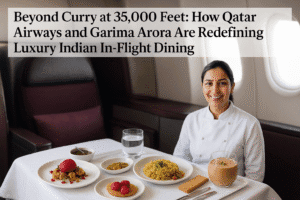
- The Starter – Chaat, Reimagined: The opening act is a deconstructed, elevated chaat. Combining a tangy berry sorbet with savoury dal dumplings, sweet yoghurt, and a pomegranate drizzle, it is a play on contrasts. At altitude, where taste buds can dull by up to 30%, this dish is designed to awaken the senses. The cold sorbet, the crisp dumpling, the juicy pomegranate—each element is engineered to deliver maximum flavour perception, proving that complexity can be achieved without heaviness.
- The Main Course – Grandmother’s Wisdom, Modern Translation: The centrepiece is a millet khichdi, inspired by Arora’s grandmother’s recipe. In Indian households, khichdi is the ultimate comfort and convalescence food—a simple, nourishing blend of grains and lentils. By choosing millet, an ancient, nutrient-dense grain, Arora contemporises the classic. Served with homemade pickles, condiments, and a warm shorba (broth), this dish is the epitome of the Ayurvedic principle of Sattvic eating: pure, clean, and easily digestible. For a passenger crossing time zones, this is a far more considerate offering than a rich, sleep-inducing meal.
- The Dessert – A Familiar Cup, Unforgettable Form: The finale is a stroke of nostalgic genius: a masala chai mousse. It captures the aromatic essence of India’s favourite beverage in an airy, elegant form. Paired with dipped Parle-G biscuits—a ubiquitous childhood snack—and raspberries filled with candied ginger, it balances sweetness with spice, and sophistication with comforting familiarity. It’s a dessert that feels both globally refined and intimately Indian.
The 30,000-Foot Challenge: Why This Menu is a Technical Feat
Creating for the skies is arguably one of the greatest challenges a chef can face. The dry, pressurised cabin environment severely impacts our sense of taste and smell, particularly dulling sweetness and saltiness. Ingredients behave differently; sauces can separate, and textures can degrade.
Arora’s menu demonstrates a deep understanding of these constraints. The use of bold, acidic elements (berry sorbet, pomegranate, pickles), umami-rich ingredients (dal, fermented condiments), and contrasting textures is a direct response to the high-altitude dining problem. The focus on easily digestible, vegetable-forward dishes also aligns with modern passenger preferences for feeling good upon arrival. This is wellness-oriented design, not as a trend, but as a core function of the experience.
Beyond the Plate: What This Launch Truly Signifies
This partnership is a bellwether for several key trends in luxury travel and global gastronomy:
- The Rise of Culinary Authenticity: Travellers, especially from culturally rich nations like India, seek authentic representations of their heritage. They are rejecting watered-down, pan-ethnic versions. By investing in a chef of Arora’s calibre, Qatar Airways is acknowledging and honouring the intelligence of its passengers’ palates.
- Wellness as the New Luxury: Luxury is increasingly defined by how something makes you feel, not just by its opulence. An Ayurvedic-inspired menu, with its focus on balance and digestion, is a premium wellness offering. It caters to the passenger who values arriving refreshed and grounded.
- The Chef as Cultural Ambassador: Airlines have long used celebrity chefs, but often from a European-centric fine-dining perspective. This collaboration positions an Indian chef as the author of a global luxury narrative. Arora isn’t just providing recipes; she’s providing a philosophy. Her planned quarterly refreshes will keep the offering dynamic, turning the menu into a curated, seasonal journey.
- Strategic Route-Based Customisation: The initial rollout on India routes, with plans to expand to the US, shows a smart strategy. It first deepens loyalty with a core market that will instantly appreciate the nuances. Subsequently, introducing it on competitive US routes becomes a powerful differentiator, offering long-haul passengers a unique, culturally immersive dining experience they cannot find elsewhere.
The Future of In-Flight Dining Takes Flight
Qatar Airways’ launch with Garima Arora sets a formidable new standard. It moves the conversation from “what is served” to “why it is served.” It challenges the industry to think of inflight meals not as a logistical necessity, but as an integral, enriching chapter of the journey itself—a chapter that can educate, nourish, and delight.
As this menu evolves quarterly and wings its way to other continents, it does more than feed passengers. It carries a modern, sophisticated, and wholesome vision of Indian cuisine across the globe, proving that at the intersection of altitude and attitude, true innovation can, indeed, take flight. The next time you fasten your seatbelt, the most exciting part of the journey might just be on your tray table.
You must be logged in to post a comment.