
Beyond Code: Why India’s AI Ambitions Are Now Hinging on a Human Capital Revolution
The recent Human Capital Working Group meeting at IIT Guwahati, hosted by MeitY, IndiaAI, and the Government of Assam, marked a pivotal strategic shift in India’s AI agenda, moving the focus from pure technological infrastructure to the foundational role of human capital. Deliberations emphasized that for India to harness its demographic dividend and navigate the risks of job displacement, it must transcend fragmented skilling initiatives and build inclusive, lifelong learning ecosystems that prioritize cognitive agility, critical thinking, and human-centered capabilities. Crucially, the dialogue—set intentionally in the Northeast—stressed regional equity, gender-responsive policies to protect against workforce disparities, and the need for sovereign AI tools for widespread human augmentation, framing AI progress not merely as technical advancement but as a tool for democratizing opportunity and ensuring an equitable transition for Viksit Bharat 2047.
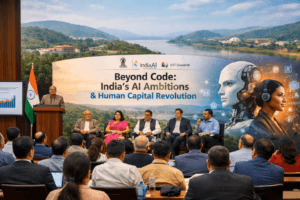
Beyond Code: Why India’s AI Ambitions Are Now Hinging on a Human Capital Revolution
The serene campus of IIT Guwahati, nestled on the banks of the Brahmaputra, recently became the unlikely epicenter of a critical national conversation. On January 5th and 6th, 2026, a gathering convened by MeitY, the IndiaAI Mission, the Government of Assam, and IIT Guwahati wasn’t debating the next leap in neural network architecture or GPU procurement. Instead, the “Human Capital Working Group Meeting” focused on a more fundamental, and often overlooked, pillar of technological dominance: people. This meeting, a precursor to the grand India AI Impact Summit in New Delhi this February, signals a pivotal and mature shift in India’s AI strategy—from chasing computational power to empowering its billion-strong human potential.
The Stakes: Why Human Capital is India’s Make-or-Break AI Frontier
For years, the global AI narrative has been dominated by a race for compute, data, and algorithmic breakthroughs. However, as Prof. T. G. Sitharam, Chair of the Working Group, underscored, India’s transition to an AI-enabled economy must be “inclusive and people-centric, with human capital at its core.” This isn’t mere idealism; it’s strategic necessity.
India’s traditional strength—its vast IT and outsourcing sector—faces an existential challenge from AI automation. Shri Syedain Abbasi, Special Chief Secretary of Assam, issued a stark warning: the concentration of AI capabilities among a few global players threatens to exacerbate inequalities and disrupt this employment model. The risk is a double-edged sword: missing the AI innovation wave while simultaneously suffering job displacement from it. The Guwahati dialogue recognized that India’s unique demographic dividend can only become an AI dividend if the nation masters the human side of the equation.
From “Skilling” to “Lifelong Learning Ecosystems”: A Paradigm Shift
A recurring theme, powerfully articulated by multiple speakers, was the urgent need to move beyond conventional, fragmented “skilling” drives. The 20th-century model of front-loading education for a static career is obsolete. AI’s evolution is too rapid.
Prof. Sitharam emphasized building “lifelong learning ecosystems” that prioritize adaptability, judgment, and human-centred capabilities alongside technical skills. Shri K. S. Gopinath Narayan, Assam’s Principal Secretary for IT, highlighted “micro-skilling” and AI literacy as essential public capabilities. This represents a fundamental reimagining of education as a continuous, integrated process spanning schools, universities, workplaces, and community centers. The goal is not just to create AI engineers, but to create an AI-fluent citizenry—from farmers using predictive analytics to nurses collaborating with diagnostic algorithms.
The Northeast and Inclusive Growth: Democratizing the AI Conversation
The choice of Guwahati as the host city is profoundly symbolic. It moves the AI policy dialogue beyond the traditional tech hubs of Bangalore, Hyderabad, and Delhi. By anchoring this discussion in the Northeast, the IndiaAI Mission acknowledges that a national strategy cannot succeed if it deepens the digital divide between regions.
Prof. Devendra Jalihal, Director of IIT Guwahati, highlighted the institute’s role as a convening platform that bridges research, policy, and real-world impact for the region. The discussions here feed into a national agenda with a crucial filter: regional equity. How can AI-driven education reach remote villages in Assam? How can workforce transition programs be designed for the specific economic fabric of the Northeast? This geographic intentionality ensures the “Viksit Bharat 2047” vision is built on an inclusively designed AI foundation.
Gender and the AI Transition: Navigating Risk with Responsive Policy
One of the most consequential sessions of Day 1 was the panel on “Gender-Responsive Strategies for the AI Transition.” It moved beyond tokenism to a hard-nosed analysis of systemic risk. The panel identified clear dangers: AI’s propensity to automate routine, entry-level clerical and service roles—sectors with high female participation—could disproportionately impact women’s employment. Furthermore, algorithmic bias in hiring and lending tools, coupled with unequal access to advanced AI skilling, threatens to widen existing wage and opportunity gaps.
The solutions proposed were multifaceted. Ms. Tulika Pandey from MeitY and other panelists called for:
- Inclusive Design: Mandating diversity in AI development teams and audit processes.
- Adoption-Led Reskilling: Proactively creating pathways for women in roles at high risk of automation to transition into AI oversight, data curation, and ethical governance positions.
- Ecosystem-Driven Interventions: Policy incentives for companies that demonstrate equitable AI adoption and retention.
This focus ensures that the AI transition is measured not just by GDP growth, but by its ability to enhance, not erode, gender equity in the workforce.
Redefining Education: From Rote Learning to Cognitive Agility
The panel on “Redefining Education for the Cognitive Age” tackled the root of the human capital challenge. If AI excels at information retrieval and pattern recognition, what is the purpose of education?
The consensus was a decisive shift from content-heavy, rote-based instruction to fostering cognitive agility. As Prof. Anupam Basu noted, the objective must be to cultivate critical thinking, complex problem-solving, collaboration, and creativity—skills where humans hold a comparative advantage. AI’s role in this new pedagogy is not as a replacement for teachers, but as a powerful tool for personalization. It can free educators from administrative burdens, allowing them to mentor and foster human connection, while providing tailored learning journeys for students.
Mr. Venkatesh Reddy of ConveGenius and Mr. Siddhant Sachdeva of Rocket Learning emphasized the need for “community-tested, human-centric AI tools” that are accessible in diverse Indian languages and contexts. The future being drafted in Guwahati is one where AI doesn’t create a detached digital learning experience, but enhances the human teacher’s ability to reach every student.
The Road to the Summit and Beyond: Synthesis and Sovereign Capacity
The deliberations in Guwahati are not academic exercises. As Ms. Shikha Dahiya of IndiaAI made clear, their outcomes will directly inform the global-level discussions at the India AI Impact Summit 2026. The Working Group is synthesizing actionable recommendations on:
- Education Reform: Aligning curricula with cognitive-age competencies.
- Workforce Transition: Creating safety nets and pathways for sectors in flux.
- Sovereign AI Tools: Building domain-specific AI systems for agriculture, healthcare, and governance that augment Indian professionals.
- Ethical Governance: Ensuring AI adoption protects dignity and promotes resilience.
The keynote by Prof. Gautam Barua on “Democratizing Competency” crystalized the end goal: using sovereign AI not for flashy automation, but for large-scale human augmentation—raising the baseline capability of every professional, from a veterinarian to a tax official, while ensuring social protection for those in transition.
Conclusion: Building the Foundation for an AI-Powered Civilization
The Human Capital Working Group Meeting at IIT Guwahati marks a watershed moment. It reveals a government and ecosystem that understands technology is ultimately a reflection of human choices. India’s AI journey is no longer just about building models; it’s about building minds and building fairness.
By placing human capital at the heart of its strategy—emphasizing lifelong learning, regional inclusion, gender equity, and cognitive education—India is attempting something unprecedented: to guide a technological disruption with a conscious, democratic, and human-centric compass. The success of this endeavor will determine whether AI becomes a tool for concentrated power or, as the Guwahati dialogue aspires, an engine for distributed opportunity and inclusive growth for the Global South. The world will be watching not just the announcements at the New Delhi summit in February, but the long-term human outcomes seeded on the banks of the Brahmaputra in January.
You must be logged in to post a comment.