
Beyond Buyer-Seller: The Deep Tech Pivot Reshaping India-Israel Defence Ties
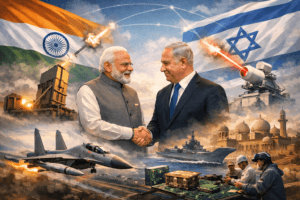
Beyond Buyer-Seller: The Deep Tech Pivot Reshaping India-Israel Defence Ties
When the wheels of Indian Prime Minister Narendra Modi’s aircraft touched down in Tel Aviv, it marked more than just a diplomatic visit; it signified the culmination of a relationship that has quietly matured from a clandestine affair into one of the most robust strategic partnerships of the 21st century. The headlines surrounding the visit buzzed with talk of “landmark defence agreements,” but the real story is not about the hardware that might change hands. It is about a fundamental shift in trust.
For decades, the India-Israel defence relationship was transactional—a discreet exchange of money for immediate military needs. But as PM Modi stood before the Knesset, Israel’s parliament, and spoke of a “strong defence partnership between trusted partners” in an uncertain world, he was codifying a new era. This era is not about buying weapons; it is about building them together. It is a pivot from being a customer to becoming a co-developer, a shift that grants India access to a level of technology Israel has rarely shared.
The Architecture of Deterrence: Forging the “Sudarshan Chakra”
To understand the significance of this moment, one must look at the map of India. With over 15,000 kilometers of land border and 7,500 kilometers of coastline, India faces a multi-spectrum threat. The memory of the aerial duel with Pakistan in May 2019, where swarms of Turkish drones and long-range missiles probed Indian defenses, is still fresh in the minds of strategists in New Delhi. It was a wake-up call that exposed the vulnerabilities of a nation trying to secure its vast periphery with finite resources.
The current Indian air defense umbrella—comprising the Russian S-400 Triumf, the indigenous Akash system, and the Israeli Barak series—is formidable, but it is not seamless. This is where the Israeli “arsenal” comes into play. The discussions in Tel Aviv reportedly center on creating an “impregnable shield,” a concept India refers to as the “Sudarshan Chakra”—a multi-layered, pan-Indian defense grid by 2035.
This shield requires layers that the existing systems cannot fully provide. The lowest, most vulnerable layer—the threat from drones, rockets, and mortars—is where Israel has revolutionized modern warfare. The potential acquisition of the Iron Dome and the revolutionary Iron Beam represents a generational leap in defensive thinking.
The Economics of Light: Why Iron Beam Changes the Game
While the Iron Dome has proven its mettle in combat, intercepting rockets with expensive missiles (Tamir interceptors) has always been a game of economic attrition. If a $100,000 missile takes down a $500 drone, the defender eventually loses the financial war.
This is where the Iron Beam—a 100-kilowatt-class laser weapon system—enters the conversation. It is not just a weapon; it is an economic solution to a modern problem. At an estimated cost of just $2 per shot, Iron Beam represents the democratization of air defense. It can fry drones, mortars, and rockets out of the sky at the speed of light, offering an almost infinite magazine as long as it has power.
For India, which faces potential swarm-drone attacks on its military bases in Ladakh or terror attacks on its cities, Iron Beam offers a cost-effective, psychological deterrent. Integrating such a system into the Indian grid would not just bolster defense; it would send a message that the economics of aggression no longer favor the aggressor. The fact that India is pushing for technology transfer to manufacture such systems under the ‘Make in India’ initiative suggests that New Delhi wants to move from being a consumer of protection to a manufacturer of deterrence.
The Long Arm of Retribution: Offensive Capabilities and Strategic Depth
But defense is only one side of the coin. A nation that cannot retaliate with devastating force is merely a fortress waiting to be starved. The second dimension of the MoU reportedly focuses on offensive collaboration, arming India with weapons designed to penetrate the deepest and most hardened of enemy assets.
Among the systems discussed, the Golden Horizon stands out. Described as a successor to the Sparrow missile family, this is a rare class of weapon. With a range of up to 2,000 km and speeds reaching Mach 5, it blurs the line between a cruise missile and a ballistic missile. For the Indian Air Force (IAF), integrating this with the Sukhoi-30MKI fleet would provide a stand-off capability that is currently unmatched in the region.
The strategic value of a Mach 5 missile lies not just in its speed, but in its impossibility. At such hypersonic velocities, reaction times for enemy air defenses shrink to near zero. The kinetic energy of the impact alone is enough to destroy underground bunkers and nuclear facilities without requiring a massive warhead. For India, which adheres to a “No First Use” nuclear policy but maintains a credible minimum deterrence, systems like Golden Horizon provide the conventional punch needed to respond to serious provocations without immediately escalating to the nuclear threshold.
Similarly, missiles like the Air LORA (Loitering Munition) and the Rampage air-to-ground missile offer the IAF the ability to strike deep into enemy territory from stand-off ranges, keeping pilots and high-value aircraft out of the danger zone of integrated air defense systems. This is the kind of “deep strike” capability that transforms a tactical air force into a strategic force.
The Geopolitical Web: India in the “Hexagon of Alliances”
Perhaps the most profound development to emerge from this visit was not a weapon system, but a statement. Israeli Prime Minister Benjamin Netanyahu’s vision of a “hexagon of alliances”—bringing together India, Israel, the moderate Arab nations, Greece, Cyprus, and African nations—is a radical reimagining of Middle Eastern and South Asian geopolitics.
For decades, India walked a tightrope in the Middle East. It could not fully embrace Israel for fear of alienating its traditional allies in the Arab world and its domestic Muslim populace. That tightrope has now become a superhighway. The Abraham Accords have normalized relations between Israel and the UAE and Bahrain. India has deepened its ties with the UAE (signed a Comprehensive Economic Partnership Agreement) and Saudi Arabia.
Netanyahu’s hexagon is an attempt to formalize a “security alliance of the pragmatic.” It is a coalition explicitly designed to counter what he termed “the radical axes” of Islam, particularly the expansionist ideology of the Iranian regime.
For India, joining such a coalition—even informally—is a massive strategic win.
- Intelligence Sharing: It opens the door for trilateral intelligence sharing between India, Israel, and pro-West Gulf nations regarding terror financing and radical networks that often target India.
- Naval Cooperation: The inclusion of Greece and Cyprus in the eastern Mediterranean, linked with India via the Red Sea and the Arabian Sea, creates a maritime chain of stability. It allows for joint naval exercises to protect critical shipping lanes—a vital interest for India, given its dependence on Gulf oil.
- Countering Pakistan: It strategically isolates Pakistan, which has historically relied on its “strategic depth” in the Islamic world (including ties with Iran and Turkey). If India is sitting at the table with the “moderate” Arab powers and Israel, Pakistan’s influence in the region is significantly diluted.
The “Make in India” Imperative: Beyond Technology Transfer
The underlying thread in all these discussions is the insistence on technology transfer. India is no longer interested in being a dumping ground for foreign arms. The Defence Acquisition Council’s push for indigenous manufacturing means that any deal with Israel must include provisions for Indian industry.
This is where the partnership becomes truly symbiotic. Israel is a small country with brilliant research and development (R&D) but limited manufacturing capacity and a small domestic market. India offers a massive market, vast manufacturing capabilities, and the strategic depth of a major power.
By co-developing systems like the Iron Beam or the Golden Horizon in India, Israel gets a production partner that can scale up manufacturing to volumes impossible in Israel, driving down costs for both nations. India, in turn, gets the crown jewels of Israeli technology—algorithms, seeker technologies, and propulsion systems—that it can then integrate into its own platforms.
This collaboration transforms the relationship from a temporary marriage of convenience to a permanent industrial complex. Once an Indian company learns how to build a Rafael missile or an IAI radar component, the knowledge stays in India, fostering future innovation.
A Bond Forged in Asymmetry
The relationship between India and Israel is unique. It is a partnership between two ancient civilizations that found their modern footing in the tragedy of the 20th century—one born from the horrors of the Holocaust, the other from the violence of Partition. Both nations have spent their existence fighting wars of survival against hostile neighbors.
This shared experience of being the “other” in their respective neighborhoods has forged a bond that goes beyond geopolitics. It is a visceral understanding of the need for self-reliance and the necessity of overwhelming force to ensure peace.
As PM Modi and PM Netanyahu shake hands, the documents they sign will detail missile ranges and laser wattages. But the real agreement is unspoken: a mutual commitment to ensuring that the radical forces that threaten one nation will never feel safe from the combined ingenuity of the other. This is not just a defence deal; it is the blueprint for a new axis of resilience stretching from the shores of the Mediterranean to the peaks of the Himalayas.
You must be logged in to post a comment.