
Beyond Borders: What the US Supreme Court’s Tariff Verdict Teaches India About Constitutional Guardianship
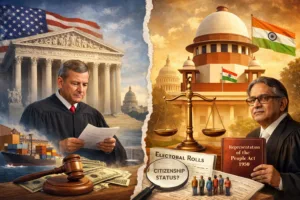
Beyond Borders: What the US Supreme Court’s Tariff Verdict Teaches India About Constitutional Guardianship
A Tale of Two Courts, One Constitutional Crisis
On a chilly February morning in Washington D.C., Chief Justice John Roberts read aloud a decision that would send shockwaves through the political establishment: President Donald Trump’s ambitious tariff regime, imposed on allies and adversaries alike, stood unconstitutional. The 6-3 verdict wasn’t merely about trade policy—it was a resounding declaration that even the most powerful office in the land remains subordinate to the Constitution’s original design.
Six thousand miles away, in the bustling corridors of India’s Supreme Court, a different kind of constitutional drama unfolds. For months, the court has deliberated on the Special Intensive Revision (SIR) of electoral rolls—a process that critics argue fundamentally alters the democratic fabric without explicit parliamentary sanction. The contrast between how these two supreme courts approach executive overreach offers profound lessons for India’s constitutional democracy.
The American Precedent: When the Court Said “No” to Executive Power
To understand why the SCOTUS verdict resonates far beyond American shores, we must first grasp what made it extraordinary. President Trump didn’t merely impose routine tariffs; he invoked the International Emergency Economic Powers Act (IEEPA) of 1977—a Cold War-era statute designed to give presidents flexibility during genuine national security crises. The justification? Drug trafficking from Canada, Mexico, and China, combined with persistent trade deficits that Trump argued threatened American manufacturing.
But here’s where history intervenes: no previous American president had ever used IEEPA to impose tariffs. Not during the Iran hostage crisis. Not after 9/11. Not during the 2008 financial meltdown. The absence of historical precedent became a crucial indicator that something fundamental had shifted in how executive power was being conceptualized.
Chief Justice Roberts’ majority opinion cut to the constitutional heart of the matter. The Constitution explicitly grants Congress the power to “lay and collect Taxes, Duties, Imposts and Excises.” This wasn’t some obscure clause—it represented the framers’ deliberate choice to place taxing authority in the people’s representatives, not in a single executive. The Court recognized that allowing the president to impose tariffs “unbounded in scope, amount and duration” would effectively rewrite the constitutional separation of powers without going through the amendment process.
Perhaps most striking was the Court’s rejection of the emergency justification. The United States wasn’t at war with Canada or Mexico. Trade deficits, however concerning, didn’t constitute the kind of existential threat that might justify unilateral executive action. By drawing this line, the Court reminded us that emergencies cannot become permanent excuses for constitutional shortcuts.
The Indian Context: Electoral Rolls and Constitutional Questions
Now shift focus to India, where the Election Commission’s Special Intensive Revision process has sparked a constitutional debate of comparable magnitude. The SIR, as it’s commonly known, involves a comprehensive revision of electoral rolls across multiple states—a process that determines who gets to exercise the franchise in the world’s largest democracy.
The Election Commission defends its authority by citing Article 327 of the Constitution, which empowers Parliament to make laws regarding electoral roll preparation. But here’s the critical distinction the American case illuminates: the enabling legislation matters. The Representation of People Act, 1950, which operationalizes constitutional provisions, specifically limits revision of electoral rolls to “a constituency or part thereof.” It nowhere authorizes the sweeping, multi-state revisions that characterize the current SIR.
This isn’t a mere technicality. When administrative agencies exceed their statutory mandate, they don’t just violate a law—they fundamentally alter the relationship between citizens and their representatives. Every name added or removed from electoral rolls carries implications for political representation, resource allocation, and ultimately, the democratic character of the nation.
The Citizenship Question: Where Executive Power Meets Constitutional Limits
Perhaps the most contentious aspect of the SIR debate involves the Election Commission’s claim that it can examine citizenship status while preparing or revising electoral rolls. This assertion stands on shaky constitutional ground, contradicted by multiple Supreme Court judgments that have carefully delineated the boundaries between electoral administration and citizenship determination.
The Foreigners Act, 1949, and the Citizenship Act, 1955, establish specific procedures for determining citizenship—procedures that involve judicial magistrates, not election officials. When the Election Commission attempts to merge these distinct functions, it doesn’t merely overreach; it potentially deprives individuals of procedural safeguards built into citizenship determination.
The American case offers a powerful parallel. Just as President Trump couldn’t use emergency powers to bypass Congress’s constitutional role in taxation, the Election Commission cannot use administrative convenience to bypass Parliament’s legislative framework for citizenship. Constitutional powers aren’t fungible—they come with specific purposes and limitations that cannot be traded or reimagined through creative interpretation.
The Silence That Speaks Volumes: India’s Judicial Restraint
Here’s where the comparison becomes uncomfortable for those watching India’s constitutional landscape. The US Supreme Court acted with remarkable speed, recognizing that continued uncertainty around tariff policy created economic instability and constitutional ambiguity. Within months of the challenge being filed, the Court rendered its verdict, providing clarity and reaffirming constitutional boundaries.
India’s Supreme Court, by contrast, has allowed the SIR process to continue while reserving judgment on its constitutional validity. The Court has issued directions for palliative measures—procedural adjustments that might make the process marginally fairer—without addressing the fundamental question: does the Election Commission possess the authority to conduct such revisions at all?
This incremental approach carries significant risks. As the SIR process advances, it creates facts on the ground. Electoral rolls get revised. Names are added or removed. Political calculations shift. By the time the Court finally addresses the constitutional question, the practical consequences may be irreversible regardless of the legal outcome.
The Deeper Lesson: Self-Correcting Constitutional Mechanisms
The American verdict’s greatest contribution to constitutional discourse lies in its affirmation of what scholars call “self-correcting mechanisms.” Constitutional systems don’t maintain themselves—they require institutional actors willing to enforce boundaries even when doing so proves politically inconvenient or institutionally uncomfortable.
The US Supreme Court understood that allowing the tariff regime to stand would establish a dangerous precedent: that presidents could manufacture emergencies to justify power grabs, that Congress’s enumerated powers meant little if a determined executive could find statutory loopholes, and that constitutional silence in one era could be interpreted as constitutional license in another.
India faces a similar moment of choice. The constitutional question surrounding SIR isn’t merely about electoral rolls—it’s about whether statutory limits bind administrative agencies, whether parliamentary enactments mean what they say, and whether the Supreme Court will intervene before constitutional violations become irreversible rather than after.
Historical Amnesia and Constitutional Memory
One aspect of the American decision deserves particular attention: the Court’s emphasis on historical practice. The fact that no previous president had used IEEPA for tariffs wasn’t treated as coincidence but as evidence of constitutional understanding. Generations of presidents, from both parties, had read the statute differently—and that collective interpretation carried constitutional weight.
India’s constitutional history offers similar guidance. The Representation of People Act has governed elections for over seven decades. Throughout this period, electoral roll revisions followed established patterns. If the current SIR represents a radical departure from historical practice, that departure itself warrants constitutional scrutiny. Why now? Why in this manner? What has changed to justify reinterpretation?
These questions become particularly urgent when the departure affects vulnerable populations. Critics have raised concerns that the SIR disproportionately impacts marginalized communities, religious minorities, and linguistic minorities—precisely the groups the Constitution seeks to protect through its commitment to secularism and equality.
The Political Context: When Executive Power Meets Electoral Politics
No discussion of either case would be complete without acknowledging the political dimensions. President Trump’s tariffs enjoyed significant support among certain constituencies who believed aggressive trade policies would protect American jobs. The Supreme Court wasn’t deaf to these concerns—it simply insisted that policy preferences must be pursued through constitutional means.
Similarly, the SIR process occurs against a backdrop of intense political competition. Different parties have staked out opposing positions, with some defending the Election Commission’s actions and others challenging them as politically motivated. The Court cannot ignore this context, but neither can it allow political convenience to determine constitutional interpretation.
The American experience suggests that courts serve democracy best when they remain focused on constitutional structure rather than policy outcomes. The question isn’t whether tariffs are wise or foolish, whether electoral roll revisions help one party or another. The question is whether the institution taking action possesses constitutional authority to do so.
What India Can Learn: Procedural vs. Substantive Review
The US Supreme Court’s approach offers a model of what constitutional adjudication looks like when focused on structure rather than outcome. The Court didn’t examine whether Trump’s tariffs were economically sound or whether they achieved their stated objectives. It examined whether the president possessed constitutional authority to impose them—and concluded he did not.
This structural approach has profound implications for India’s SIR review. The Supreme Court need not determine whether particular electoral roll entries are correct or whether the Election Commission has exercised its discretion wisely. The fundamental question is simpler and more profound: does the Representation of People Act authorize the SIR as currently conceived?
If the answer is no, the constitutional inquiry ends there. Good intentions cannot substitute for statutory authority. Administrative convenience cannot override legislative limits. The Election Commission’s expertise in conducting elections doesn’t automatically translate into authority to expand its statutory mandate.
The Cost of Delay: Constitutional Uncertainty as Its Own Injury
Perhaps the most urgent lesson from the American case involves timing. The US Supreme Court recognized that constitutional uncertainty imposes its own costs—on businesses making investment decisions, on trading partners planning their economic futures, on citizens trying to understand the rules governing their relationship with government.
India’s prolonged consideration of the SIR’s constitutionality creates similar costs. Election officials must implement a process whose validity remains uncertain. Political parties must organize around electoral rolls that may or may not survive judicial scrutiny. Citizens must navigate a system whose fundamental legality remains unresolved.
This uncertainty particularly harms those with fewer resources to navigate complexity. Wealthy and connected individuals can adapt to changing rules; marginalized communities often cannot. When the Supreme Court allows a constitutionally questionable process to continue while reserving judgment, it effectively places the burden of uncertainty on those least able to bear it.
Beyond Comparison: India’s Unique Constitutional Challenges
While the American case offers valuable lessons, India’s constitutional landscape presents unique features that require distinct consideration. India’s parliamentary system differs fundamentally from America’s presidential structure. India’s commitment to secularism and social justice imposes obligations unknown to American constitutional law. India’s history of emergency rule and authoritarian temptation creates sensitivities that American courts need not navigate.
Yet these differences ultimately reinforce rather than diminish the American case’s relevance. If anything, India’s constitutional commitments demand even greater vigilance against executive overreach. When the Election Commission exceeds its statutory authority, it doesn’t merely violate administrative law—it potentially undermines the carefully constructed framework that ensures fair representation for India’s diverse population.
The Constitution’s framers, like their American counterparts, understood that power attracts power. They created institutions with specific roles, expecting each to operate within defined boundaries. When those boundaries blur, the entire constitutional architecture faces strain.
The Path Forward: Constitutional Adjudication as Democratic Preservation
As India’s Supreme Court continues its deliberation, it carries responsibility not merely for resolving a legal dispute but for affirming constitutional government itself. The SIR question, like the American tariff question, ultimately asks whether statutory limits bind administrative agencies or whether creative interpretation can circumvent legislative intent.
The answer matters far beyond the immediate case. If administrative agencies can reinterpret their statutory authority without judicial intervention, parliamentary democracy loses meaning. If constitutional provisions can be circumvented through procedural creativity, the entire constitutional project faces jeopardy.
The American experience offers hope as well as warning. The US Supreme Court demonstrated that constitutional limits remain enforceable even against a determined executive with significant popular support. The Court showed that institutional courage can overcome political pressure, that constitutional text matters more than administrative convenience, and that democracy requires courts willing to say “no” even when saying “yes” would be easier.
Conclusion: The Constitution as Living Limit, Not Living License
Constitutional democracies face a perpetual challenge: maintaining fidelity to founding documents while adapting to changing circumstances. The American framers, like India’s constitution-makers, understood that constitutions must evolve—but evolution differs from erosion. Change requires amendment, not reinterpretation that stretches language beyond recognition.
The US Supreme Court’s tariff verdict reminds us that constitutions impose limits as well as confer powers. The IEEPA gave presidents emergency authority, but that authority had boundaries—boundaries defined by constitutional structure, historical practice, and statutory text. When President Trump attempted to stretch those boundaries beyond recognition, the Court intervened.
India’s Supreme Court now faces a comparable moment. The Election Commission possesses significant authority under the Representation of People Act, but that authority has limits—limits defined by the Act’s text, by historical practice, and by Parliament’s legislative choices. When the Commission attempts to stretch those limits through the SIR process, the Court must decide whether to intervene before constitutional damage occurs or to allow the process to continue while reserving judgment for later.
The choice will tell us much about India’s constitutional future. Will the Court follow the American example, intervening decisively to enforce constitutional boundaries? Or will it permit administrative creativity to reshape electoral democracy without explicit parliamentary authorization?
The answer lies not in legal technicalities but in constitutional vision. Courts that understand themselves as guardians of democratic structure act differently from courts that see themselves as dispute resolvers among competing interests. The US Supreme Court, whatever its flaws, remembered its guardian role in the tariff case. India’s Supreme Court now faces its own guardian moment—and the nation watches to see how it will respond.
You must be logged in to post a comment.