
Beyond Borders: How an Indo-Egyptian Pharma Alliance Could Reshape Healthcare Access in the MENA Region
In a strategic move poised to reshape regional healthcare access, a high-level Indian delegation led by Pharmexcil’s Raja Bhanu and Ambassador Suresh K. Reddy engaged with Egyptian stakeholders to forge a deepened pharmaceutical alliance, moving beyond simple trade to establish a model of South-South cooperation where India’s globally recognized expertise in producing affordable generics, biosimilars, and vaccines converges with Egypt’s ambitions to expand its domestic healthcare coverage and become a manufacturing hub for the MENA region.
This collaboration, focusing on technology transfer, joint ventures, and capacity-building, aims to leverage Egyptian strategic location and growing market to localize production, thereby reducing import dependency, lowering medicine costs, and improving treatment accessibility for millions, while simultaneously positioning India as a key partner in Egypt’s economic vision and securing its own gateway to a critical regional market through shared expertise and mutual growth.
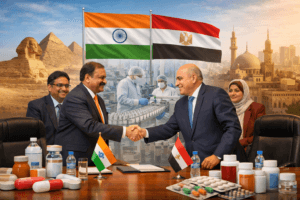
Beyond Borders: How an Indo-Egyptian Pharma Alliance Could Reshape Healthcare Access in the MENA Region
In a meeting that symbolizes a significant geopolitical and economic alignment, a high-powered Indian delegation recently concluded pivotal talks in Cairo. Led by Raja Bhanu of Pharmexcil and Ambassador Shri Suresh K. Reddy, the discussions aimed to weave the threads of India’s pharmaceutical prowess with Egypt’s ambitious healthcare vision. This isn’t merely a trade meeting; it’s a strategic gambit with the potential to alter the landscape of medicine production and accessibility for millions across the Middle East and Africa.
The Strategic Convergence: Why Now?
The timing of this reinforced collaboration is critical. Egypt, grappling with economic pressures and a population nearing 106 million, is on a determined path to expand universal healthcare coverage and reduce its hefty bill for imported medicines. Simultaneously, it seeks to cement its position as a strategic industrial and logistical hub for the MENA region. Enter India, the “Pharmacy of the World,” whose expertise in producing high-quality, affordable generic medicines, vaccines, and biosimilars is unmatched. For India, deepening ties with Egypt opens a gateway to a massive regional market, diversifying its export destinations and strengthening its diplomatic footprint in a strategically vital nation.
This partnership moves beyond simple buyer-seller dynamics. As Ambassador Reddy pointedly noted, the goal is collaboration that benefits “the wider MENA region.” This statement underscores a shared vision: transforming Egypt into a regional pharmaceutical powerhouse, supplied and supported by Indian technology and scale.
India’s Offering: More Than Just Medicines
India’s strength lies in a formidable trifecta: scale, skill, and cost-effectiveness. Having perfected the art and science of generic drug manufacturing, Indian pharma companies supply over 50% of Africa’s generic medicine needs. But the delegation’s focus on biosimilars and vaccines signals a move up the value chain. Biosimilars—complex, near-identical versions of expensive biologic drugs—are crucial for treating chronic conditions like cancer and diabetes at a fraction of the cost. Indian firms are global leaders in this nascent field.
The proposed technology transfer and joint ventures are the cornerstone of this deal. It’s not just about shipping finished products; it’s about transplanting knowledge. Egyptian companies stand to gain expertise in advanced manufacturing processes, quality control paradigms that meet stringent international standards, and R&D methodologies. This builds local capacity, creates skilled jobs, and fosters long-term industrial resilience.
Egypt’s Aspiration: From Market to Manufacturing Hub
Egypt’s pharmaceutical market, projected to grow to $5.7bn, is attractive, but its real value lies in its potential as a springboard for regional distribution. With its strategic location, existing free trade agreements with Arab and African blocs, and a government pushing for import substitution, Egypt is an ideal site for localized production.
For Egypt, partnering with India mitigates the risks and accelerates the timeline of developing its own pharma sector. Instead of decades of independent trial and error, Egyptian firms can leverage proven Indian models. This collaboration directly supports national goals like the “100 Million Healthy Lives” initiative and broader economic vision plans focused on local manufacturing. The aim is to eventually export “Made in Egypt” medicines, with Indian collaboration, to neighboring markets, ensuring supply chain security and currency conservation.
The Human Impact: Bridging the Healthcare Gap
The real-world implications of this collaboration are profound. The MENA region faces a dual burden of disease: persistent infectious challenges alongside a rapid rise in non-communicable diseases like heart conditions and diabetes. Access to affordable treatment remains a critical barrier.
By establishing joint production facilities for generics and biosimilars in Egypt, the two nations can dramatically lower the cost and increase the availability of essential medicines. A biosimilar produced in Egypt via Indian partnership could bring life-saving cancer therapy within reach for thousands of families who currently have no options. This model of “affordable innovation” is India’s key export and Egypt’s most pressing need.
Furthermore, collaboration in clinical research can be transformative. Egypt’s large, diverse patient population offers a robust base for trials. Combined with Indian expertise in conducting cost-effective, compliant clinical studies, this could accelerate the development of new drugs and therapies suited to regional health profiles, moving both countries from mere manufacturers to innovators.
Navigating the Road Ahead: Challenges and Opportunities
While the synergy is clear, success is not automatic. Challenges include:
- Regulatory Harmonization: Aligning Egyptian regulations with international norms (and India’s experience with stringent regulators like the US FDA) will be crucial for product quality and export potential.
- Intellectual Property: Navigating IP frameworks in joint ventures, especially for biosimilars, requires careful, transparent agreements.
- Infrastructure & Investment: Sustained investment in manufacturing infrastructure and the cold-chain logistics needed for vaccines and biologics is essential.
The delegation’s visit, culminating in new initiatives for investment and knowledge exchange, is a strong first step. Continuous dialogue between Pharmexcil, the Indian Embassy, and Egyptian industry bodies will be the glue that holds this partnership together.
A Model for South-South Cooperation
Ultimately, the India-Egypt pharmaceutical partnership stands as a textbook case of impactful South-South cooperation. It is a relationship built on mutual need and complementary strengths rather than donor-recipient dynamics. India provides the technical prowess and economies of scale; Egypt provides the strategic location, market access, and regional ambition.
If successfully implemented, this alliance will do more than boost trade figures. It will enhance healthcare sovereignty, build regional resilience against health crises, and most importantly, make the fundamental right to medicine a tangible reality for a broader swath of the Arab world and Africa. In the complex calculus of global health, this collaboration proves that the most sustainable solutions often arise from shared challenges and mutual respect between emerging powers. The seeds planted in Cairo this week promise a harvest of health, growth, and strategic partnership for years to come.
You must be logged in to post a comment.