
Beyond Billions: How India’s Climate Finance Taxonomy is Forging a New Global Blueprint
Prime Minister Narendra Modi’s endorsement of an article on India’s draft Climate Finance Taxonomy signals a strategic shift in the nation’s role from a supplicant in global climate negotiations to a pragmatic architect of its future. By developing a standardized classification system—or taxonomy—for what constitutes “green” investment, India is addressing the core problems of transparency and inefficiency that plague global climate finance, such as investor confusion and greenwashing.
This homegrown framework, tailored to India’s needs for a just energy transition and climate adaptation, not only aims to discipline its own burgeoning green finance market but also positions the country to export this model as a blueprint for the developing world, thereby reshaping the global financial architecture with common standards and genuine leadership.
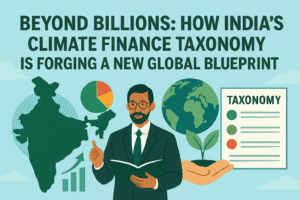
Beyond Billions: How India’s Climate Finance Taxonomy is Forging a New Global Blueprint
Meta Description: Discover how India’s draft Climate Finance Taxonomy moves beyond mere funding to create a transparent, common language for green investment, positioning the nation as a pragmatic leader in the global climate arena.
The Global Climate Finance Conundrum: A Trillion-Dollar Problem
For decades, the conversation around global climate action has been haunted by a persistent, multi-trillion-dollar ghost: climate finance. Developed nations have pledged, debated, and often delayed the mobilization of $100 billion annually to help developing nations mitigate and adapt to climate change. Yet, even when funds are promised, a more insidious problem lurks beneath the surface: a cacophony of definitions, a lack of transparency, and the ever-present risk of “greenwashing.”
Into this fractured landscape steps a potential game-changer, not with a grand political declaration, but with a pragmatic, technical document. The recent endorsement by Prime Minister Narendra Modi of Union Minister Bhupender Yadav’s article is more than a routine social media share. It is a strategic signal that India is no longer just a claimant in the climate finance dialogue but is poised to become its architect.
India’s draft Climate Finance Taxonomy and its burgeoning domestic green finance ecosystem represent a quiet revolution. This isn’t just about attracting more money; it’s about rebuilding the entire plumbing of the global financial system to ensure that every dollar invested genuinely counts toward a sustainable future.
The “Tower of Babel” in Green Finance: Why We Need a Common Dictionary
Imagine a world where every country defined a “car” differently. One nation might define it as a four-wheeled vehicle, another as a gasoline-powered machine, and a third as anything with a steering wheel. Trade, regulation, and innovation would descend into chaos. This is precisely the state of global climate finance today.
Without a unified taxonomy, we face a “Tower of Babel” problem:
- Investor Confusion: An investment fund labeled “green” in one country might fund a highly efficient coal plant, while in another, it might be restricted to only solar and wind projects. This ambiguity erodes investor confidence and slows down capital flow.
- Greenwashing Proliferation: Companies can easily label projects as “environmentally friendly” without any standardized, verifiable criteria, misleading investors and the public.
- Inefficient Allocation: Scarce financial resources may flow to projects that are only marginally green, while truly transformative technologies in areas like green hydrogen, sustainable agriculture, or circular economy models struggle for funding.
The European Union has its own taxonomy, China has developed one, and several other nations are following suit. However, these are often tailored to their specific economic structures and energy transitions. The danger is a fragmented global system with competing standards. India’s draft taxonomy enters this arena not as another competitor, but as a potential bridge and a model for the developing world.
Decoding India’s Draft Taxonomy: Pragmatism Over Polemics
So, what makes India’s approach so significant? It lies in its foundational principles, which reflect the complex realities of a rapidly growing economy with immense developmental needs.
- A “Traffic Light” System for Clarity:Unlike a binary green/not-green model, India’s taxonomy is expected to employ a more nuanced system. It is likely to categorize economic activities as:
- Green (Dark Green): Activities that make a substantial contribution to climate goals (e.g., solar energy, afforestation).
- Amber (Light Green): Transitional activities that are not fully sustainable but are significantly cleaner than the industry average and are essential for the transition (e.g., highly efficient natural gas plants, cleaner cement production).
- Red: Activities that are harmful and need to be phased out (e.g., new coal plants without carbon capture).
This “traffic light” system is crucial. It acknowledges that the path to net-zero is a journey, not a flip of a switch. It allows capital to flow towards activities that are making genuine improvements, even if they are not perfectly green yet, preventing economic dislocation.
- Aligning with National Priorities:India’s taxonomy is being designed for India’s context. It will likely prioritize:
- Energy Security: Recognizing the role of transitional fuels while aggressively scaling renewables.
- Climate Adaptation: A critical area often overlooked in finance. Activities related to water resource management, climate-resilient agriculture, and disaster management could be classified as green, directing vital funds to help vulnerable communities.
- Just Transition: Ensuring that the shift away from fossil fuels does not devastate local economies and livelihoods, potentially classifying retraining and economic diversification projects as eligible for green finance.
The Ripple Effect: From Domestic Discipline to Global Leadership
The creation of a robust domestic taxonomy is not an inward-looking exercise. It has profound external implications, positioning India for a new kind of global leadership.
- Building a Trustworthy Domestic Green Market:The taxonomy provides the bedrock for India’s own green finance revolution. It enables:
- Credible Green Bonds: Both sovereign and corporate green bonds can be issued with clear, verifiable definitions, boosting their appeal to international investors wary of greenwashing.
- Banking Sector Alignment: The Reserve Bank of India can use the taxonomy to guide priority sector lending, incentivizing banks to fund genuinely green projects.
- Corporate Accountability: Listed companies can be mandated to report their green revenues and expenditures against the taxonomy, bringing unparalleled transparency to their ESG (Environmental, Social, and Governance) claims.
- Shaping the Global “Rules of the Game”:When India, the world’s most populous nation and a representative of the global South, develops a sophisticated taxonomy, it gains a powerful seat at the international negotiating table. It can argue for its principles to be incorporated into the frameworks of organizations like the G20, the International Sustainability Standards Board (ISSB), and the UNFCCC.
As Prime Minister Modi highlighted, this is about “pragmatic leadership.” India is demonstrating that it is not just asking for finance but is also creating the transparent, efficient, and trustworthy system necessary to absorb and deploy that finance effectively. It shifts the narrative from “you must pay” to “here is how we can all do this better, together.”
The Road Ahead: Challenges and the Call for Collaboration
The path forward is not without its challenges. Finalizing the taxonomy will require navigating intense lobbying from various industries. Ensuring rigorous, independent verification to prevent misuse will be critical. Furthermore, achieving interoperability with the EU’s and other taxonomies is a complex technical task to avoid creating new trade barriers.
However, the signal from the highest level of the Indian government is clear. This is a strategic priority. By championing this initiative, India is offering a blueprint for a future where climate finance is no longer a source of friction but a well-oiled engine for global transformation.
The article shared by the Prime Minister is a declaration that India is ready to move from the sidelines to the center of this critical conversation. It’s a recognition that in the 21st century, leadership is not just about economic or military might; it’s about the power to set the standards, define the terms, and build the frameworks that will shape our collective future on this planet. In the complex algebra of climate action, India is now writing a key part of the formula.
You must be logged in to post a comment.