
Beyond Assembly Lines: How Tata & JLR’s Tamil Nadu Gambit Redefines India’s Automotive Ambition
Tata Motors and Jaguar Land Rover’s inauguration of a new greenfield facility in Panapakkam, Tamil Nadu, represents a strategic evolution from merely assembling luxury vehicles for the domestic market to establishing India as a sophisticated global hub for premium and electric vehicle manufacturing. Backed by a phased ₹9,000 crore investment and aiming for a capacity of 2.5 lakh units, the plant is a dual-purpose springboard designed to cater to India’s rapidly growing luxury demand while also serving as a resilient export base for JLR’s global portfolio, including future electric models. This move strategically de-risks JLR’s supply chain, leverages the Tata Group’s local expertise, and signals a maturation of India’s “Make in India” initiative by fostering a high-value supplier ecosystem, generating skilled employment, and enabling a critical transfer of advanced EV and manufacturing technology—ultimately positioning India not just as a volume market, but as a competitive player in the high-stakes global automotive landscape.
Beyond Assembly Lines: How Tata & JLR’s Tamil Nadu Gambit Redefines India’s Automotive Ambition
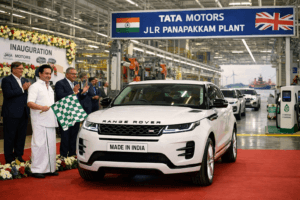
The ceremonial flag-off of a gleaming Range Rover Evoque in Panapakkam, a locality 80km from Chennai, this week was more than just another plant inauguration. It was a strategic declaration, a tangible pivot in India’s journey from a volume-driven auto market to a sophisticated global hub for premium and electric vehicle manufacturing. The new greenfield facility, inaugurated by Tamil Nadu Chief Minister M. K. Stalin and backed by Tata Motors’ phased ₹9,000 crore commitment, marks a decisive leap for both Tata Motors Passenger Vehicles and its storied British subsidiary, Jaguar Land Rover (JLR).
This move is not merely about shifting assembly kits from Pune to Panapakkam. It is a complex chess move on the global automotive board, with implications for supply chains, job creation, technological assimilation, and India’s brand as a manufacturing destination.
The Strategic Underpinnings: More Than Just Geography
For years, JLR’s Indian presence was confined to the assembly of Completely Knocked-Down (CKD) kits at Tata’s Pune plant. This was a market-entry strategy—a way to mitigate import duties and make these luxury brands more accessible to India’s growing affluent class. The Panapakkam plant signifies an evolution from assembly for India to manufacturing from India.
- De-risking the Global Supply Chain:The post-pandemic and geopolitical landscape has brutally exposed the fragilities of concentrated, just-in-time supply chains. Automakers worldwide are seeking diversification and resilience. India, with its stable democracy, vast engineering talent pool, and improving infrastructure, presents a compelling “China-plus-one” alternative. For JLR, having a state-of-the-art, scalable manufacturing base in India, supported by the deep-pocketed Tata Group, is a strategic hedge against global uncertainties. It allows for a more balanced production footprint beyond the UK, Slovakia, and China.
- Tapping a Dual-Market Springboard:The plant’s mandate is clear: cater to both domestic and global markets. India’s luxury vehicle market, though small as a percentage of total sales, is among the world’s fastest-growing. As Richard Molyneux, JLR’s CFO, noted, the ambition to grow brands like Jaguar, Range Rover, and Defender in India is “very strong.” A local manufacturing base enables better price management, faster model updates, and sharper customer responsiveness.
Simultaneously, this facility is poised to become a key export hub. With plans to scale to 250,000 units over 5-7 years—a number that far exceeds current Indian luxury demand—the vision is inherently global. Expect right-hand-drive models for markets like the UK, Japan, and Australia, and potentially left-hand-drive vehicles for regions like the Middle East and Africa, to roll out from Tamil Nadu, leveraging India’s competitive cost structures.
- The Electric Imperative:The announcement explicitly includes electric models for both Tata and JLR. This is perhaps the most critical insight. Tata Motors, with its successful Nexon EV and upcoming Avinya platform, is a domestic EV leader. JLR is in the midst of a dramatic “Reimagine” electrification strategy. By building a “fresh” facility, as Tata Sons Chairman N. Chandrasekaran stated, they are baking in flexibility for new EV architectures and battery assembly from the ground up. This co-location fosters an unparalleled cross-pollination of EV knowledge—JLR’s advanced propulsion and luxury vehicle integration expertise meeting Tata’s deep understanding of cost-optimized, ruggedized engineering for emerging markets.
The Ripple Effect: Ecosystem, Employment, and Elevation
The investment of ₹9,000 crore is a magnet that will attract far more capital. The projected 5,000 direct and indirect jobs are just the beginning.
- Supplier Ecosystem Transformation: Premium vehicle manufacturing demands a higher quality threshold. The development of a “strong local supplier ecosystem” means Indian auto-component makers will need to level up to meet global luxury and safety standards. This will pull the entire ancillary industry up the value chain, creating a cluster of excellence around Chennai (already dubbed the “Detroit of India”). Suppliers who qualify for JLR’s global supply chain will gain credentials to serve other international OEMs.
- Skill Development: Manufacturing vehicles like the Range Rover requires advanced robotics, precision engineering, and sophisticated quality control. The workforce trained at Panapakkam will possess skills transferable across advanced manufacturing sectors, contributing to a permanent uplift in the region’s human capital.
- Infrastructure and Logistics Boost: Such a large-scale export-oriented operation will necessitate upgrades in port facilities at Chennai and Ennore, road connectivity, and power infrastructure (especially green energy for sustainable manufacturing claims), benefiting the entire state’s economy.
The Tamil Nadu Factor: A State of Execution
The choice of Tamil Nadu is no accident. While other states offered incentives, Tamil Nadu has consistently demonstrated an unmatched track record in translating automotive investments into operational success. It houses the manufacturing bases of Hyundai, Ford (now taken over by Tata Motors itself), BMW, Daimler, and many others, alongside a mature component ecosystem. The state government’s proactive approach in ensuring seamless clearances and infrastructure support provides the predictability global boardrooms require for billion-dollar bets.
The Challenge and the Vision
The path ahead is not without challenges. Balancing the brand equity and “Britishness” of JLR with localized Indian production will require meticulous messaging and unwavering quality consistency. Managing a dual-brand facility (mass-market Tata and luxury JLR) under one roof demands operational dexterity to maintain distinct brand philosophies and production standards.
However, the vision articulated by the leadership is clear. This is about “strengthening India’s capabilities in premium vehicle manufacturing.” It represents a maturation of the “Make in India” narrative—from making for India to making the best in India, for the world.
In conclusion, the Panapakkam plant is a multifaceted symbol. For Tata Motors, it is vertical integration and global ambition realized. For JLR, it is strategic growth and supply chain resilience secured. For India, it is the most potent signal yet that it is ready to move beyond being the world’s small-car factory and ascend to the high-value, high-tech echelons of global automotive manufacturing. The first Range Rover off the line is not just a vehicle; it is a prototype of India’s industrial future.
You must be logged in to post a comment.