
Beyond Assembly Lines: How Adani-Embraer Pact Could Reshape India’s Aviation Ambitions
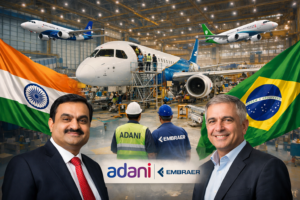
Beyond Assembly Lines: How Adani-Embraer Pact Could Reshape India’s Aviation Ambitions
A quiet invitation to a “historic” announcement at India’s civil aviation ministry has set the industry abuzz. According to a source familiar with the matter, the Adani Group’s aerospace arm and Brazilian aerospace giant Embraer are poised to unveil a partnership to assemble commercial aircraft on Indian soil. This move, expected to be formalized next week, is far more than a business deal—it’s a potential inflection point for a nation long relegated to the role of a voracious aircraft buyer, now aspiring to become a strategic maker.
The Deal’s Anatomy: More Than Meets the Eye
While the official details await the announcement, reports indicate a Memorandum of Understanding has been signed to establish a Final Assembly Line (FAL) for Embraer’s regional jets in India. Embraer, the world’s third-largest planemaker, is a specialist in the 70-150 seat market, a niche where its E-Jet families have found global success. For Adani Aerospace & Defence, a relatively new but aggressively ambitious player, this marks a staggering leap into the big leagues of aerospace manufacturing.
This isn’t about merely screwing together imported kits. An FAL represents the final, complex integration of fuselage, wings, engines, and avionics into a certified aircraft. Establishing one is a statement of capability, a vote of confidence in local engineering talent, and a commitment to deep industrial integration. For India, which has assembled military aircraft under license for decades but has never hosted a commercial jet FAL, this is uncharted territory.
Decoding the Strategic Calculus: Why This Deal Makes Sense Now
For years, Airbus and Boeing politely deflected Indian government nudges to set up local assembly, citing insufficient volumes and complex economics. So why is Embraer breaking ranks, and why with Adani?
- India’s Unmet Regional Demand: Embraer’s own forecast is the clearest clue. The company believes India will need over 500 aircraft in the 80-146 seat range over two decades. This segment is crucial for connecting Tier-2 and Tier-3 cities—the next frontier of Indian aviation growth. Current Indian carriers, however, are overwhelmingly focused on large narrow-body orders from Airbus and Boeing (over 1,500 collectively). This leaves a glaring “missing middle” in the fleet, perfect for Embraer’s E175-E190 family.
- Adani’s Ecosystem Ambition: Gautam Adani’s conglomerate has moved with startling speed in aerospace. From managing airports (it’s India’s largest private airport operator) to defence manufacturing and MRO (Maintenance, Repair, and Overhaul) services, the group is constructing a vertically integrated aviation ecosystem. Adding aircraft assembly is the keystone. It provides control over a critical part of the value chain, ensures a steady stream of work for its MRO facilities, and aligns perfectly with the government’s “Make in India” and “Aatmanirbhar Bharat” (self-reliant India) doctrines.
- Embraer’s Global Rebalancing Act: For Embraer, still navigating the aftermath of a failed joint venture with Boeing, India represents a strategic counterweight. With a massive, growth-oriented market and a government eager for partnership, India offers scale and political alignment. Local assembly reduces costs through potential supplier development, insulates the company from import duties, and makes its jets more commercially attractive to Indian airlines, potentially turning India into a regional export hub.
The Ripple Effects: Industry, Jobs, and Geopolitics
The implications of a successful pact are profound:
- Catalyzing a Supplier Base: An FAL doesn’t operate in isolation. It requires a network of Tier-2 and Tier-3 suppliers for components, raw materials, and subsystems. This could finally catalyze the high-precision aerospace manufacturing cluster India has long sought, benefiting MSMEs and creating high-skilled jobs.
- Empowering Regional Aviation: Affordable, locally-assembled regional jets could revolutionize air connectivity. State governments and new airline startups could find viable models to serve thinner routes, decongest major hubs, and boost regional economies.
- A New Aerospace Axis: The deal subtly signals a shift in global aerospace alliances. While the West (Airbus, Boeing) and the East (COMAC) dominate, an India-Brazil partnership in aerospace manufacturing creates a new South-South corridor of technology sharing and strategic industrial cooperation.
- The Defense Connect: It’s impossible to ignore the defense undertones. Adani’s defense unit and Embraer’s defense portfolio (like the C-390 Millennium military transport and A-29 Super Tucano) are significant. Successful civil collaboration paves the way for deeper defense partnerships, potentially addressing the Indian military’s needs for medium transport and ISR (Intelligence, Surveillance, Reconnaissance) aircraft.
Navigating the Turbulence: Inherent Challenges
The optimism must be tempered with realism. The path is fraught with challenges:
- The Economics of Scale: Can the Indian market generate enough orders to make the FAL economically viable? Airlines are notoriously price-sensitive and may demand significant cost benefits over directly imported jets.
- Building the Spine: Developing a qualified, certified local supply chain from scratch is a decade-long endeavor, not a two-year project. It will require patient capital and unwavering policy support.
- Global Certification: Aircraft assembled in a new FAL must be certified by Indian regulators (DGCA) and, crucially, by regulators in export destination countries. This is a complex, rigorous process.
- Competitive Response: How will Airbus and Boeing react? They could offer more aggressive financing or pricing on their own smallest jets (A220, 737-7) to protect market share.
A Vision Beyond the Headline
The forthcoming Adani-Embraer announcement is not merely about assembling aircraft. It is a test case for India’s industrial ambition. It asks whether the country can move beyond being the world’s most exciting aviation market to becoming a credible, complex manufacturing partner in one of the most technology-intensive industries on earth.
If successful, it could recalibrate India’s position in global aerospace from the back office to the shop floor. It would demonstrate that with the right mix of industrial ambition, corporate daring, and strategic foreign partnership, India can indeed build its own wings. The announcement next week may just be the signing of a pact, but its true legacy will be written in the years to come, on factory floors and in airport terminals across the nation and perhaps, the wider world.
You must be logged in to post a comment.