
Beyond an Office: Why Airbus’s New Bengaluru Centre is a Blueprint for India’s Aerospace Future
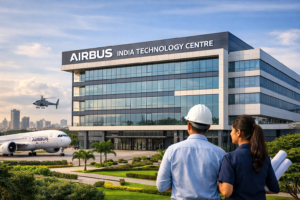
Beyond an Office: Why Airbus’s New Bengaluru Centre is a Blueprint for India’s Aerospace Future
The Bengaluru Blueprint: Inside Airbus’s New Indian Nerve Centre and What It Really Means for Global Aviation
On a Saturday in early 2024, a virtual button was pressed. On one side of the digital divide was Union Civil Aviation Minister Kinjarapu Ram Mohan Naidu; on the other, a sprawling new campus in the heart of Bengaluru, India’s Silicon Valley. The occasion was the inauguration of the Airbus India Technology Centre, a facility that, on paper, sounds like just another corporate expansion. In reality, it is a profound statement of intent—a testament to a shifting axis in the world of high-tech aerospace.
The headlines will tell you it is a “significant step” and that it will create “high-skilled employment.” But to understand why this event, attended also by Karnataka’s Deputy Chief Minister D. K. Shivakumar, matters far beyond the ribbon-cutting, you have to look past the press release and into the very DNA of modern aviation.
This isn’t just about opening an office. It is about Airbus planting a flag in the ground, declaring that the future of flight will not only be built in Toulouse or Hamburg but will be significantly designed and engineered on the streets of Bengaluru.
More Than a Back Office: The GCC Revolution
To grasp the magnitude of this, we must first understand the evolution of the Global Capability Centre (GCC) in India. In the 1990s and early 2000s, these were often referred to as “back offices”—captive centres for IT support, call centres, and low-level business process outsourcing. The work was necessary but ancillary. The “real” engineering, the “real” design, happened in the West.
That era is dead. And the new Airbus India Technology Centre is its gleaming tombstone.
As Minister Naidu correctly noted, India has rapidly emerged as a “preferred destination for Global Capability Centres.” But the keyword here is “Capability,” not “Cost.” While the cost arbitrage of skilled Indian labour remains a factor, the driving force today is capability arbitrage. India now possesses a massive, youthful, and increasingly specialized pool of talent that simply doesn’t exist in the same volume elsewhere.
The Airbus centre is a perfect example. It is the company’s second-largest digital and engineering hub outside Europe. Let that sink in. For a titan of European industry—a consortium that represents the pinnacle of French, German, Spanish, and British engineering—its largest outpost of intellectual heavy lifting is now in India. This isn’t about saving money on call centre staff; it’s about accessing the brainpower that will design the wings, the landing gear, the digital systems, and the artificial intelligence for the aircraft that will carry us in 2035 and beyond.
Inside the New Hub: Where Software Meets Sky
So, what will actually happen inside this new Bengaluru campus? The officials speak of “strengthening research, design and digital capabilities.” But let’s put some flesh on those bones.
Imagine a young engineer, perhaps a graduate of the Indian Institute of Science (IISc) located just a few kilometres away, sitting down at her workstation. She is not processing purchase orders. She is working on a digital twin of an Airbus A350’s wing, running millions of simulations to optimize aerodynamic performance and reduce fuel burn. Down the hall, a team of data scientists is building machine learning algorithms that will help predict maintenance needs for a fleet of helicopters before a pilot even knows there’s a problem. In another lab, software developers are coding the next-generation cockpit interfaces, making them more intuitive and connected.
This centre is designed to be the nerve centre for these activities. It will house engineers working on:
- Commercial Aircraft Design: From structural analysis to systems integration, Indian engineers will now have a seat at the table where the core architecture of future planes is decided.
- Helicopter Technology: India is a massive market for helicopters, both for civilian and defence purposes. Having the engineering team co-located with the market allows for faster customization and innovation tailored to Indian conditions, from the high Himalayas to the humid coasts.
- Digital & Data Analytics: This is perhaps the most crucial aspect. Modern aircraft are flying data centres. The ability to harness that data—for predictive maintenance, fuel optimization, and air traffic management—is the new frontier in aviation. Airbus is betting that India’s world-renowned software prowess will give it an edge in this digital transformation.
The Human Element: A Story of Reverse Brain Drain
For Deputy Chief Minister D. K. Shivakumar, whose state of Karnataka has long been the engine of India’s tech boom, the inauguration is a validation of a decades-long bet on education and infrastructure. But for the Indian aerospace community, it represents something more emotional: the reversal of a painful trend.
For years, the dream of working on cutting-edge aerospace projects meant one thing: leaving India. The brightest minds from the Indian Institutes of Technology (IITs) and other premier colleges would head to the United States or Europe to work for Boeing, Lockheed Martin, or Airbus itself. It was a classic brain drain. They left because the projects were there, and the ecosystem to support such high-end work was not.
Facilities like the new Airbus India Technology Centre are slowly but surely reversing that flow. They are creating an ecosystem where an engineer can work on world-class, cutting-edge projects without leaving their family, their culture, or their country. It allows someone to earn a global salary (in relative terms) while contributing to the local economy.
More importantly, it creates a virtuous cycle. When a company like Airbus sets up a deep-tech R&D centre, it doesn’t just hire engineers; it creates a demand for specialised skills. This, in turn, pressures universities to update their curricula, it spawns a new generation of niche startups to service the industry, and it creates a talent pool that attracts other global players. Airbus becomes an anchor tenant in a growing innovation district, and the value generated ripples far beyond its campus walls.
A Boost for ‘Make in India’ and Self-Reliance
The inauguration also dovetails seamlessly with the Indian government’s strategic vision. The “Make in India” initiative, and more specifically the “Atmanirbhar Bharat” (Self-Reliant India) campaign in defence and aerospace, requires precisely this kind of deep technology transfer.
Having a centre where critical systems are designed and developed locally isn’t just about prestige. It’s about sovereignty. For India’s own growing civil aviation market—set to be the world’s third-largest—having design and engineering expertise onshore means better support for local airlines, faster resolution of technical issues, and the potential to influence the design of aircraft that will predominantly fly in Indian skies.
Furthermore, as India builds its own military helicopters and transport aircraft through programs like the Indigenous Multi-Role Helicopter (IMRH), having a partner like Airbus with a deep local engineering presence can facilitate collaboration in a way that a simple buyer-seller relationship never could. It moves the needle from being a consumer of technology to a co-creator.
The Road Ahead: Challenges and the Long Game
Of course, inaugurating a centre is the easy part. The real work begins now. The challenge for Airbus will be to ensure this centre is truly integrated into its global workflow, not siloed away as an “India team” that simply executes tasks designed elsewhere. True global engineering hubs require a culture of trust where the best idea wins, regardless of whether it comes from Toulouse, Hamburg, or Bengaluru.
There is also the challenge of retaining this talent. The competition for top engineers in Bengaluru is fierce, with global tech giants offering lucrative packages. Airbus will need to offer not just a job, but a career path—a chance to see one’s ideas take flight, literally. The allure of working on a physical product that soars through the sky, as opposed to abstract code, is a powerful motivator, but it must be nurtured.
Conclusion: A Milestone, Not a Destination
The virtual inauguration by Minister Naidu was a moment captured in a single day. But the Airbus India Technology Centre is a story that will unfold over the next decade. It is a story about the democratization of high technology, about the shifting geography of innovation, and about a young nation’s ambition to move from the back office to the design studio.
It is a powerful symbol of the new India—confident, skilled, and ready to co-pilot the future of global industries. As those 1,200 (and eventually more) engineers file into their new labs in Bengaluru, they carry with them not just the weight of their own careers, but the hopes of an entire ecosystem. They are no longer just supporting the global aerospace industry; they are building it. And that makes all the difference.
You must be logged in to post a comment.