
Beyond $100 Billion: How India and Africa Are Building a New Model of Partnership
In a landmark achievement for South-South cooperation, India-Africa trade has surpassed the $100 billion milestone. This growth is fueled by a strategic partnership between two demographic powerhouses facing shared global challenges and shifting geopolitical dynamics. Their economies are highly complementary: Africa’s vast natural resources meet India’s expertise in digital innovation, pharmaceuticals, and agriculture. Beyond trade, the partnership is deepened by over $75 billion in Indian investment and development initiatives, including 50,000 scholarships for African youth.
Collaboration is now focused on key sectors like clean energy, food security, and digital infrastructure. This evolving relationship, underscored by the African Union’s G20 inclusion, moves beyond traditional aid to a model of mutual respect and co-creation. Together, they are building a resilient and prosperous shared future.
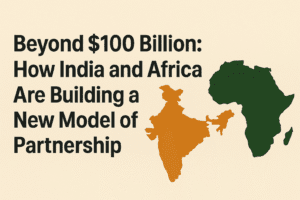
Beyond $100 Billion: How India and Africa Are Building a New Model of Partnership
In a world increasingly fractured by geopolitical tensions and protectionist policies, a quiet but powerful story of South-South cooperation is unfolding. The recent 20th India-Africa Business Conclave in New Delhi wasn’t just another diplomatic meeting; it was a celebration of a milestone: bilateral trade between India and the 54 nations of Africa has officially surged past the $100 billion mark.
But to view this figure as just a trade statistic is to miss the larger, more compelling narrative. This growth represents a strategic and necessary pivot—a conscious effort by two of the world’s most significant demographic powerhouses to write their own rules of engagement.
More Than Just Numbers: A Partnership Forged in Shared Experience
The convergence of India and Africa on the global stage feels almost inevitable. They are not a traditional donor and recipient, but peers facing strikingly similar challenges and opportunities.
- A Shifting Global Landscape: Both have felt the sting of rising tariffs and unwelcoming immigration policies in the West. This has accelerated the search for reliable partners in the Global South who operate on a foundation of mutual respect rather than conditional aid.
- The Demographic Dividend: With overwhelmingly young populations, both regions are racing to create jobs and opportunities for the next generation. Their future stability and prosperity depend on it.
- Complementary Economies: The partnership is beautifully asymmetrical yet balanced. Africa is endowed with the vast natural resources, fertile land, and critical minerals that fuel economies. India, on the other hand, possesses a deep well of expertise in building scalable digital infrastructure, a thriving pharmaceutical industry, and advanced capabilities in sectors like agriculture and renewable energy.
This isn’t a relationship of dependency; it’s one of symbiotic need. As one delegate noted, “We are not looking for handouts; we are looking for hands to join in building.”
The Engine of Growth: Moving Beyond Traditional Trade
The conclave revealed that the $100 billion trade figure is merely the foundation. The real story is in the multifaceted layers of engagement being built on top of it:
- Strategic Investment: India is now a top-five investor in Africa, with cumulative investments exceeding $75 billion. This capital is fueling projects in manufacturing, technology, and infrastructure, creating local jobs and building capacity.
- Capacity Building, Not Just Capital: India has extended over $12 billion in concessional loans and $700 million in grants for projects across Africa. Perhaps more impactful is the investment in people: the offer of 50,000 scholarships to African youth has already nurtured over 42,000 future leaders, doctors, and engineers, creating a powerful alumni network that will bind the regions for decades.
- Sectoral Synergy: The focus has shifted to high-impact collaborations:
- Digital Transformation: Africa’s “leapfrog” moment mirrors India’s own digital revolution. There is immense potential for sharing India’s playbook on digital ID (Aadhaar) and unified payments (UPI) to build inclusive digital economies.
- Food Security: Collaboration in agriculture and food processing can help unlock Africa’s potential as the world’s breadbasket, while ensuring stable food supplies for India.
- Clean Energy: With abundant sunlight, Africa is a prime partner for India in solar and renewable energy projects, addressing climate goals and energy access simultaneously.
The Road Ahead: Small Steps for a Big Impact
The inclusion of the African Union as a permanent G20 member during India’s presidency was a profound diplomatic victory, signaling that Africa must have a seat at the global table. But the real work happens on the ground.
The Centre Director’s advice to “take small steps to make a big impact” is the crucial takeaway. The future of this partnership won’t be defined solely by mega-deals but by the cumulative effect of:
- Indian tech startups solving African logistics challenges.
- African agriculture producers processing goods in facilities built with Indian partnership.
- Indian pharmaceuticals manufacturing vital medicines locally in Africa.
- The thousands of students exchanging knowledge and building lifelong professional bonds.
The $100 billion milestone is a powerful signpost, but it is not the destination. It marks the beginning of a new chapter—one where India and Africa, together, are co-creating a shared future built on mutual respect, tangible growth, and an unwavering belief in their collective potential.
You must be logged in to post a comment.