
Between Ruins and Resolutions: The Unwavering Quest for Accountability in Gaza
Amidst the launch of a new international Board of Peace plan for Gaza in January 2026, the UN Human Rights Council’s independent Commission of Inquiry has reaffirmed its unwavering mandate to investigate grave abuses and seek accountability for all parties involved in the Hamas-Israel war, operating separately from political roadmaps. The panel, led by Chair Srinivasan Muralidhar, continues its work despite severe funding shortages that limit its scope, emphasizing the need for justice as a foundation for lasting peace. It builds upon prior findings, including the controversial assertion by a former chair of Israeli genocide, and condemns actions that obstruct truth-seeking, such as the killing of journalists and the destruction of UN agency infrastructure, stressing that humanitarian law and accountability cannot be sidelined by transitional political administrations.
Between Ruins and Resolutions: The Unwavering Quest for Accountability in Gaza
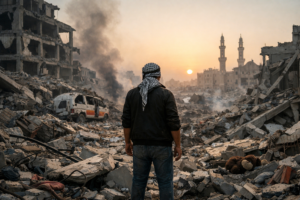
In the stark, windswept landscape of Gaza, a UNICEF tent stands as a fragile testament to both survival and devastation. Pitched before the skeletal remains of a building, its blue and white fabric is a jarring contrast to the acres of grey rubble. This single image, repeated in countless variations across the Strip, encapsulates the current reality: a profound humanitarian crisis met by emergency aid, all set against the backdrop of a war whose legal and moral reckonings are fiercely contested. As new political structures emerge, the fundamental human cry for justice persists, voiced by those tasked with one of the world’s most difficult investigations.
In January 2026, as former President Donald Trump launched an international “Board of Peace” plan for Gaza—a initiative welcomed by UN Security Council Resolution 2803 as a transitional administration—a parallel, independent process affirmed its own unwavering course. The United Nations Human Rights Council’s Commission of Inquiry (COI) on the Occupied Palestinian Territory, including East Jerusalem, and Israel, made it clear that diplomatic roadmaps, however high-level, do not supersede the pursuit of accountability.
“Our task is investigating violations of human rights,” stated Srinivasan Muralidhar, the Commission’s Chair, drawing a clear line between political and legal mandates. “That task we understand to be the mandate the UN has given us.” This declaration underscores a critical tension in post-conflict landscapes: the clash between the urgent political imperative for stability and the slower, often uncomfortable judicial imperative for justice.
The Weight of a Mandate: Investigating Amidst Geopolitical Shifts
Established in May 2021, this COI is among the UN’s most robust investigative bodies. Its mandate is broad and unprecedented: to investigate all alleged violations of international humanitarian and human rights law leading up and since April 2021, and to root out their underlying causes. Unlike temporary fact-finding missions, it is an ongoing body, designed to persist regardless of the conflict’s fluctuating intensity.
The Commission’s work gained grim momentum following the horrific Hamas-led attacks of October 7, 2023, which killed approximately 1,200 people in Israel, and the subsequent Israeli military campaign in Gaza. The conflict’s brutality forced the commission into the center of a global firestorm. In September 2025, then-Chair Navi Pillay stated that the Commission had found evidence that Israel had committed acts of genocide against Palestinians in Gaza. Israel’s vehement denial was immediate and absolute, highlighting the deep chasm the COI must bridge.
With a new panel now at the helm—including Muralidhar, Zambian jurist Florence Mumba, and Australian human rights expert Chris Sidoti—the work continues with a specific focus for 2026. Muralidhar noted investigations into “attacks by armed Palestinian militias on others within these two territories,” a reminder that their scrutiny, though often spotlighted on Israel’s powerful military, is intended to be even-handed. This principle is central to its legitimacy, even as it remains a lightning rod for criticism.
The Board of Peace and the Shadow of Impunity
The unveiling of the Board of Peace plan introduces a new, complex layer. Framed as a mechanism for redevelopment and transitional administration, it represents a political future. The COI’s response is not opposition, but a steadfast insistence on compartmentalization. Muralidhar expressed a hope that the Commission’s findings “will feed into some adjudicatory system,” suggesting that true, lasting peace cannot be built on a foundation of unaddressed atrocity.
This highlights a fundamental philosophical debate: can you build a stable future without reckoning with the past? History offers mixed answers. South Africa’s Truth and Reconciliation Commission is often cited as a model of tying justice to peace-building, while other conflicts have seen amnesties traded for silence. The COI operates on the belief that accountability is non-negotiable for sustainable peace. Sidoti, commenting on the vital role of UNRWA—whose East Jerusalem headquarters was recently destroyed—framed this in practical terms: “Israel needs to think very carefully before it rejects the work that UNRWA has done… Of course, there will be consequences for human rights… children have a right to education.”
Their concern is that political solutions, if not carefully crafted, might inadvertently entrench impunity or sideline fundamental rights in the name of expediency.
Silencing Witnesses: The Attack on Truth-Tellers
Beyond the macro-level investigations, the COI’s recent condemnations point to the granular realities of their work. The reported killing of three Palestinian journalists in an Israeli airstrike just a day before their Geneva press conference drew a sharp, human response from Commissioner Mumba: “When you’re killing a journalist, it means you have something to hide.”
This statement cuts to the core of the Commission’s challenge. Its investigations rely on evidence gathered from the ground—testimonies, videos, forensic data. Journalists, local human rights workers, and aid agencies are the de facto field researchers in this environment. Attacks on them are not just tragedies; they are direct assaults on the pipeline of information that justice mechanisms depend upon. Each loss makes the COI’s task harder, dimming the world’s window into the conflict and potentially burying crucial evidence under rubble and silence.
The Stark Reality of Underfunded Justice
Perhaps one of the most telling revelations from Geneva was the admission that the COI’s lofty mandate is hamstrung by a prosaic problem: a lack of money. Despite being authorized to investigate critical issues like the supply of arms to conflict parties and settler violence in the West Bank, Chair Muralidhar confessed, “Because of a shortage of finances, we could not go into those areas.”
This admission is a sobering reminder of the hierarchy of global priorities. Billions are spent on weaponry and immediate aid, while the meticulous, unglamorous work of building legal cases for war crimes operates on a shoestring budget. An underfunded inquiry risks producing incomplete findings, which can then be dismissed as biased or partial, creating a vicious cycle that undermines the very concept of international justice it seeks to uphold.
The Long Road from a Tent to a Home
The journey from the emergency shelter to a just and durable peace is unimaginably long. The UNICEF tent in the photo is a response to immediate, physical need. The Board of Peace plan is an attempt to blueprint a political future. But the Commission of Inquiry represents the essential, messy in-between—the arduous process of establishing a verified narrative, assigning responsibility, and affirming that international law is not optional.
Their work is an act of faith. Faith that facts matter. Faith that legal norms can restrain raw power. Faith that the mothers, fathers, and children living in those tents and ruins deserve more than just a new roof over their heads; they deserve a recognition of the wrongs they endured and a guarantee that such wrongs will not be ignored for the sake of political convenience.
As the new political administration for Gaza takes shape, the world will watch not only its ability to pour concrete and restore electricity but also its capacity to engage with the uncomfortable truths being documented. The true test of any “Board of Peace” will be whether it has the courage to make space for justice, or whether it chooses to build its foundations over an unmarked grave of unresolved crimes. The independent experts in Geneva, despite all obstacles, seem determined to ensure it is the former.
You must be logged in to post a comment.