
Bethlehem’s Defiant Light: The Christmas Tree That Is More Than a Celebration
The Christmas tree lighting in Bethlehem’s Manger Square, the first since 2022, was far more than a revived holiday tradition; it was a profound act of collective resilience and a muted celebration held tightly within a context of grief and solidarity.
For a city where tourism has collapsed due to the war in nearby Gaza and tightened restrictions in the West Bank, the ceremony was a critical signal to the world and a desperate bid for economic survival. Undertaken with solemnity—notably without fireworks—the event consciously balanced a glimmer of joy with deep anguish for Gaza, serving as a unifying Palestinian symbol for both Muslims and Christians and standing as a defiant beacon of hope and continued identity amid ongoing occupation and uncertainty.
Bethlehem’s Defiant Light: The Christmas Tree That Is More Than a Celebration
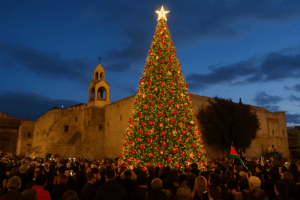
The lighting of a 20-meter Christmas tree in Bethlehem’s Manger Square on a Saturday in December was a quiet act of profound defiance. For the first time since 2022, red and gold baubles glittered against the backdrop of the ancient Church of the Nativity, ending a two-year hiatus imposed by war in Gaza. Yet, the cheers from the gathered crowd were not merely for the return of a holiday tradition. They were a collective, hopeful exhale from a city—and a people—choosing to celebrate life amid overwhelming grief, economic ruin, and an uncertain future. This ceremony was not a distraction from reality, but a declaration within it: a message of resilience, a plea for economic survival, and a testament to a community’s unbroken spirit.
The Weight of a Decision: To Celebrate Amid Suffering
The choice to publicly celebrate Christmas after two somber years was neither simple nor unanimous. Bethlehem Mayor Maher Canawati acknowledged the internal conflict, stating, “Some may say it’s not appropriate and others say it’s appropriate… But deep inside my heart, I felt that this was the right thing to do because Christmas should never be stopped or cancelled. This is the light of hope for us”.
This sentiment underscores a critical tension. The city’s celebrations have consciously been subdued and reflective, featuring hymns and prayers for peace instead of the usual rowdy festivities, dances, and fireworks. The absence of pyrotechnics was a solemn nod to the ongoing suffering in Gaza, just 60 kilometers away. Mayor Canawati himself connected the joy in Bethlehem directly to the anguish elsewhere: “The wound of Gaza is our wound, the people of Gaza are our people”. For Bethlehem’s residents, many of whom have family and friends in Gaza, the tree lighting was an expression of hope tethered to solidarity, not separate from it.
An Economic Lifeline Hanging by a Thread
Beneath the symbolic weight lies a stark economic reality. Bethlehem’s lifeblood is tourism, with around 80% of its residents depending on the industry. The dual blows of the COVID-19 pandemic and the Gaza war have brought this economy to its knees. The statistics paint a dire picture:
| Economic Indicator | Pre-War Context (2019/2022) | Current Situation (Late 2025) | Impact |
| Annual Tourists | 1.5 million visitors (2022) | 90% drop from pre-war levels | Industry on the “brink of collapse” |
| Daily Losses | N/A | Estimated $1.5 – $2.5 million per day | Catastrophic for local businesses |
| Unemployment | ~14% (pre-war) | 31%-65% | Widespread poverty, forced migration for work |
| Business Climate | Bustling pilgrim economy | Hotels empty, souvenir shops quiet, generational businesses closing | “Without tourism there is no life” |
The human cost of these numbers is felt daily. Hotel owners like Fares Banak describe scrambling for the occasional guest just to prevent total ruin, comparing the situation to a car abandoned for years. Restaurant owners, such as Alaa Salameh, note that many families can no longer afford even cheap traditional snacks. The lighting of the Christmas tree was, therefore, a critical signal to the world: Bethlehem is open. As one resident put it, the ceremony was an opportunity to “tell the world that Bethlehem is open and ready to receive them” in hopes of “breathing some life into their strangled economy”.
A Unifying Beacon for Muslims and Christians
In a powerful display of national solidarity, the celebration transcended religious lines. Bethlehem, though globally revered as the birthplace of Jesus, has a Muslim-majority population. The Christmas festivities have long been a shared cultural and economic cornerstone for all residents.
Community leaders emphasize this unity. Samir Hazboun of the Bethlehem Arab Society for Rehabilitation notes that celebrations “unite Muslims and Christians alike in a spirit of national solidarity”. This year, both Palestinian Christians and Muslims were seen posing for selfies together in front of the illuminated tree. The message is clear: Christmas in Bethlehem is a Palestinian tradition, a part of the national fabric that reinforces a common identity and shared fate in the face of external pressures.
Defiance in the Shadow of Occupation and Conflict
The celebration occurs within a landscape of escalating tension and restriction. The West Bank remains under Israeli occupation, and the past two years have seen increased military operations, checkpoints, and a dramatic surge in violence from Israeli settlers.
- Settlement Expansion: South of Bethlehem, the town of Beit Sahour—home to the biblical Shepherds’ Field—faces an immediate threat. Mayor Elias Iseed has warned of an Israeli plan to build a new settlement, “Shdema,” on lands once allocated for a Palestinian children’s hospital. He calls this an “act of dispossession” that would “terrorize” the community and push residents toward forced migration.
- Daily Violence: According to UN data cited by local officials, there have been 757 settler attacks since the beginning of the year—a 13% increase from the previous year. Bethlehem’s governor has described these attacks, along with land confiscations and military incursions, as continuing “unabated”.
- Movement Restrictions: Israel’s network of checkpoints and barriers has tightened, cutting Bethlehem off and strangling its economy. A resident from Ramallah described a commute of six hours to travel less than 20 miles to reach Bethlehem for the celebrations.
In this context, the simple act of gathering to sing carols and light a tree becomes a profound political statement. As one analysis powerfully framed it: “Christmas here is not escapism. It is defiance. A declaration that joy will not be extinguished, that faith survives occupation”. The tree is a beacon of life and identity, insisting on the right to celebrate and exist despite walls, checkpoints, and expanding settlements.
The Cautious Path Forward
The return of celebrations brings a fragile, cautious optimism. Deputy Mayor Lucy Talgieh expects around 11,000 visitors during Christmas week, a fraction of former crowds but a significant improvement from the total silence of the past two years. Hotels report a promising influx of bookings, hoping to reach 70% occupancy during the holiday period.
However, the future remains precarious. The ceasefire in Gaza is shaky, and the economic damage is deep. The world’s attention is fickle. For Bethlehem, the Christmas season is long—spanning Western Christmas on December 25, Orthodox Christmas on January 7, and Armenian Christmas on January 18—offering a prolonged window for pilgrims to return and for the city’s message to resonate.
Ultimately, the lights on the tree in Manger Square tell a story far older and deeper than a single holiday. They speak of a community’s unwavering grip on hope, its determination to preserve dignity through culture, and its plea not to be forgotten. As the angels proclaimed to shepherds in the fields near Bethlehem two millennia ago, “Glory to God in the highest, and on earth peace”. This year, the city of Christ’s birth lights a tree not just in celebration, but as a persistent, glowing question to the world: In the face of ongoing injustice and suffering, will you listen?.
You must be logged in to post a comment.