
Bengaluru’s February Fever: The Slow Erosion of a City’s Legendary Climate
Bengaluru’s February Fever: The Slow Erosion of a City’s Legendary Climate
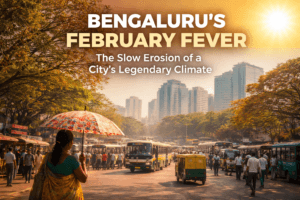
The scene at the Kempegowda Bus Terminal in Bengaluru on a recent Thursday afternoon was a study in adaptation. A passenger, a woman in a cotton saree, deftly manoeuvred through the crowd, a bright umbrella held aloft not as a shield against the brief, afternoon shower the city is famous for, but as a desperate defence against a harsh, unrelenting sun. The date was February 26, a time of year that, in the collective memory of its long-time residents, should still carry the pleasant nip of “Neralu” — the gentle winter.
But the old rhythms are breaking. According to the India Meteorological Department (IMD), the mercury has been flirting with and consistently crossing the 30-degree Celsius mark since February 21. Data reveals a stark trajectory: 30.8°C on the 21st, a leap to 32.4°C the next day, and a peak of 32.8°C on February 23. For a city once celebrated for its “eternally spring-like” climate, this February fever is more than just a weather update; it’s a symptom of a profound transformation.
The Data Tells a Story of Two Cities
To understand the present, we must look at the past. The IMD’s long-term data, cited by officials, points to a clear inflection point: the last two decades. This period coincides directly with Bengaluru’s explosive growth as the IT capital of India. The city of gardens and pensioners gave way to a metropolis of glass-and-steel tech parks and a booming population. The data points are like fever spikes in a patient’s chart.
This isn’t a gradual, uniform warming. It’s a pattern of sharp, jarring peaks. In recent years, February has become a month of extremes. The provided data shows a shocking high of 35.9°C on February 17, 2005 — a record that still stands as a warning. But the frequency of these extreme events has intensified. February 2019 saw the mercury hit 35.5°C, February 2024 recorded 34.5°C, and just last year, on February 20, 2025, the city sweltered at 34.4°C. The winter of 2023 seems a distant memory, with its relatively mild 30.9°C on February 16.
The official explanation is clinical: “An increase in city temperatures in February has been seen over the past two decades… after its transformation as the IT capital of India.” The official, speaking on condition of anonymity, added the crucial reason: “A lot of trees have been cut for development, and concretisation has increased, resulting in the creation of heat islands. Hence, there is an impact on city temperatures.”
This is the core of the story. Bengaluru isn’t just experiencing climate change; it is actively creating its own, hyper-local climate crisis. The city is a living laboratory for the Urban Heat Island (UHI) effect, where built-up areas — dense with concrete, asphalt, and dark roofing — absorb and re-emit the sun’s heat far more than natural landscapes.
The Cost of the Concrete Gold Rush
The transformation is visible from any high-rise in the city. Where expansive, green canopies of avenue trees once lined the roads, providing natural cooling corridors, there are now concrete flyovers and dusty, choked medians. Lakes, the city’s traditional lungs and natural cooling systems, have either vanished under real estate projects or turned into sewage-filled tanks surrounded by apartment complexes.
The economic boom that made Bengaluru the Silicon Valley of India came with an environmental price tag that is now coming due. Every new tech park, every widened road, and every luxury apartment complex contributed to a massive removal of biomass. The old Bengaluru was a city where you could walk in the shade for miles. The new Bengaluru is a city where you dash from one air-conditioned bubble—your car, your office, your home, your mall—to the next, because the space in between has become inhospitable.
This loss of green cover has a direct, measurable impact. Trees provide shade, reducing the amount of solar radiation absorbed by the ground. Through evapotranspiration, they act as natural air conditioners, releasing moisture into the air and cooling their surroundings. When a tree is felled to make way for a granite-paved footpath, that cooling effect is lost. The dark granite absorbs heat throughout the day and radiates it back into the environment well into the night, preventing the city from cooling down after sunset.
The result is a city where microclimates have become starkly defined. A walk in Cubbon Park or the Indian Institute of Science (IISc) campus can still offer a glimpse of the old Bengaluru, with temperatures noticeably lower. Step out onto the adjacent MG Road or the concrete expanse of Majestic, and you’re hit by a wall of heat, trapped by the buildings and rising from the dark roads. These are the “heat islands” the IMD official spoke of, pockets of amplified warmth that make the overall city average temperature a misleading statistic.
A Public Health Emergency in the Making
The implications go far beyond comfort. The early heat trends are a red flag for public health. Health experts are already warning of a surge in gastrointestinal infections, a common summer affliction, but the risks are more severe. Heat stress, dehydration, and heat strokes become genuine dangers, particularly for the city’s most vulnerable populations: the elderly, children, and the vast workforce employed in construction, as daily-wage labourers, and in the informal sector.
These are the people who cannot afford to stay indoors between noon and 3 pm, the peak hours experts advise avoiding. They are the ones selling vegetables on the roadside, driving auto-rickshaws without air conditioning, or working on scaffolding under the direct sun. For them, the rise in February temperatures means a longer, more punishing summer, reduced working capacity, and a direct threat to their health and livelihood.
The advice given by experts—to stay hydrated and avoid going out during peak hours—is sound but rings hollow for a large section of the city’s population. It highlights a climate inequity where the consequences of the city’s growth are borne disproportionately by those who benefited the least from the IT boom.
The government’s own response has often been reactive. The High Court, in a recent observation on the state of Bengaluru’s stormwater drains, noted a stark reality: “The administration woke up only when an upscale/rich locality where the rich and famous lived came under water.” The same principle applies to the heat. The discomfort is universal, but the ability to escape it—into an air-conditioned car, office, or home—is not. The real crisis will be measured not just in degrees Celsius, but in clinic visits, lost wages, and the diminished quality of life for the city’s working majority.
Rewriting a Climate Legacy
There is a poignant irony in the court’s observation on the city’s stormwater drains. It noted that “every Bengalurean was of the impression that there can be no flooding in their city,” a testament to the former efficiency of its natural systems. The court praised the British-era topographical surveys, conducted on donkeys’ backs, that gave the city a “blueprint etched in stone” for preserving its water bodies and drains.
Today, as we struggle with advanced technology to undo the mess we’ve created, it’s worth remembering that blueprint. The “salubrious weather” Bengaluru was famous for wasn’t an accident. It was the result of a delicate balance between its geography, its abundance of trees, and its network of lakes and wetlands that acted as a natural cooling system. We have systematically dismantled that system.
The story of Bengaluru’s February heatwave is not just about a few degrees on a thermometer. It is a story about choices. The choice to prioritise short-term economic gain over long-term environmental sustainability. The choice to see trees as obstacles to development rather than essential infrastructure. The choice to build a city for machines (cars, servers) rather than for people.
As another February gives way to March, and the mercury is set to climb even higher, Bengaluru stands at a crossroads. It can continue down the path of unbridled, heat-amplifying concretisation, or it can begin the painstaking work of retrofitting itself. This means aggressive, scientifically-planned greening, not just cosmetic planting. It means protecting every remaining lake and green space as sacred. It means mandating cool roofs, permeable pavements, and building designs that work with the climate, not against it.
For now, the passenger at the bus terminal will continue to use her umbrella against the sun, a simple, personal adaptation to a city-wide failure. But the hope is that her image will serve as more than just a photo caption. It should serve as a wake-up call—a reminder that Bengaluru’s legendary climate is not an eternal birthright. It is a fragile gift that the city is perilously close to squandering forever. The fever in February is a symptom, and the prognosis depends entirely on whether the city can find the will to heal itself.
You must be logged in to post a comment.