
Bengaluru Under the Siege of Skies: Navigating Ditwah’s Legacy and the City’s New Rain-Fueled Reality
Bengaluru Under the Siege of Skies: Navigating Ditwah’s Legacy and the City’s New Rain-Fueled Reality
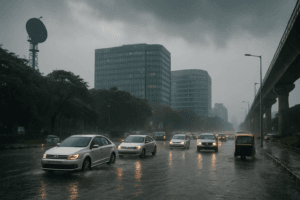
The familiar rhythm of Bengaluru’s mornings—the hum of tech shuttles, the aroma of filter coffee, and the brisk pace of urban life—was replaced today by a different symphony: the persistent patter of rain on windows and the swish of tires on wet roads. As the weakened but potent remnant of Cyclone Ditwah drifts towards the Tamil Nadu coast, its far-reaching influence has thrown a wet blanket over Karnataka’s capital, transforming its gardens and glass façades into a misty, waterlogged tableau. The India Meteorological Department’s (IMD) ‘yellow’ alert is not just a meteorological bulletin; it is a directive for a city to slow down, brace itself, and remember its often-fraught relationship with water.
Beyond the Alert: Decoding Ditwah’s Lingering Whisper
Cyclone Ditwah, having spent its fury over the sea, is now classified as a depression. Yet, in meteorology, as in life, what remains can be powerfully disruptive. The system’s movement towards Tamil Nadu-Puducherry is drawing immense moisture inland from the Arabian Sea and the Bay of Bengal, funneling it directly over Karnataka’s coastal and interior regions, including Bengaluru. This isn’t a direct hit; it’s an atmospheric ripple effect, where the cyclone’s dying breaths are energizing the monsoon trough, leading to widespread, intense cloud formation.
For Bengaluru, this translates to a profound shift. The predicted high of 26°C and low of 18°C, a notable drop from usual December norms, speaks of a significant loss of atmospheric pressure. This pressure drop is the engine pulling in the rain clouds. The IMD’s forecast for “generally cloudy sky” with “light to moderate rain/thunder showers” and mist in the early hours paints a picture of a sustained, damp embrace rather than a fleeting downpour. The alert extends to coastal districts, but for Bengaluru—a city built on a ridge—the concern is less about storm surges and more about urban inertia: waterlogging, traffic paralysis, and the perennial test of its crumbling infrastructure.
The Human Forecast: Life in the Lane of Pouring Challenges
The real story of Bengaluru’s weather unfolds not on satellite maps, but on its ground. A ‘yellow’ alert for the city is a cascade of personal and collective adjustments:
- The Commuter’s Calculus: The simple act of getting to work becomes a strategic operation. Familiar potholes morph into invisible lakes, and key corridors like ORR, Silk Board, and Marathahalli become parking lots. The commuter’s insight shifts from finding the fastest route to finding the least flood-prone one.
- The Local Wisdom vs. Digital Grid: While apps give delivery estimates, locals know which underpass will be submerged first. There’s a shared, unspoken knowledge about which tree might fall or which basement will flood. This event is a reminder that in Bengaluru, community groups and street vendor warnings often provide the most timely, hyper-local “nowcasts.”
- The Home Front: For residents in low-lying areas or newer suburbs with inadequate drainage, every heavy shower brings anxiety. It’s a fight against seepage, a race to move vehicles to higher ground, and the resignation of inevitable power fluctuations. The “mist in the early morning” the IMD predicts isn’t romantic; it’s a visibility hazard for early-morning walkers and a dampness that seeps into homes.
The Bigger Picture: Bengaluru, Climate, and the New Normal of December Rains
This episode is not an anomaly; it’s a chapter in a changing narrative. Bengaluru’s traditional weather calendar, with pleasant, dry Decembers, is being rewritten. Intense, unseasonal rainfall events are becoming more frequent, pointing to larger climatic shifts. Warmer ocean temperatures fuel more potent cyclonic systems in the post-monsoon period, whose effects ripple far inland. The city’s own urban heat island effect and drastically altered topography—with vanishing lakes and exploding concrete—create microclimates that can intensify these rainfall patterns.
The IMD’s prediction of dry weather returning from December 6-8 offers little long-term solace. Each such event is a stress test, revealing the same vulnerabilities: insufficient stormwater drains, unchecked construction on waterways, and poor waste management that leads to clogged drains. The conversation needs to evolve from merely “bracing for rain” to fundamentally “redesigning for water.”
Navigating the Damp Days: A Practical Guide for Bengalureans
Beyond the headlines, here’s how to translate the forecast into actionable insight:
- Rethink Mobility: If possible, embrace remote work. If you must travel, factor in at least double the commute time. Public transport, despite crowds, is often a more predictable option than personal vehicles in extreme waterlogging.
- Home Preparedness: Ensure drainage outlets around your home are clear. Have emergency lights, charged power banks, and a stock of essentials. Check on elderly neighbors who might be more vulnerable to the chill and isolation the rains bring.
- Digital Vigilance: Follow the IMD and credible local weather bloggers for updates. The Karnataka State Natural Disaster Monitoring Centre (KSNDMC) provides excellent real-time rainfall maps. City traffic police handles social media updates are invaluable.
- Community Check-ins: A quick message in your apartment or neighborhood group can be a lifeline—sharing info on blocked roads, fallen trees, or even offering help.
- Long-Term Advocacy: Use this event as a catalyst to engage with civic issues. Support and demand sustainable urban planning, lake restoration, and robust stormwater drainage projects. The real “alert” is for citizen action towards a more resilient city.
Conclusion: The Rain as a Revealer
Cyclone Ditwah’s final act over Bengaluru is more than a weather event; it is a revealer. It strips bare the city’s infrastructural frailties, tests its adaptive spirit, and underscores the intimate connection between distant oceanic phenomena and our daily lives. As the mist settles and the rain washes the city, it leaves behind a clear choice: continue with a reactive cycle of bracing and repairing, or embark on a proactive journey of building a Bengaluru that doesn’t just endure the rain, but lives in harmony with it. For now, the city slows, listens to the rain, and navigates, one careful commute at a time, through the legacy of a storm that passed by the coast but settled firmly over its conscience.
You must be logged in to post a comment.