
Being the “Wrong Kind of Jew”: One Teen’s Deportation and the Rift Over Israel’s Soul
Leila Stillman-Utterback, an 18-year-old Jewish American and rabbi’s daughter from Vermont, was detained by Israeli authorities and banned from Israel for 10 years after participating in a solidarity program that provided a “protective presence” for Palestinian olive harvesters in the occupied West Bank, an act she viewed as living Jewish values of justice. Her deportation highlights a broader Israeli crackdown on activists amid record-high settler violence and underscores a deep generational rift, as younger American Jews like Leila increasingly feel compelled to criticize Israeli policies while maintaining a connection to their Jewish identity.
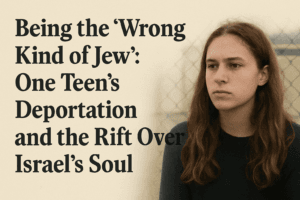
Being the “Wrong Kind of Jew”: One Teen’s Deportation and the Rift Over Israel’s Soul
When 18-year-old Leila Stillman-Utterback began reciting the shacharit morning prayers from a prayerbook in an Israeli detention center, the police officer watching her wore a look of confusion. Handcuffed and awaiting deportation from the Jewish state, this rabbi’s daughter from Vermont was an unsettling paradox: a deeply committed Jew being expelled for living out the very values she was taught. Her crime? Providing a “protective presence” for Palestinian farmers during the olive harvest in the occupied West Bank. Her punishment—a 10-year ban from Israel—has become a flashpoint in a growing conflict over who defines Judaism, what criticism of Israel is permitted, and the future relationship between Israel and the Jewish diaspora.
The Journey to the Olive Grove
Leila Stillman-Utterback’s path to a police station in the settlement of Ariel began with a deep, critical connection to Israel. After graduating from Middlebury Union High School, she chose a gap year with Achvat Amim (“Solidarity of Nations”), a program combining Jewish text study with volunteer work in Israel and the West Bank. For Leila, this was the perfect way to engage with a place she loved but also struggled against, guided by the Jewish principles of tikkun olam (repairing the world) and b’tselem elohim (the belief that every human is created in God’s image).
In Jerusalem, she found a community of Jewish leftists who split their time between synagogue, political demonstrations, and solidarity actions with Palestinians. Twice a week, she volunteered with the Israeli organization Rabbis for Human Rights, accompanying Palestinian farmers to their olive groves. The goal was simple yet profound: to use her presence as a Jew to help shield Palestinians from harassment or attack by Israeli settlers. “Accompanying farmers as Jews made a statement,” she wrote. “We would not stand idly by”.
“You Are the Wrong Kind of Jew”
On October 29, after a day of harvesting olives, Leila and ten other volunteers were stopped by Israeli soldiers while walking back to their bus. They were detained and taken to a police station. What she assumed would be a brief inconvenience—other activists she knew had been released with temporary bans from the West Bank—turned into an ordeal. After hours of interrogation, she was informed her detention had become an arrest. A deportation hearing was set for 3 a.m.
Leila was stunned. “I am not Greta Thunberg,” she reflected, referencing the climate activist deported weeks earlier. “I am an 18-year-old Jewish American, the daughter of a rabbi”. In her mind, her Jewish credentials were impeccable: she kept Shabbat, spoke fluent Hebrew, and wore rings etched with the words of the Shema prayer. Yet, none of this mattered. “All that seemed to matter is that by showing up as a Jew to aid Palestinians, I was the wrong kind of Jew”.
This experience highlights a central, painful irony. Leila felt her deportation was a personal betrayal by a nation she was told was a homeland for all Jews. The message from the state, however, was clear: solidarity with Palestinians is an unwelcome act. As Daniel Sokatch, CEO of the New Israel Fund, stated, “The message the Israeli government is sending to Jews around the world is a stark rebuke… Diasporic Jews are not welcome in Israel if they dare protest what the self-described Jewish State does”.
Part of a Broader Crackdown
Leila’s case is not an isolated incident but part of a systematic crackdown on solidarity activism. In October 2025 alone, Israel detained and deported 32 foreign activists accompanying Palestinian harvesters near the town of Burin. Just a week before Leila’s deportation, a 57-year-old American Jewish woman was similarly banned for ten years after participating in the same olive harvest.
Authorities have repeatedly blocked efforts by Israeli and international volunteers to assist with the harvest, a practice activists call providing a “protective presence.”. The rationale is often a violation of tourist visa terms by entering a “closed military zone”—a designation the army can impose at will. For the volunteers, the goal is to deter violence through witness. For the Israeli government, it represents an unacceptable challenge to its control and the actions of settlers.
The Violent Backdrop: Settler Attacks Surge
This crackdown on activists occurs against a backdrop of escalating settler violence. The olive harvest, a crucial economic and cultural event for Palestinians, has become a particularly dangerous time.
- Unprecedented Scale: The United Nations recorded more than 260 settler attacks in October 2025—the highest monthly count since it began monitoring in 2006. Another 126 attacks were specifically related to the olive harvest.
- Organized Campaigns: Attacks are not random. Analyses describe them as “deliberate efforts to undermine Palestinian rural life” and an “organized campaign of revenge” intended to drive Palestinians from their land.
- Climate of Impunity: A key driver is the near-total lack of accountability. According to the Israeli human rights group Yesh Din, only about 3% of investigations into settler violence between 2005 and 2024 resulted in a full or partial conviction. Under the current far-right government, police have opened 75% fewer investigations into settler violence than in 2023.
Table: The Escalating Crisis of Settler Violence in the West Bank
| Aspect | Key Detail | Source |
| Recent Surge | UN recorded >260 attacks in Oct 2025, the highest monthly tally since 2006. | |
| Economic Target | Olive harvest-related attacks are frequent, aiming to destroy a primary source of Palestinian livelihood. | |
| Accountability Gap | Only ~3% of investigations into settler violence (2005-2024) led to conviction. | |
| Government Ties | Key ministers have ideological ties to extremist settlers and have supported new settlement expansions. | |
| Strategic Goal | Analysts state violence aims to create “facts on the ground” and make Palestinian life unsustainable. |
Ideology, Opportunism, and Political Will
Scholars and analysts point to a confluence of factors fueling this violence:
- Religious-Zionist Ideology: A segment of the settler movement views Jewish control over the entirety of the historical Land of Israel as a divinely mandated step toward redemption. From this perspective, violence against Palestinians is a sanctioned tool to solidify control.
- Political Opportunism: The war in Gaza and the rise of the most right-wing government in Israel’s history have created a permissive environment. Key ministers like Finance Minister Bezalel Smotrich (who lives in a settlement) and National Security Minister Itamar Ben-Gvir (a convicted inciter) have close ties to the settler movement and have advocated for annexing most of the West Bank.
- Strategic Annexation: Violence “from below” by settlers works in tandem with policy “from above” to advance a clear goal: the coerced depopulation of Palestinians from strategic areas to enable de facto Israeli annexation.
A Generational Rift in American Jewry
Leila’s story resonates powerfully because it exposes a deepening generational divide among American Jews regarding Israel. Her mother, Rabbi Danielle Stillman, expressed concern that such actions damage the relationship between Israel and the diaspora. Data supports this worry:
- A Washington Post survey found that while about two-thirds of American Jews over 65 feel emotionally attached to Israel, only about one-third of those aged 18-34 share that attachment.
- Furthermore, about half of younger Jews believe Israel has committed genocide in Gaza, compared to about a third of older Jews.
For younger, progressive Jews like Leila, their Jewish identity is inseparable from social justice. When Israel’s actions conflict with these values, they choose to critique, not disengage. Leila explicitly rejects the notion that criticism of Israel is antisemitic, arguing it is possible and necessary to “hold criticism and love at the same time”.
Refusing to Give Up
Despite her harrowing experience, Leila Stillman-Utterback is appealing her 10-year ban and remains committed to her vision of justice. In her essay, she issued a determined call: “I am not done with Israel, not done with Judaism. I am not giving up, and neither should any leftist American Jew”.
Her stance embodies the “power” she found in defying binaries. By asserting that she stands with Palestinians because of her Judaism, not in spite of it, she challenges the very foundations of the current political narrative. Her story is no longer just about one teenager’s disrupted gap year. It has become a symbol of the struggle for the soul of Jewish identity and the future of a land where, as she insists, the only way forward is “in the place of struggle”.
You must be logged in to post a comment.