
Barriers to the Bar: How India’s Law Entrance Exams Exclude Disabled Aspirants
Despite India’s constitutional guarantees and the progressive Rights of Persons with Disabilities Act (2016), which mandate reasonable accommodations, candidates with disabilities face systemic exclusion in law entrance exams like CLAT and AILET. Interviews with 34 aspirants reveal a consistent pattern of failure in implementation: inaccessible exam centers, an unreliable and stressful scribe system, untrained and often hostile invigilators unaware of legal accommodations, and exam designs featuring visually intensive questions that inherently disadvantage visually impaired candidates.
These barriers collectively transform a test of legal aptitude into an unfair trial of endurance, undermining the principles of equality and dignity that the legal profession vows to uphold. The persistent gap between statutory obligation and ground-level execution highlights a critical failure to ensure that the gateway to legal education is truly accessible, betraying the very justice system these aspirants seek to join.
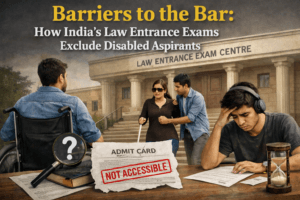
Barriers to the Bar: How India’s Law Entrance Exams Exclude Disabled Aspirants
For thousands of young Indians, entrance exams like the CLAT or AILET represent a gateway to a career in law—a profession built on the principles of justice, equality, and fairness. Yet, for a significant number of aspirants with disabilities, this gateway is obstructed by a glaring paradox: the very system designed to select future guardians of the law is itself failing to comply with it.
A recent study, drawing from interviews with 34 candidates with disabilities who attempted various law entrance exams between 2014 and 2023, paints a distressing picture[reference:0]. Despite robust constitutional guarantees and progressive legislation like the Rights of Persons with Disabilities (RPwD) Act, 2016, these aspirants encounter a pattern of systemic failure that transforms a test of aptitude into a grueling trial of endurance and exclusion[reference:1].
The Promise of the Law vs. The Reality on the Ground
The Indian Constitution enshrines equality, non-discrimination, and dignity as fundamental rights[reference:2]. The RPwD Act of 2016 translates these principles into concrete entitlements, mandating “reasonable accommodations” to ensure a level playing field in education and examinations[reference:3]. These are not mere suggestions but legally enforceable obligations.
Furthermore, the Department of Empowerment of Persons with Disabilities has issued detailed “Revised Comprehensive Guidelines” (2025) that specify everything from barrier-free access and separate rooms to scribe provisions and compensatory time[reference:4]. The legal framework is unambiguous. The problem, as the candidates’ experiences reveal, is one of widespread non-compliance and haphazard implementation.
A Catalogue of Exclusion: Where the System Fails
The barriers faced by candidates are not isolated incidents but interconnected failures across the entire examination ecosystem.
- The First Hurdle: Inaccessible InfrastructureThe challenge often begins long before the exam paper is distributed. Candidates reported being assigned examcentres located 20-40 km away, requiring exhausting travel that drains them before the test even begins[reference:5]. Upon arrival, they frequently find the infrastructure unprepared: a lack of ramps or lifts forces some to be physically carried up multiple flights of stairs[reference:6]. The absence of separate, quiet rooms is particularly detrimental for those using scribes or entitled to compensatory time, as noise and disturbances from other candidates leaving the hall disrupt their concentration[reference:7].
- The Scribe System: A Source of Anxiety, Not SupportFor many visually impaired or dyslexic candidates, a scribe is not a luxury but a necessity. However, the process of arranging one is fraught with uncertainty. While some exams allow candidates to bring their own, others insist on providing one, often with disastrous results. Candidates described meeting their assigned scribe for the first time just days—or even minutes—before the high-stakes exam, leaving no time to build the essential rapportand默契 needed for effective communication[reference:8]. One candidate recounted a “particularly troubling experience” where last-minute confusion and rigid rules at an exam centre nearly left them without a scribe altogether[reference:9].
- Accommodations Undermined by IgnoranceEven when accommodations are formally granted, they are often negated by a lack of awareness at the ground level. Multiple candidates reported that invigilators were completely unaware of rulesregarding compensatory time, forcing the candidate to waste precious minutes arguing for their legal right[reference:10]. Others faced suspicion and hostility, with invigilators making dismissive comments or accusing them of being “fake PWD”[reference:11]. This adversarial environment adds an immense mental burden during an already high-pressure situation.
- Inherently Biased Exam DesignPerhaps themost profound failure is in the design of the tests themselves. Candidates with visual disabilities identified “visually intensive” questions (involving diagrams, graphs, or seating arrangements) and excessively long reading comprehension passages as major barriers[reference:12]. These question types test visual processing speed and memory recall through a mediator (the scribe), rather than logical reasoning or legal aptitude. As one candidate pointed out, the “elitist” and speed-heavy nature of exams like the CLAT creates barriers not just for disabled candidates, but for many from diverse linguistic and educational backgrounds[reference:13]. The study notes that the 2021 CLAT, which avoided such formats, was widely regarded as more accessible without compromising quality, proving that inclusive design is possible[reference:14].
From Compliance to Inclusion: A Blueprint for Change
The candidates themselves offered clear, practical recommendations for reform, moving beyond box-ticking compliance toward genuine inclusion:
- Scribe Reforms: Allow candidates to meet and practice with scribes weeks in advance, not days. Relax rigid rules on scribe qualifications while providing them with sensitivity and subject-matter training[reference:15].
- Expand Choices: Offer a genuine choice between a human scribe and computer-based assistive technology like screen readers[reference:16].
- Rethink Time and Design: Compensatory time must be meaningful and account for the actual reading load of modern exams. Exam patterns must be audited for accessibility, reducing reliance on visually dense and memory-intensive formats[reference:17][reference:18].
- Mandatory Training: Comprehensive, mandatory training for all invigilators and centre staff on disability etiquette, legal obligations, and the purpose of accommodations is non-negotiable[reference:19].
- Proactive Planning: Use registration data to plan accommodations in advance, conduct pre-exam accessibility audits of centres, and avoid last-minute changes to patterns or rules[reference:20].
Conclusion: A Test of the System’s Integrity
The findings are a stark indictment of the current state of affairs. As the article concludes, “The challenge before examination authorities is no longer one of clarity, but of compliance”. The Supreme Court has repeatedly ruled that accessibility cannot be an afterthought but must be embedded in design and execution from the outset[reference:22].
Every law aspirant with a disability who is forced to navigate this broken system is a testament to a profound failure. They are not asking for an advantage, but for the equal opportunity that is their fundamental right. Ensuring that the gateways to legal education are open to all is not just a matter of policy—it is the first and most crucial test of the legal system’s own integrity and its commitment to the justice it promises to uphold. The question is no longer what the law says, but whether we have the will to enforce it.
You must be logged in to post a comment.