
Barak’s Demographic Blueprint: What Epstein Files Reveal About Israel’s Ethnic Engineering
The recently released Epstein files reveal a secret recording in which former Israeli Prime Minister Ehud Barak outlined to Jeffrey Epstein a deliberate strategy of demographic engineering, advocating for the importation of “one more million” Russians to dilute the growing Palestinian citizen population within Israel, which he explicitly framed as a concerning “issue.” In the conversation, Barak established a stark hierarchy of belonging, prioritizing equality for Druze and Christian citizens over others, while disparaging earlier waves of Mizrahi Jewish immigrants from Arab countries as a historical necessity rather than a choice. These candid remarks expose the utilitarian mindset behind long-standing policies, viewing human beings as demographic tools to reshape national character and maintain a particular ethnic balance, all while revealing the ethically troubling context of such planning being discussed with a convicted sex trafficker who served as Barak’s financial adviser and confidant.
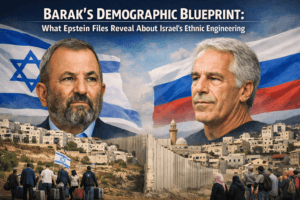
Barak’s Demographic Blueprint: What Epstein Files Reveal About Israel’s Ethnic Engineering
A secret recording captures a former Israeli prime minister discussing with a convicted sex trafficker how to reshape his country’s population through selective immigration—treating human beings as demographic pawns in a geopolitical chess game.
The release of the Epstein files has unveiled more than just connections between powerful men and a convicted sex offender. In one startling recording, former Israeli Prime Minister Ehud Barak can be heard explaining to Jeffrey Epstein his vision for Israel’s demographic future—a plan involving the deliberate importation of one million Russians to “dilute” the Palestinian presence. Barak’s remarks expose a rarely articulated but deeply influential philosophy: that demographics can and should be engineered to serve political ends, with different ethnic groups assigned different values in a national hierarchy. These revelations provide a rare, unfiltered glimpse into the thinking that has shaped Israeli policy for decades.
The Barak-Epstein Demographic Proposal
In the recording made on February 14, 2015, Barak outlines a calculated strategy to reshape Israel’s population balance. He recounts telling Russian President Vladimir Putin that Israel needed “just one more million to change Israel in a dramatic, dramatic manner” through Russian immigration. His rationale is explicitly demographic: “Even within the borders of smaller Israel, there is still an issue. And I think the Arabs [Palestinian citizens of Israel] are growing slowly. They were 40 years ago, they were 16 percent and now they are 20 percent”.
Barak’s approach reflects a belief in social engineering through selective migration. He advocates that Israel should now “control the quality” of Russian settlers rather than accepting all who come, as was done with previous waves. His vision includes breaking “the monopoly of the orthodox rabbinate on marriage and funerals and whatever, and the definition of a Jew” to facilitate mass conversions. This strategy reveals a pragmatic, almost utilitarian approach to Jewish identity—viewing religious conversion less as spiritual transformation than as a demographic tool for national objectives.
The Hierarchy of Belonging: Who Deserves Equality?
Perhaps most revealing in Barak’s comments is his explicit ranking of ethnic and religious groups within Israeli society, creating a clear hierarchy of who deserves full equality:
| Group | Barak’s Characterization | Suggested Level of Equality |
| Druze | “Totally Israelis in their behavior” | First priority for equality |
| Christians | “Have an education system which is better than ours” | Second priority |
| Russian immigrants | Could be absorbed to change demographics | Selective, quality-controlled absorption |
| Mizrahi Jews | Taken from Arab countries “from whatever” | Historically treated as necessity rather than choice |
| Palestinian Muslims | Growing percentage seen as “issue” | Not mentioned for equality priorities |
This hierarchy aligns disturbingly with documented patterns of systemic discrimination within Israel. According to research by organizations like Amnesty International, Israel maintains “a cruel system of domination” against Palestinians that amounts to apartheid under international law. While Barak’s comments focus specifically on Palestinian citizens of Israel (approximately 21% of the population), they reflect a broader mentality that privileges certain groups over others based on perceived loyalty or utility to the state.
Historical Context: The Mizrahi Experience
Barak’s apparent disparagement of Jews from Arab and Muslim countries—referring to them as people Israel’s founders took “from North Africa, from the Arabs, from whatever”—echoes a painful history of ethnic discrimination within Israeli society. Following Israel’s establishment in 1948, approximately 900,000 Jews migrated, fled, or were expelled from Muslim-majority countries.
Despite making up over half of Israel’s Jewish population today, Mizrahi Jews (those from Middle Eastern backgrounds) have historically faced systemic marginalization by the predominantly Ashkenazi (European Jewish) establishment. They were often settled in peripheral development towns with fewer resources, faced discrimination in housing and employment, and encountered cultural denigration of their Middle Eastern heritage.
Barak’s suggestion that Israel could be more “selective” now than when it accepted Mizrahi immigrants implicitly devalues the humanitarian aspect of Israel’s earlier absorption efforts. During the mass exodus of Jews from Arab countries in the 1950s and 1960s, Israel pursued an “One Million Plan” to accommodate Jewish immigrants from these regions, accepting nearly 650,000 by 1972. Barak’s comments suggest viewing this humanitarian effort through a utilitarian lens—as an unavoidable necessity rather than a moral imperative.
The Mechanics of Demographic Engineering
Barak’s proposed strategy for managing the “quality” of Russian immigrants reveals a sophisticated approach to demographic engineering. He suggests that conversion to Judaism need not be a strict “precondition” for Russian immigrants, predicting that “under the social pressure of the need, especially of the second generation, to adapt. It will happen”. This reflects a long-term assimilationist perspective, counting on societal pressures to accomplish what formal policy might not mandate.
This thinking aligns with historical Israeli policies aimed at maintaining a Jewish demographic majority. According to Amnesty International, since its establishment in 1948, Israel has pursued a policy of “establishing and then maintaining a Jewish demographic majority, and maximizing control over land and resources to benefit Jewish Israelis”. This has manifested in practices like “Judaization” programs in the Negev and Galilee regions, where Palestinian communities face home demolitions and land confiscation while Jewish settlement is encouraged.
The Epstein recording suggests Barak viewed Russian immigration as a demographic counterbalance to Palestinian population growth. With Palestinian citizens of Israel comprising approximately 21% of the population and growing, Barak’s comments reveal a perception of this natural demographic trend as a problem requiring engineered solutions.
The Unsettling Nature of the Conversation
The context of these revelations—a private conversation with Jeffrey Epstein—adds disturbing dimensions to the already troubling content. Barak visited Epstein’s New York townhouse more than 30 times between 2013 and 2017, suggesting a substantial relationship beyond a single conversation. According to an FBI memo in the Epstein files, “Epstein was close to the former Prime Minister of Israel, Ehud Barak, and trained as a spy under him”.
Their relationship appears to have included discussions of financial opportunities for former leaders. In another part of their conversation, Barak and Epstein discuss the “gigantic” sums paid to former British Prime Minister Tony Blair for consulting work, with Barak asking Epstein “how do we make money out of” government contracts. This transactional dimension reveals Epstein serving as what one analysis describes as “a trusted financial adviser, fixer, concierge, sounding board and even friend to Barak”.
The presence of these demographic discussions within a conversation that also touches on financial opportunities for ex-leaders creates an unsettling intersection of political power, demographic engineering, and personal gain. It raises questions about how demographic policies might be influenced by or connected to personal financial considerations of those in power.
The Broader Implications for Israeli Society
Barak’s comments, while particularly explicit, reflect a continuum of demographic thinking in Israeli politics. The “demographic threat” narrative has long influenced Israeli policy, from the original formulation of the Law of Return to contemporary debates about citizenship laws. What makes Barak’s remarks notable is their candor in articulating a vision of human beings as demographic instruments rather than individuals with inherent rights.
This thinking has tangible consequences for millions. Palestinian citizens of Israel face more than 60 laws that discriminate against them directly or indirectly. They experience systematic discrimination in housing, with approximately 80% of state lands off-limits to them and thousands of homes threatened with demolition due to discriminatory planning policies. Meanwhile, under Israel’s Law of Return, Jews from anywhere in the world can immigrate and receive automatic citizenship, a policy Barak’s comments suggest should be strategically deployed for demographic objectives.
Conclusion: Beyond the Scandal
The Epstein files revelation about Ehud Barak’s demographic discussions provides more than just another scandalous headline about a disgraced financier’s powerful associates. It offers a rare unfiltered window into how some political leaders conceptualize population groups as instruments of policy—to be managed, balanced, and strategically deployed for national objectives.
The recording exposes a hierarchical vision of citizenship that continues to influence policy, where different ethnic and religious groups are valued differently based on their perceived utility to maintaining a particular demographic balance. While Barak’s comments specifically address Russian immigration as a counterweight to Palestinian population growth, they reflect a broader utilitarian approach to human beings that has shaped Israeli policy toward multiple communities throughout its history.
These revelations arrive amid growing international scrutiny of Israel’s treatment of different population groups. From the 2018 “Jewish nation-state law” that enshrined Jewish supremacy in Israel’s quasi-constitutional framework, to ongoing “Judaization” policies in the Negev and Galilee, to the separate legal systems in the occupied territories that human rights organizations describe as apartheid, Barak’s private comments help explain the philosophical underpinnings of policies that have drawn increasing international condemnation.
The conversation between Barak and Epstein serves as a disturbing reminder that demographic engineering is not just a historical concept but an ongoing practice in some political contexts. It challenges us to consider the ethical implications of treating human beings as demographic statistics to be manipulated rather than as individuals with inherent dignity and rights. As Israel continues to grapple with questions of identity, citizenship, and equality, these candid remarks from a former prime minister may prove difficult to reconcile with the country’s democratic aspirations.
You must be logged in to post a comment.