
Bangladesh’s Fractured Democracy: How Hadi’s Death Ignites Unrest and Imperils Regional Stability
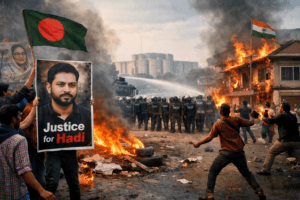
Bangladesh is facing a period of intense political turmoil and diplomatic strain, ignited by the assassination of prominent activist Sharif Osman Hadi, which sparked violent protests targeting media offices, cultural centers, and Indian diplomatic facilities. The interim government of Chief Adviser Muhammad Yunus has responded with security crackdowns, identifying suspects involved in the unrest, while scrambling to reassure international observers ahead of critical 2026 elections. This domestic crisis has severely strained relations with India, primarily over India’s sheltering of ousted leader Sheikh Hasina, leading to suspended visa services and heated diplomatic exchanges, all of which threaten to destabilize both Bangladesh’s fragile democratic transition and regional stability in South Asia.
Bangladesh’s Fractured Democracy: How Hadi’s Death Ignites Unrest and Imperils Regional Stability
The December 2025 unrest near the Indian Assistant High Commissioner’s residence in Chattogram was more than a fleeting security incident. It represents a dangerous flashpoint in a nation caught between a fragile democratic transition, deepening anti-India sentiment, and the looming shadow of a pivotal national election. The identification of three suspects involved in this specific act is the tip of a much larger iceberg, revealing systemic tensions that threaten to destabilize not only Bangladesh but the geopolitical balance of South Asia.
The Catalyst: The Assassination of a Revolutionary Icon
The unrest sweeping Bangladesh has a name and a face: Sharif Osman Hadi, a 32-year-old former spokesperson for the youth-led political platform Inqilab Mancha. Hadi was not just another activist; he was a prominent leader of the widespread July 2024 student uprising that ultimately toppled the 15-year authoritarian rule of Prime Minister Sheikh Hasina. His political journey—from protest leader to an independent candidate for parliament in the Dhaka-8 constituency—symbolized the aspirations of a generation seeking change.
His violent end was a shock to the system. On December 12, 2025, the day after Bangladesh’s Election Commission announced the schedule for the February 2026 general elections, Hadi was shot in the head by masked assailants on a motorcycle while traveling in Dhaka. He was flown to Singapore for treatment but succumbed to his injuries on December 18. His death became a powerful catalyst, transforming grief into widespread fury.
The public anger was multi-directional:
- At the State: Many protesters accused the interim government of failing to protect Hadi and demanded the resignation of top security officials.
- At Political Rivals: Rumors, amplified on social media, alleged that the attacker was an activist from the ousted Awami League who had fled to neighboring India.
- At Media and Culture: Newspapers perceived as pro-establishment or pro-India, and cultural institutions seen as symbols of a secular elite, became physical targets for the mob’s rage.
Escalation: From Protests to Coordinated Attacks
The wave of violence that followed Hadi’s death was notable for its coordinated nature and ideological targets. It moved far beyond spontaneous demonstrations, revealing a deliberate strategy to attack specific pillars of society.
- Assault on Independent Media: On the night of December 18, mobs attacked the offices of Bangladesh’s two leading newspapers, Prothom Alo and The Daily Star. The violence was severe. At Prothom Alo’s headquarters, protesters broke in, vandalized the reception, and set fire to furniture and documents. The attack on The Daily Star was even more dire, with a fire set in the lobby trapping 25-28 journalists and staff on the roof for hours before they were rescued by firefighters and the army. These outlets were targeted because they are viewed by the protesters as taking a pro-India editorial stance, thus seen as complicit with the old regime.
- Targeting Cultural Institutions: Violence also struck at the heart of Bengali culture. The Chhayanaut cultural center, renowned for promoting traditional Bengali music and arts, was vandalized. Attackers justified this by labeling it a promoter of “Indian culture”. This assault signaled a dangerous expansion of the conflict into the cultural sphere, aiming to redefine national identity itself.
- Diplomatic Flashpoints: The anger with clear anti-India undertones inevitably reached diplomatic premises. Protesters threw stones at the Indian Assistant High Commission in Chattogram. In Sylhet, announcements of protests targeting the Indian mission led police to deploy heightened, round-the-clock security at the Assistant High Commission office, the diplomat’s residence, and the visa application center. These incidents forced the interim government of Nobel laureate Muhammad Yunus into a delicate balancing act: calming public anger while reassuring a powerful neighbor and the international community of its control.
The Government’s Response: A Race Against Time
Faced with this multifaceted crisis, Chief Adviser Muhammad Yunus’s interim government has launched a two-pronged response: swift law enforcement action and urgent diplomatic reassurance.
- Security and Investigative Crackdown:Following a high-level security meeting at the State Guest House Jamuna, authorities announced significant progress in investigations.
- Regarding the diplomatic incident in Chattogram, police identified three individuals from video footage allegedly involved in the unrest near the Indian official’s residence.
- More broadly, in connection with the attacks on media and cultural organizations in Dhaka, police have identified 31 suspects and arrested at least six people in nationwide operations.
- Yunus has publicly instructed authorities to expedite the arrest of those involved in Hadi’s killing and other illegal activities, emphasizing that maintaining law and order ahead of the election is paramount.
- Diplomatic Firefighting:The government is acutely aware of the international community’s watchful eye. The foreign secretary has briefed diplomats, assuring them of maximum security for foreign missions and the expected international election observers. This is critical, as theEuropean Union is preparing to deploy its largest observation mission to Bangladesh since 2008, with 150-200 observers. The United States has already issued a security advisory for its citizens, warning that protests could turn violent as the February election nears.
The Regional Tinderbox: Bangladesh-India Relations at a New Low
The domestic turmoil has rapidly infected one of South Asia’s most important bilateral relationships. The Bangladesh-India partnership, which reached a high point of security cooperation during Sheikh Hasina’s tenure, is now under severe strain.
- The Hasina Factor: The core irritant is the presence of Sheikh Hasina in exile in India. Convicted in absentia for crimes against humanity and sentenced to death by a Bangladeshi tribunal, Hasina remains in India, which has not agreed to extradite her. For many Bangladeshi protesters and the Yunus government, India is sheltering a convicted criminal who is undermining their democratic transition.
- Rhetorical Volleys: The diplomatic tension has escalated into a war of words. A Bangladeshi political leader from the National Citizen Party warned that if India continued to shelter Hasina and Hadi’s alleged assailants, Bangladesh might reciprocate by sheltering separatists from India’s northeastern “Seven Sister” states. This threat struck a raw nerve in New Delhi, prompting a strong rebuttal from an Indian chief minister and a formal summons of Bangladesh’s high commissioner by India’s Ministry of External Affairs.
- Operational Fallout: The friction has tangible consequences. Bangladesh temporarily suspended visa services at its missions in New Delhi, Tripura, and Siliguri, while India had earlier suspended services at its Chittagong mission. There are even discussions within Bangladesh about scaling back its diplomatic presence in India if the situation worsens.
The Crossroads: Democracy, Stability, and the Future
As Bangladesh approaches its February 2026 election, it stands at a perilous crossroads. The path forward is fraught with challenges:
- Credible Elections Under Threat: Yunus has pledged a “free, fair and peaceful” election. However, the violence targeting political figures, media, and cultural institutions creates an atmosphere of intimidation that is antithetical to a free democratic process. The international community, while offering observation, is deeply concerned about security and credibility.
- The Specter of Wider Violence: The attack on Hadi appears part of a pattern. Days after his death, another youth leader from the 2024 uprising was shot in Khulna, raising fears of a coordinated campaign to silence dissent ahead of the polls.
- A Test for the Interim Government: The Yunus administration is caught between the need to uphold law and order and the demand for justice from a furious populace. Its ability to investigate Hadi’s murder transparently, protect all citizens and institutions, and conduct a peaceful election will define its legacy and Bangladesh’s immediate future.
The identification of three individuals near an Indian diplomat’s home is a small administrative step in a vast political storm. The real story is of a nation struggling to navigate its democratic rebirth amidst powerful internal fractures and intense external pressures. The outcome will resonate far beyond Bangladesh’s borders, shaping the strategic landscape of South Asia for years to come.
You must be logged in to post a comment.