
Balancing Energy Security and Geopolitics: 5 Key Takeaways from India’s Weekly Media Briefing
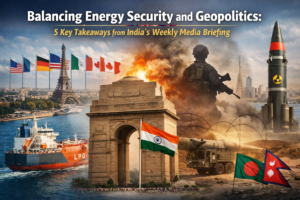
Balancing Energy Security and Geopolitics: 5 Key Takeaways from India’s Weekly Media Briefing
In the high-stakes world of diplomacy, the weekly media briefing by the Ministry of External Affairs (MEA) is often a barometer of India’s most pressing international challenges. The briefing held on March 27, 2026, was no exception. As the sun set over New Delhi, Official Spokesperson Shri Randhir Jaiswal fielded a barrage of questions that painted a vivid picture of a nation navigating a complex geopolitical labyrinth.
From the tense waters of the Strait of Hormuz to the historical reverberations of the 1971 Bangladesh Liberation War, and from the corridors of the G7 in Paris to the volatile nuclear rhetoric emanating from Pakistan, the briefing covered a wide spectrum of issues. Here is a deep dive into the five most significant takeaways that reveal India’s current diplomatic posture.
- The Strait of Hormuz: A Case-by-Case Struggle for Energy Security
The most immediate concern dominating the briefing was the safety of Indian shipping in the Strait of Hormuz, a critical chokepoint through which a significant portion of the world’s oil and LNG passes. With tensions in West Asia escalating, the movement of vessels has become perilous.
Spokesperson Jaiswal provided a crucial update: of the 24 Indian ships in the region, four laden with LPG had safely navigated the strait and arrived in India. However, the remaining 20 were still awaiting clearance. This candid admission underscores the precarious nature of the situation.
When pressed by journalists on whether Iran had granted passage for “friendly countries” and if the US had cleared these movements, Jaiswal’s response was a masterclass in diplomatic restraint. He avoided being drawn into specifics, reiterating that India is in constant touch with “all concerned countries” to ensure safe transit.
Human Insight: This isn’t just about shipping lanes; it’s about the fuel that powers Indian homes and industries. The spokesperson’s insistence that India’s energy sourcing is driven by three factors—the needs of 1.4 billion people, market dynamics, and the global situation—highlights a pragmatic, non-ideological approach. When asked directly about sourcing oil from Russia or Iran, Jaiswal skillfully deflected, stating such specifics were a matter for the Ministry of Petroleum. This separation of portfolios sends a clear signal: India’s energy policy is driven by necessity and market access, not by bowing to external pressure, even as it works diplomatically to de-risk its supply chains.
The suggestion of a potential international coalition, reportedly pushed by the UAE, to secure the strait was met with cautious acknowledgment. India is watching, but as of now, the strategy remains case-by-case, bilateral diplomacy.
- 1971 Revisited: A Clear Stance on Bangladesh’s Pursuit of Justice
Perhaps the most emotionally charged and historically significant moment of the briefing came in response to a question about a tweet by Bangladeshi Prime Minister Tarique Rahman, who had marked “Genocide Day” by calling out Pakistan.
Sidhant of WION asked for India’s stance, given its pivotal role in the 1971 Liberation War. Jaiswal’s response was unequivocal. In a striking departure from the usual neutral phrasing, he delivered a detailed and damning indictment of Pakistan’s actions during Operation Searchlight.
In both English and Hindi, he detailed the “systematic and targeted killing of millions of Bangladeshi people,” the “mass sexual violence against women,” and the resulting refugee crisis that saw millions flee to India. “It shook the conscience of the world at large,” he stated, before adding a sharp rebuke: “Pakistan however remains in denial to this very day of its crimes.”
Human Insight: This was more than a diplomatic statement; it was a reaffirmation of a foundational relationship. By explicitly supporting Bangladesh’s “desire for justice,” India is not only acknowledging its historical role but also signaling solidarity with the current government in Dhaka. The language was firm, leaving no room for Pakistan’s alternative interpretations. It served as a reminder that while India advocates for a stable neighborhood, it does not shy away from holding historical actors accountable for atrocities, especially when they shape the core identity of a close ally like Bangladesh.
- The G7 and the Voice of the Global South
External Affairs Minister Dr. S. Jaishankar was in France for the G7 Foreign Ministers’ meeting, and the briefing provided a glimpse into India’s messaging on the world stage. Spokesperson Jaiswal detailed Jaishankar’s participation in two key sessions.
In the first, on global governance, the Minister pushed for long-standing Indian priorities: United Nations Security Council reforms, streamlining peacekeeping operations, and strengthening humanitarian supply chains. But crucially, he acted as a conduit for the “Global South,” raising concerns about the impact of the West Asian conflict on food, fuel, and fertilizer security—issues that disproportionately affect developing nations.
In a second session, the focus was on connectivity and the India-Middle East-Europe Economic Corridor (IMEC). Here, Jaishankar linked the stability of the region directly to global trade resilience. He used India’s recent free trade agreements (FTAs) with the UK, EU, and EFTA countries to underline the strategic importance of a corridor like IMEC.
Human Insight: This segment reveals India’s dual strategy. On one hand, it engages with the G7 as a major power, advocating for systemic reforms. On the other, it positions itself as the voice of the Global South, ensuring that the economic fallout of conflicts—which often hits poorer nations hardest—is not forgotten in the deliberations of the wealthy. The mention of IMEC amidst the chaos in West Asia is particularly telling; India is signaling that it is looking beyond the current crisis to build long-term, resilient infrastructure that bypasses traditional chokepoints.
- Regional Dynamics: Courting Nepal, Engaging Bangladesh, and Critiquing Pakistan
The briefing offered a snapshot of India’s immediate neighborhood diplomacy.
- Nepal: With the swearing-in of a new Prime Minister, Balen Shah, in Kathmandu, India’s Ambassador was present. Prime Minister Narendra Modi promptly conveyed his congratulations, expressing a desire to take the “very special ties to even greater heights.” This swift outreach is standard practice but underscores the importance India places on its relationship with Nepal, signaling continuity and goodwill.
- Bangladesh: Beyond the 1971 comments, there was a pragmatic focus on the future. A question about Bangladesh’s High Commissioner stating that Dhaka would not take steps against India was welcomed. Spokesperson Jaiswal noted that a new government is in place, that dialogue is ongoing, and that India seeks to strengthen the “multi-dimensional” relationship. This balanced tone—acknowledging the historical bond while focusing on current bilateral engagement—reflects a maturing, stable partnership.
- Pakistan: The most pointed criticisms were reserved for Islamabad. When asked about Pakistan’s internal politics, including criticism of its army chief, Jaiswal framed it as part of a “systematic victimization of its minorities.” He highlighted the “shrinking numbers of minorities” in Pakistan as evidence of persecution.
More alarmingly, a journalist raised a former Pakistani diplomat’s threat that Delhi and Mumbai would be targeted if the US or Israel attacked Pakistan. Jaiswal’s response was terse and chilling: “I would not like to say much more on your question. However, the world knows—and we know—the serious threat, Pakistan’s nuclear arsenal poses to the entire world.”
Human Insight: This stark comment encapsulates the deep-seated security threat India perceives from its western neighbor. By shifting the focus from a diplomatic spat to a global existential threat, the spokesperson elevated the concern, implicitly arguing that Pakistan’s nuclear instability is not just a bilateral issue but a matter of international security.
- Clarifying Misconceptions: Evacuation, BRICS, and Diplomacy
The briefing also served to clear up several operational and procedural misconceptions.
- No Evacuation Needed: Amid fears of a full-scale conflict, there were questions about evacuating Indians from Gulf nations. Jaiswal firmly dispelled this, noting that hundreds of commercial flights continue to operate daily between India and the Gulf. “There is no question of evacuation,” he stated, providing a dose of reassurance to the families of the millions of Indians living and working in the region.
- The BRICS Conundrum: As the chair of BRICS, India is tasked with forging consensus. The spokesperson candidly admitted that the grouping remains “deeply divided” over the West Asia crisis. With some members directly involved in the conflict, the BRICS way of working—based on consensus—has made it difficult to issue a unified statement. This honesty reflects the limitations of multilateral forums when faced with direct geopolitical conflicts.
- Closed-Door Meetings: When asked about a reported remark by the External Affairs Minister at an all-party meeting, calling Pakistan a “dalal” (broker), Jaiswal declined to comment, citing the meeting’s closed-door nature. However, he pointed reporters to criticisms of Pakistan by its own political leaders—Defence Minister Khawaja Asif, Bilawal Bhutto, and Imran Khan. This was a clever rhetorical move, using Pakistan’s internal voices to reinforce India’s point.
Conclusion
The March 27 briefing was a window into the mind of Indian diplomacy. It revealed a government that is simultaneously managing a short-term crisis in the Strait of Hormuz, maintaining long-term strategic relationships in its neighborhood, and projecting a responsible global image at forums like the G7.
The overarching theme was one of principled pragmatism. On energy, India pursues its national interest without apology. On history, it stands firmly with its allies like Bangladesh. On security, it views Pakistan’s actions and nuclear posture with unflinching realism.
As the world awaits the next moves in West Asia, the Indian government, as articulated by its spokesperson, is focused on one thing above all: ensuring the safety of its citizens and the steady flow of resources that fuel its economic engine, all while navigating the turbulent waters of 21st-century geopolitics.
You must be logged in to post a comment.