
Australia’s Tragedy and a Geopolitical Storm: Dissecting Netanyahu’s Bondi Beach Comments
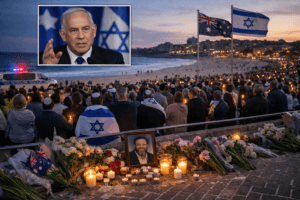
Australia’s Tragedy and a Geopolitical Storm: Dissecting Netanyahu’s Bondi Beach Comments
In the immediate, raw aftermath of a horrific terrorist attack, Israeli Prime Minister Benjamin Netanyahu ignited a geopolitical firestorm. By directly linking Australia’s recent recognition of a Palestinian state to the Bondi Beach massacre, Netanyahu transformed a moment of national grief into a contentious international debate about responsibility, antisemitism, and the price of foreign policy.
The Horrific Attack: A Community Targeted
On the evening of December 14, 2025, a community celebration at Sydney’s iconic Bondi Beach was shattered by violence. Two gunmen opened fire on a crowd of nearly 1,000 people gathered for “Chanukah by the Sea,” a public Hanukkah event. The attack, swiftly declared a terrorist incident by Australian authorities, resulted in 16 fatalities, including a child and one of the assailants, and left at least 43 people injured.
The victims included Rabbi Eli Schlanger, an organizer of the event who had served the Bondi community for 18 years. New South Wales Premier Chris Minns stated the attack was “designed to target Sydney’s Jewish community”. Police identified the perpetrators as a father and son who had pledged allegiance to the Islamic State; two IS flags were later found in their vehicle.
Netanyahu’s Swift and Sharp Accusation
Within hours of the tragedy, Prime Minister Netanyahu seized the international spotlight. He revealed he had sent a letter to Australian Prime Minister Anthony Albanese months earlier, following Australia’s September 2025 recognition of Palestine. In that letter, he claimed Australia’s policy was “promoting and encouraging antisemitism”.
At a press conference, Netanyahu escalated this warning into a direct accusation. “Your call for a Palestinian state pours fuel on the antisemitic fire. It rewards Hamas terrorists,” he stated. Using inflammatory medical metaphors, he likened the policy to a “cancer” and accused the Australian government of letting “the disease spread” with the Bondi attack as the direct result. He framed the shooting as part of a broader assault by attackers who “attack us because they attack the West”.
Albanese’s Firm Rejection and Call for Unity
Prime Minister Albanese firmly and repeatedly rejected this linkage. When asked if he accepted “any link between that recognition and the massacre in Bondi,” his answer was unequivocal: “No, I don’t”.
Instead of engaging in geopolitical blame, Albanese focused on domestic solidarity. “This is a moment of national unity where we need to come together… We need to wrap our arms around members of the Jewish community,” he emphasized. He defended Australia’s recognition of Palestine as part of a “coordinated international effort” to build momentum for a two-state solution, a position he noted is held by “overwhelmingly most of the world”.
The Core of the Dispute: Australia’s Recognition of Palestine
To understand the controversy, it’s crucial to examine what Australia actually did. On September 21, 2025, Australia, alongside the United Kingdom and Canada, formally recognized the State of Palestine.
However, this recognition was not unconditional. The official government media release spelled out clear prerequisites and expectations:
- It required that “the terrorist organisation Hamas must have no role in Palestine.”
- It was based on undertakings from the Palestinian Authority, including recognition of Israel’s right to exist, commitments to democratic elections, and reforms in finance and governance.
- It was explicitly framed as part of pursuing a “two-state solution,” which Australia described as “the only path to enduring peace and security for the Israeli and the Palestinian peoples”.
Despite these conditions, Netanyahu denounced the move at the time as an “absurdity” and a “reward for terrorism”.
A Community in Crisis: Rising Antisemitism in Australia
Netanyahu’s accusations landed in a nation already grappling with a documented surge in antisemitism. Jewish community leaders and an envoy appointed by the Australian government itself had been sounding alarms for months.
- A Spike in Incidents: In the year following the October 7, 2023, Hamas attacks on Israel, Australia recorded over 2,000 antisemitic incidents. The following year saw another 1,600 incidents.
- Government Appointee’s Warning: Jillian Segal, the government’s Special Envoy to Combat Antisemitism, stated after the Bondi attack that it “did not come without warning” and that “the writing has been on the wall”. Her report, released in July 2025 with approximately 50 recommendations, had seen little implementation in the preceding five months.
- Community Fear: Leaders like Rabbi Levi Wolff of Sydney’s Central Synagogue expressed a grim sentiment: “When antisemitism goes unchecked from the top, these are the things that happen”. For a community of just over 100,000 people, concentrated in Sydney and Melbourne, the sense of vulnerability was profound.
This context shows that while Netanyahu’s direct causal link was rejected, his comments tapped into genuine and severe concerns about community safety that predated the Bondi attack.
International Reactions and the Clash of Narratives
The world’s response to the Bondi tragedy bifurcated along two paths: universal condemnation of the attack and a divided reception to Netanyahu’s political commentary.
Global Condemnation and Solidarity: Leaders worldwide uniformly denounced the violence. U.S. President Donald Trump called it a “terrible” and “purely antisemitic attack”. King Charles III expressed being “appalled and saddened by the most dreadful antisemitic terrorist attack”. Messages of solidarity poured in from the United Nations, the European Union, New Zealand, and many other nations. Notably, the State of Palestine also issued a strong condemnation, rejecting “all forms of violence, terrorism, and extremism”.
A Contentious Political Debate: Netanyahu’s specific accusations fueled a parallel debate in media and academic circles. Some commentators echoed his sentiment, arguing that movements advocating for Palestinian rights created a permissive atmosphere for violence. Conversely, many advocates and scholars were outraged. Ben Saul, UN Special Rapporteur and chair of international law at the University of Sydney, said he was “disgusted” by the link Netanyahu made. Antony Loewenstein of the Jewish Council of Australia called Netanyahu a “disgraceful human being” for the comments, arguing that the Israeli government’s own actions endanger Jewish people globally.
The following table summarizes the core conflicting perspectives in the aftermath:
| Aspect | Netanyahu/Israeli Government Position | Australian Government & Critical Response |
| Link to Policy | Direct causation: Recognition of Palestine “fuels antisemitism” and led to the attack. | No connection. Recognition is a legitimate diplomatic step for peace, separate from domestic terrorism. |
| Primary Response | Assign geopolitical blame and demand policy reversal. | Foster national unity, support victims, and review domestic security & gun laws. |
| View on Criticism | Slogans like “From the River to the Sea” are antisemitic incitement that must be banned. | A distinction must be maintained between antisemitism and legitimate criticism of Israeli government policy. |
| Core Narrative | Australia’s “weakness” and “appeasement” enabled the tragedy. | The attack was driven by extremist ideology, and the community’s safety is a domestic priority. |
The Unanswered Questions and Lasting Implications
The Bondi Beach massacre and the political storm that followed leave difficult, unresolved questions:
- Timing and Tone: Was it appropriate for a foreign leader to issue such a sharply political critique just hours after a national tragedy, or did it exploit grief for geopolitical aims?
- Root Causes: Does foreign policy genuinely motivate isolated terrorists, or does blaming it risk oversimplifying complex personal radicalization and domestic security failures?
- Community Safety: How can nations best protect minority communities while preserving the space for robust, legitimate foreign policy debate?
The attack has already spurred concrete action in Australia, with the National Cabinet agreeing to strengthen the country’s already strict gun laws. However, the deeper wound—the fear within a community and the frayed trust between nations—will take far longer to heal.
The events at Bondi Beach underscore a painful reality of our interconnected world: a local act of hate can instantly become a global flashpoint, refracting through the prisms of distant conflicts and forcing communities to navigate their grief on a stage crowded with competing political narratives. The challenge for leaders, as Albanese attempted, is to address real security failures and legitimate geopolitical disagreements without allowing the essential task of mourning and unity to be lost in the noise.
You must be logged in to post a comment.