
Australia’s Day of Discord: When a Presidential Visit Exposed a Nation’s Raw Divisions
Australian police have defended their use of force, including pepper spray and physical clashes, during a major protest in Sydney against Israeli President Isaac Herzog’s state visit, after a court upheld restrictions that banned a planned march. While authorities cited “remarkable restraint” by officers who were “assaulted” and “outnumbered” by violent elements within the thousands-strong demonstration, protesters and civil groups condemned the response as disproportionate, citing footage of praying Muslim men being dragged away and an injured MP. The deeply divisive event, rooted in global outrage over the Gaza war and Herzog’s contested role, has exposed raw local tensions, testing Australia’s balance between public security, the right to protest, and the domestic reverberations of international conflict.
Australia’s Day of Discord: When a Presidential Visit Exposed a Nation’s Raw Divisions
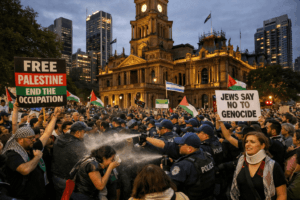
The evening air in Sydney, thick with summer humidity, carried not the usual cheerful buzz of the city but a charged current of anger and anguish. Outside the ornate façade of Town Hall, a sea of people gathered, their voices coalescing into a unified chant for Palestine. Hours earlier, a court had upheld a police order: they could assemble, but they could not march. This legal verdict, delivered just thirty minutes before the protest began, set the stage for a violent confrontation that would see police pepper spray clouding the air, punches thrown, and a nation forced to confront the profound and painful divisions playing out on its streets.
The catalyst was the state visit of Israeli President Isaac Herzog, an invitation extended by Prime Minister Anthony Albanese’s government in a gesture of solidarity following an antisemitic attack at Bondi Beach. For many in Australia’s Jewish community, still grieving the December shooting that killed 15 during a Hanukkah celebration, the visit was a symbolic arm of support. For pro-Palestinian activists and a growing number of critics, it was a profound moral affront, given Herzog’s role in the ongoing war in Gaza and a UN commission’s finding that his rhetoric had incited genocide—a claim he vehemently denies.
What unfolded next was less a simple protest and more a physical manifestation of a global conflict’s local aftershocks, testing the very fabric of Australian civil society.
The Powder Keg: Restricted Assembly and Escalating Tensions
The New South Wales government, wary of public safety after the Bondi attack, had enacted stringent “major event” powers. These rules effectively transformed parts of central Sydney into a controlled zone, granting police broad authority to prevent marches. Protest organisers argued this was a suppression of democratic rights. “We should have had the right to march,” said Josh Lees of the Palestine Action Group, framing the static protest as a provocation in itself.
For hours, the rally was peaceful. Speeches echoed against stone buildings. Sihal Jamila, her voice trembling, told the BBC of her fear for children in Gaza and her own. Jewish demonstrators like Linda Feinberg stood with signs reading “Jews say no to genocide,” highlighting the complex, non-monolithic nature of the community’s response. But as speeches concluded, the pent-up energy sought an outlet. The crowd began to chant, “Let us march.” Police lines, anticipating this, tightened.
Then, the dynamic shifted violently. Video footage captures the chaotic moment: protesters pressed against police cordons, officers surging forward, punches thrown, bodies dragged. Pepper spray hung in the air, sending people coughing and stumbling, only to find themselves hemmed in by more officers. Among those caught in the fray was NSW Greens MP Abigail Boyd, who later posted a photo of herself in a neck brace, alleging police shoved her forcefully despite her identifying herself as a parliamentarian.
The Battle of Narratives: Restraint or Excessive Force?
In the cold light of Tuesday morning, two starkly different accounts emerged.
Police leadership stood firm. NSW Police Commissioner Mal Lanyon described his officers’ actions as showing “remarkable restraint.” Assistant Commissioner Peter McKenna painted a scene of officers “threatened, jostled and assaulted” by a violent subset of a crowd that significantly outnumbered them. Their mandate, reinforced by Premier Chris Minns, was to protect attendees at a nearby event with President Herzog and maintain public order under difficult circumstances. Minns urged the public not to judge by “a 10-second clip,” framing the situation as “impossible.”
The counter-narrative, however, was visceral and damning. The Australian National Imams Council called footage of Muslim men being dragged away while praying “shocking, deeply disturbing, and entirely unacceptable.” For many observers, these images symbolised a disproportionate response, questioning whether the maintenance of order had crossed into the suppression of peaceful religious observance and legitimate protest.
This clash speaks to a deeper, ongoing debate in Australia and other democracies: where is the line between ensuring public safety and upholding the fundamental right to dissent, especially when that dissent is loud, uncomfortable, and rooted in a deep sense of international injustice?
The Shadow of Gaza: Why This Visit, Why This Fury?
To understand the intensity of the protest, one must look beyond Sydney’s streets. The invitation to President Herzog was not viewed in a vacuum. For pro-Palestinian groups, it arrived amidst a devastating war in Gaza, with a staggering civilian death toll. Herzog’s now-infamous comment that “it’s an entire nation out there that is responsible” for the October 7 Hamas attacks, and his photographed act of signing a shell destined for Gaza, have made him a potent symbol for those accusing Israel of collective punishment.
These very acts were cited in South Africa’s case at the International Court of Justice accusing Israel of genocide. While Herzog condemns the UN report as taking his words out of context, for the protesters, his presence on Australian soil, being hosted with state honour, felt like an endorsement of a military campaign they view as catastrophic. Their protest was not merely against a foreign leader; it was against their own government’s perceived complicity.
The Aftermath and the Path Forward
The fallout is ongoing. A second protest was called for Tuesday evening outside a police station, demanding dropped charges and investigations into officer conduct. The political reverberations continue, with Prime Minister Albanese expressing devastation at the scenes but firmly defending Herzog’s invitation, arguing the violence “undermined” the protesters’ cause.
Yet, this incident leaves Australia with pressing questions. Have post-Bondi security measures, however well-intentioned, created a framework where the state’s power to restrict assembly too easily overrides the democratic right to protest? In a multicultural society home to passionate communities with direct ties to overseas conflicts, how does the nation facilitate painful but necessary conversations without them spilling into violence?
The Sydney clash is a symptom of a world where international crises are no longer distant headlines but local realities. It reveals a society struggling to navigate the treacherous terrain where community solidarity, free speech, security concerns, and global moral outrage intersect. The pepper spray will dissipate, the bruises will fade, but the challenge of holding a polarized community together in respectful dialogue remains. The test for Australia is not just how it polishes its streets after a protest, but how it mends the tears in its social fabric exposed by the visit of a president and the fury it ignited.
You must be logged in to post a comment.