
Australia Divided: Herzog’s Visit Sparks Nationwide Protests and Legal Showdown
Israeli President Isaac Herzog’s official visit to Australia, intended to offer solace to the Jewish community after the Bondi Beach terror attack, instead ignited nationwide protests and a legal showdown over civil liberties, revealing deep societal divisions. Thousands rallied in major cities, decrying the visit as legitimizing Israel’s actions in Gaza, while pro-Palestinian groups lost a Supreme Court challenge against sweeping police powers invoked under counter-terrorism legislation. The visit exposed fractures within Australia’s Jewish community, sparked dissent within the governing Labor Party as backbenchers joined demonstrations, and crystallized a broader national debate over balancing international alliances, human rights, security, and the fundamental right to protest.
Australia Divided: Herzog’s Visit Sparks Nationwide Protests and Legal Showdown
- Nationwide protests erupt across Australia as Israeli President Isaac Herzog arrives on a state visit, with major rallies in Sydney and Melbourne.
- Pro-Palestinian groups lose a Supreme Court challenge against sweeping police powers declared for the visit, raising concerns about protest rights.
- The visit exposes deep divisions within Australia’s Jewish community and creates political rifts within the governing Labor Party.
Introduction: A Nation at a Crossroads
When Israeli President Isaac Herzog landed in Sydney on a four-day state visit, he arrived at a nation deeply divided over his presence. Intended to comfort a Jewish community grieving from the devastating Bondi Beach terror attack that claimed 15 lives, the visit instead ignited nationwide protests and a constitutional showdown over the right to protest in Australia. Thousands gathered in capital cities, defying expanded police powers in what has become a flashpoint for Australia’s debates about international justice, domestic security, and free expression.
The Protests: A Nationwide Display of Dissent
From Sydney to Hobart, Australians took to the streets in coordinated demonstrations against what organizers called a “propaganda tour for genocide.” The protests represented the largest coordinated action against an Israeli official’s visit in recent Australian history.
Scale and Scope Across Australia
The following table summarizes the scale of protests across major Australian cities:
| City | Estimated Attendance | Key Features |
| Sydney | Thousands at Town Hall | Significant police presence; legal challenge backdrop |
| Melbourne | Hundreds at Flinders St Station | Intersection flooded; “Free Palestine” flags |
| Hobart | Hundreds gathered | Chants of “Herzog, you’re not welcome here” |
| Canberra | Approx. 500 at Garema Place | Attendance by federal Greens leader and Independent Senator |
| Perth | Rally planned | Premier urged “respectful and peaceful” protest |
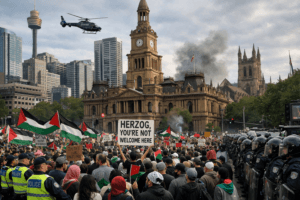
The Sydney protest became the epicenter of both the demonstration and a constitutional conflict. Despite police urging organizers to move from Town Hall to Hyde Park, organizers insisted on maintaining what they called “the most visible town square” for their message.
The atmosphere grew tense as police blocked additional protesters from entering the packed Town Hall precinct, prompting chants of “let us in” from those stranded outside. Above, police helicopters hovered, their rotors drowning out the chants of “Free Palestine” echoing through the square.
The Legal Battle: Protest Rights Versus Security Powers
Just hours before the Sydney protest was to begin, the Palestine Action Group suffered a significant legal defeat. The NSW Supreme Court dismissed their challenge to the government’s declaration of Herzog’s visit as a “major event” under the Major Events Act 2009.
This declaration granted police extraordinary powers throughout Sydney’s CBD and eastern suburbs for four days, including the authority to:
- Search anyone within the designated zones
- Close specific locations
- Issue move-on directions
- Impose fines up to $5,500 for non-compliance
The legal challenge centered on whether the government had improperly invoked legislation typically reserved for sporting or cultural events to suppress political protest. Barrister Felicity Graham argued that describing protesters as “spectators” and police as the “promoter” of the visit revealed the improper application of the law.
However, Justice Robertson Wright ultimately accepted the government’s argument that the powers were necessary for “securing safety” in the context of heightened community tensions following the Bondi terror attack.
This decision marked the first time the Major Events Act had been used solely for a foreign dignitary’s visit, raising broader questions about the balance between public safety and fundamental democratic freedoms. The court’s finding that Hyde Park remained available for protests suggested some attempt at balance, though organizers argued this relegated them to being “out of sight, out of mind”.
Conflicting Narratives: Official Purpose Versus Protester Objections
The controversy highlighted dramatically different interpretations of the visit’s purpose and legitimacy:
The Official Narrative: Solidarity and Comfort
Prime Minister Anthony Albanese framed the invitation as extending appropriate solace to a grieving community. “President Herzog is coming particularly to engage with members of the Jewish community who are grieving the loss of 15 innocent lives,” he stated.
Herzog’s first official act underscored this purpose. At Bondi Beach, he laid a wreath and two stones from Jerusalem, stating they would remain “for eternity” in memory of the victims. “When one Jew is hurt, all Jews feel their pain,” he told mourners.
Jewish leaders like Alex Ryvchin of the Executive Council of Australian Jewry welcomed the visit as spiritually meaningful: “His visit will lift the spirits of a pained community”.
The Protester Narrative: Normalizing Atrocity
Protesters and human rights organizations presented a starkly different view. They pointed to a September 2025 UN Commission of Inquiry finding that Herzog was among Israeli leaders who had “incited the commission of genocide” through public statements.
Australian human rights lawyer Chris Sidoti, who served on that UN commission, called for Herzog’s arrest: “This is one of the most divisive figures in the world. Bringing him to Australia will undermine social cohesion, it will not rebuild it”.
Protest organizer Jasmine Duff articulated the sentiment driving demonstrations: “We’re saying that the absolute tragedy of Bondi should not be turned into a propaganda tour for genocide”.
A Fractured Response: Divisions Within the Jewish Community
The visit revealed that Australian Jews are far from monolithic in their response. While mainstream organizations welcomed Herzog, significant dissent emerged from within the community itself.
An open letter published in major newspapers and signed by 600 Australian Jews declared Herzog “does not speak for us and is not welcome here”. The progressive Jewish Council of Australia argued the visit “risks entrenching the dangerous and antisemitic conflation between Jewish identity and the actions of the Israeli state”.
Perhaps most poignantly, Jewish Bondi resident David Leser wrote in the Sydney Morning Herald: “As a Jewish man, I’d like to say that I draw no comfort from Herzog’s presence in Australia.” He connected his personal grief over the Bondi attack to his moral opposition to Israel’s actions in Gaza, describing the tension many Jews feel between solidarity with Israel and horror at its military campaign.
This internal division reflects a broader global phenomenon among Jewish communities since the Gaza war began, complicating the simple narrative of a unified Jewish response to Herzog’s visit.
Domestic Political Fallout: Rifts in the Labor Party
The controversy created unusual political divisions within the governing Labor Party at both state and federal levels:
- Federal Level: Muslim MP Ed Husic publicly expressed being “very uncomfortable” with the visit, while the government maintained its position recognizing Palestinian statehood—a point of contention with Israel.
- State Level: Three NSW Labor backbenchers—Stephen Lawrence, Cameron Murphy, and Sarah Kaine—defied Premier Chris Minns to attend the Sydney protest.
Lawrence justified his participation by referencing the International Criminal Court’s proceedings: “To issue an invitation to the head of state at this time tends to suggest that we as a country don’t take those proceedings seriously”.
This internal dissent highlighted the difficult balancing act facing the Albanese government as it navigates between Australia’s traditional alliance with Israel, its recent recognition of Palestinian statehood, and domestic political pressures from both sides of the debate.
Security and Civil Liberties: The Expanding Powers of the State
The security response to the protests revealed how counter-terrorism measures initially implemented after the Bondi attack were now being applied to political demonstrations.
Beyond the “major event” declaration, police operated under a separate “public assembly restriction declaration” passed in the immediate aftermath of the Bondi attack. This legislation allowed police to restrict protests for up to three months in designated areas.
At Bondi Beach itself during Herzog’s visit, police issued move-on orders to several individuals, including a 24-year-old man who yelled at the presidential motorcade.
These expanded powers reflect a global trend of governments enhancing security capabilities after terrorist attacks, often with implications for civil liberties and protest rights that extend far beyond their original counter-terrorism purpose.
Conclusion: A Mirror Held Up to Australian Society
The protests against President Herzog’s visit have become about much more than one foreign dignitary’s itinerary. They have become a national referendum on several intersecting issues:
- How Australia balances its international alliances with its commitment to human rights
- How a society maintains security without sacrificing fundamental democratic freedoms
- How a diverse nation navigates profound disagreements about justice and accountability
- How trauma from domestic terrorism interacts with global geopolitical conflicts
As the protests continue and Herzog completes his visit, Australia finds itself confronting difficult questions that extend far beyond this four-day event. The tensions revealed this week—between security and liberty, between different conceptions of justice, between solidarity and accountability—will likely shape Australian politics and society long after the protest banners are folded and the last police barricade is removed.
The ultimate legacy of these protests may not be measured in immediate policy changes, but in how they force Australians to examine what kind of nation they want to be in an increasingly polarized world, and what values they are willing to defend when those values come into conflict with one another.
You must be logged in to post a comment.