
Aurum Biosciences: Pioneering Stroke Treatment and a New Era in UK-India Life Sciences Collaboration
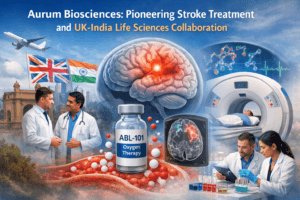
Aurum Biosciences: Pioneering Stroke Treatment and a New Era in UK-India Life Sciences Collaboration
In mid-February 2026, a quiet revolution in stroke care will land in India. Aurum Biosciences, a Scottish biopharmaceutical company, is bringing its groundbreaking ABL-101 technology to one of the world’s fastest-growing healthcare markets as part of a prestigious UK government trade mission. This initiative represents more than just a business trip; it is a strategic alignment of innovative British science with India’s formidable manufacturing and clinical development capabilities, aiming to address one of medicine’s most urgent global challenges.
The Stark Reality of Stroke and the Limitations of Current Care
Stroke remains a colossal global health burden. It is the world’s second leading cause of death and a primary cause of long-term adult disability. Every year, approximately 15 million people suffer an acute ischemic stroke (AIS) worldwide. The human cost is mirrored in the staggering biological toll: for every minute a stroke goes untreated, an estimated 1.9 million neurons and 14 billion synapses are lost.
Despite this urgency, therapeutic options are severely limited and inaccessible to most. The cornerstone treatment, thrombolytic “clot-busting” drugs, is constrained by a narrow 4.5-hour treatment window from symptom onset. A more advanced procedure, mechanical thrombectomy, is restricted to large artery occlusions and is only widely available in major specialist centers. The consequence is a sobering treatment gap: currently, only about 10% of stroke patients globally receive any form of acute therapeutic intervention. The remaining 90% are managed supportively, often facing preventable, severe disabilities.
Table: The Stroke Treatment Gap and ABL-101’s Potential Impact
| Aspect | Current Reality | ABL-101’s Proposed Solution |
| Treatment Accessibility | ~10% of patients receive acute therapy | Potential to be administered to a much broader patient population, irrespective of precise stroke onset time |
| Therapeutic Window | Thrombolysis: ≤4.5 hours; Thrombectomy: ≤6-24 hours | Designed to be effective beyond narrow time windows by directly addressing oxygen deprivation |
| Core Mechanism | Restoring blood flow (reperfusion) | Delivering oxygen directly to starving tissue (neuroprotection) |
| Diagnostic Capability | CT/MRI scans show anatomy & blood flow | Advanced MRI (GOLD/19F) can identify salvageable tissue and inflammation, guiding personalized treatment |
ABL-101: A Dual-Action “Theranostic” Breakthrough
Born from a collaboration between NHS Greater Glasgow and Clyde, the University of Glasgow, and InnoScot Health, Aurum’s innovation, ABL-101, is a first-in-class perfluorocarbon (PFC) emulsion. Its brilliance lies in a simple yet powerful premise: if blood can’t reach brain cells after a stroke, take the oxygen directly to them.
- The Therapeutic Power: An Ultra-Efficient Oxygen CourierPerfluorocarbons are exceptional at dissolving and carrying gases like oxygen. ABL-101 is engineered to beup to 45 times smaller than a red blood cell, allowing it to navigate through collateral blood vessels and bypass the main arterial blockage that red blood cells cannot. Once it reaches the oxygen-starved “penumbra” (the at-risk tissue surrounding the dead core of the stroke), it offloads its oxygen payload. This direct delivery of oxygen can stave off cell death, extending the window for recovery and potentially working synergistically with existing clot-removal treatments.
- The Diagnostic Intelligence: Visualizing the Salvageable BrainABL-101 is not just a treatment; it’s a precision imaging tool—a combination known as a “theranostic.” When used with specialized MRI techniques developed by Aurum, such as Glasgow Oxygen Level Dependent (GOLD) imaging, it acts as ametabolic biosensor. By observing how the brain’s metabolic signature changes with an oxygen challenge delivered via ABL-101, doctors can accurately map the penumbra. This allows them to distinguish between brain tissue that is irrevocably dead and tissue that is “stunned” but still salvageable, even in patients who wake up with a stroke and have an unknown onset time.
- A Third Application: Tracking Hidden InflammationBeyond acute stroke, ABL-101 holds promise in inflammation imaging. The PFC particles are naturally taken up by immune cells called macrophages, which congregate at sites of inflammation. Using a specialized 19Fluorine MRI scan, clinicians can track these cells. This could provide crucial insights intoinflammatory conditions like rheumatoid arthritis, Crohn’s disease, or unstable atherosclerotic plaques—the very plaques that can cause strokes.
The Strategic Mission: Why India, and Why Now?
Aurum’s participation in the Department for Business and Trade (DBT) delegation from February 16-19 is a calculated move in its global strategy. The mission will take the company to Mumbai, Hyderabad, and Ahmedabad, with a key stop at the BioAsia 2026 summit in Hyderabad—”Asia’s foremost life sciences and healthcare event”.
The alignment is near-perfect:
- A Manufacturing Powerhouse: ABL-101 is already being manufactured in India. Partnering with Indian pharmaceutical giants can provide the scale, expertise, and cost-efficiency needed for global production.
- A Thriving Clinical and Research Ecosystem: India’s vast and diverse patient population is essential for the large-scale Phase 2 and future Phase 3 clinical trials that ABL-101 requires. The country is a global hub for contract research and manufacturing (CRAMS).
- A Massive, Growing Market: India’s pharmaceutical sector is valued at approximately £55 billion and is forecast to reach £73 billion by 2030. As the country’s economy and healthcare infrastructure grow, so does demand for advanced, innovative therapies.
- Favorable Trade Winds: This mission builds upon a strengthening UK-India economic relationship, highlighted by a burgeoning Free Trade Agreement framework. Bilateral trade was already at £47.2 billion for the year to Q2 2025, a 15.2% increase.
Table: Aurum Biosciences’ International Growth Trajectory
| Event | Location | Date/Period | Strategic Objective |
| JP Morgan Healthcare Week | San Francisco, USA | January 2026 | Engage with global investors and pharma leaders; featured in an “innovator lookbook.” |
| UK-India Pharmaceutical Cohort | Mumbai, Hyderabad, Ahmedabad | February 2026 | Forge partnerships for scaling manufacturing, clinical development, and market access. |
| BioAsia 2026 Summit | Hyderabad, India | February 2026 | Showcase technology to global pharma companies and investors at Asia’s top life sciences event. |
| Flagship Life Sciences Conference | London, UK | April 2026 | Demonstrate technology potential to European investors and partners. |
The Road Ahead: Clinical Pathway and Lasting Impact
ABL-101 has successfully navigated pre-clinical studies and early Phase 1/2a human trials, demonstrating a good safety profile. The planned Phase 2 trials in stroke and inflammation imaging in 2026 are the critical next step. UK regulatory approval for a Phase 2 stroke trial was secured in 2018, underscoring the methodical progress of the development program.
The company’s journey has been bolstered by significant investor confidence, having raised nearly £1.4 million in recent funding rounds from Scottish Investment Bank, TRICAPITAL, and other investors. Furthermore, its technology is protected by a growing portfolio of granted patents in the US and EU.
Conclusion: A Partnership for Global Health
Aurum Biosciences’ mission to India transcends a simple export opportunity. It represents a model for 21st-century medical innovation: breakthrough science from a UK academic-NHS partnership seeking scale and impact through strategic collaboration with a global life sciences leader.
If successful, ABL-101 could fundamentally reshape the first hours of stroke care. It promises to transform the fate of the “silent majority”—the 90% of patients who currently watch the clock tick down without recourse. By delivering oxygen as both a life-saving treatment and a guide for precision medicine, this Scottish innovation, forged in the labs of Glasgow and now reaching out to India, carries with it the hope of preserving millions of futures from the devastating consequences of stroke.
You must be logged in to post a comment.