
Assassination in Gaza: How a Strike on a Hamas Commander Threatens a Fragile Peace
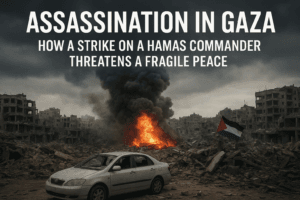
Assassination in Gaza: How a Strike on a Hamas Commander Threatens a Fragile Peace
The targeted killing of Raed Saad, a senior Hamas commander, in a Gaza City strike on December 13, 2025, was more than another chapter in Israel’s long campaign against the militant group. It was a sudden, violent tremor through an already fragile landscape, threatening to shatter a two-month-old ceasefire and derail an internationally backed peace plan. The assassination exposes the stark chasm between diplomatic agreements and the bitter realities on the ground, highlighting the immense challenges of moving from a cessation of violence to a lasting resolution.
The Strike and Its Target
On Saturday, December 13, an Israeli missile struck a vehicle in Gaza City. In a joint statement, the Israeli military and its Shin Bet security agency announced they had “eliminated” Raed Saad, the head of weapons production for Hamas’s military wing, the Qassam Brigades. Hamas officials confirmed the death a day later, stating that four people in the car were killed and multiple passers-by were injured by the blast.
Saad was no ordinary figure. Israeli authorities described him as one of the chief architects of the devastating October 7, 2023, attack on southern Israel. As a senior commander, he was responsible for producing weapons, building up Hamas’s forces, and was believed to be a member of the group’s newly formed five-member military leadership council. His elimination was the culmination of a pursuit spanning over two decades, which included a notable failed attempt to capture or kill him during an Israeli raid in Gaza City in March 2024.
A Ceasefire Under Strain
This high-profile assassination occurred against the backdrop of an unstable, U.S.-led ceasefire that took effect on October 10, 2025. The strike happened on the Palestinian-controlled side of the so-called “Yellow Line,” which has divided Gaza since that ceasefire began, with Israeli forces controlling the area to the east.
The killing immediately became a flashpoint. A senior Hamas leader, Khalil al-Hayya, declared the strike a violation of the ceasefire, warning that such actions were “threatening how long the agreement might last”. Israel, in turn, has consistently accused Hamas of repeatedly violating the truce. This mutual blame underscores the precariousness of the peace. A report from the Council on Foreign Relations notes that since the ceasefire, Israel has been accused of carrying out more than 100 instances of shellings and shootings in Gaza, while Hamas has been accused of attacking Israeli soldiers and failing to deliver the remains of hostages as agreed.
The Devastating Backdrop: A Gaza in Ruins
To understand the full weight of this strike, one must look at the apocalyptic landscape in which it occurred. After two years of war, Gaza lies shattered. A UN assessment from October 2025 estimates the cost of reconstruction at a staggering $70 billion. Destruction across the enclave stands at 84%, and in parts of Gaza City, it reaches 92%. The territory is littered with an estimated 60 million tonnes of rubble, mixed with unexploded bombs and bodies.
The human cost is incomprehensible. Gaza’s Hamas-run health ministry reports that over 70,000 Palestinians have been killed by Israeli military action since October 2023. Human Rights Watch’s 2025 report details that this figure does not include many who died from illness or under rubble, and notes that 70% of fatalities verified by the UN were women and children.
Furthermore, international legal bodies have issued grave rulings. Amnesty International and a UN Special Rapporteur have leveled accusations of genocide, arguing Israel has inflicted conditions calculated to bring about the physical destruction of Palestinians. The International Court of Justice (ICJ) has issued multiple provisional measures ordering Israel to allow humanitarian aid into Gaza at scale, which Israel has largely flouted.
Table: Key Statistics on Gaza’s Destruction (As of Late 2025)
| Metric | Figure | Source |
| Estimated Reconstruction Cost | $70 billion | UN Assessment |
| Overall Infrastructure Destroyed | 84% | UN Development Programme |
| Palestinian Deaths Reported | >70,000 | Gaza Health Ministry |
| Housing Units Damaged/Destroyed | ~300,000 | UN Satellite Centre |
Competing Visions for the Future
This assassination also strikes at the heart of a nascent and contentious diplomatic process. The first phase of former U.S. President Donald Trump’s 20-point peace plan—centered on the ceasefire, hostage return, and prisoner release—is largely complete. The focus is now shifting to the next, far more difficult stage: the disarmament of Hamas and the “de-radicalisation and redevelopment of Gaza”.
In November 2025, the UN Security Council approved a U.S.-drafted resolution endorsing this plan, which includes a path to a future Palestinian state. The plan envisions Gaza being run by a temporary “technocratic, apolitical Palestinian committee” overseen by an international “Board of Peace,” with security provided by an International Stabilization Force (ISF).
However, this top-down vision faces fierce resistance. Hamas has rejected provisions requiring it to disarm and relinquish control, calling the proposed ISF a party to the conflict. Meanwhile, Palestinians on the ground have their own aspirations. A coalition of over 700 Palestinian experts developed the “Phoenix of Gaza” plan, a home-grown vision focused on restoring the social and geographic fabric of Gaza, not transforming it into an international project. This stands in stark contrast to externally generated proposals like the “Gaza Riviera,” a glitzy, AI-powered smart city concept linked to Trump’s circle.
The targeted killing of a Hamas military council member like Saad directly impacts this precarious political equation. It weakens Hamas’s command structure but also risks hardening its resolve, complicating any potential negotiations over disarmament. As one analyst noted, “The first stage of this peace plan is the easy part… these intractable issues will be no less difficult to solve”.
The Path Ahead: More Than Rubble to Clear
The assassination of Raed Saad is a microcosm of the entire conflict. It represents Israel’s unwavering commitment to targeting those it holds responsible for terrorism. It serves as a potent symbol of Hamas’s resilience and a rallying cry for its supporters. And, most critically, it acts as a dangerous stress test for a diplomatic framework that remains deeply unpopular with key actors on both sides.
The road to peace requires more than clearing 60 million tonnes of rubble. It demands navigating a minefield of mutual distrust, contradictory visions for the future, and the raw, unhealed wounds of catastrophic violence. As Gazans like 63-year-old Abu Iyad Hamdouna sift through the ruins of their homes, expressing despair that reconstruction will take a decade, the actions of militants and generals in distant offices feel worlds away. Yet, it is precisely these actions—a missile strike, a defiant speech, a rejected clause in a peace plan—that will determine whether Gaza’s future is one of renewed conflict or painful, precarious recovery. The strike that killed Raed Saad proves that even in a ceasefire, the war for Gaza’s future is very much alive.
You must be logged in to post a comment.