
Arctic Tensions and Transatlantic Strains: A Day of Crises Tests International Order
On January 11, 2026, a convergence of international crises revealed deep strains on the global order, as tensions flared between NATO allies over U.S. ambitions to acquire Greenland—a move Danish officials condemned as an illegitimate threat to sovereignty—while simultaneously, escalating violence in Iran exposed sharp divisions within UK politics, with the Conservative opposition endorsing potential U.S.-backed regime change against the government’s more cautious stance. These external crises were mirrored by domestic fractures in Britain, from a heated debate over leaving the European Convention on Human Rights to a surprising cross-party split on banning social media for under-16s, collectively illustrating a world where traditional alliances are being tested, international norms are under pressure, and the lines between domestic policy and global instability are increasingly blurred.
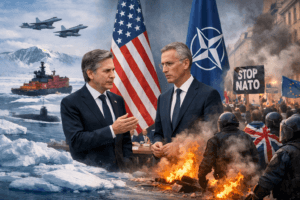
Arctic Tensions and Transatlantic Strains: A Day of Crises Tests International Order
The world woke up to a Sunday where Danish officials were contemplating what one parliamentarian called “the dumbest war in history”, British politicians were divided over supporting potential U.S. intervention in Iran, and the foundations of the NATO alliance were being publicly questioned by its most powerful member.
On January 11, 2026, a cascade of international crises converged, revealing deepening fractures in the global order. At the center stood Greenland—a semi-autonomous Danish territory suddenly thrust into geopolitical significance as the Trump administration renewed its interest in acquisition. Meanwhile, escalating violence in Iran prompted conflicting responses from UK political leaders, while domestic debates about social media regulation and human rights commitments further highlighted a world where traditional alliances and principles faced unprecedented stress.
The Greenland Crisis: Sovereignty Versus Superpower Ambition
The renewed U.S. push for Greenland represents more than a territorial dispute—it challenges fundamental principles of alliance sovereignty. Danish Defense Minister Troels Lund Poulsen acknowledged the need for dialogue, stating, “This is the dialogue that is needed, as requested by the government together with the Greenlandic government”. This diplomatic language masked deeper concerns as European leaders scrambled to respond to what French President Emmanuel Macron denounced as “the law of the strongest”.
Strategic Importance and Conflicting Narratives
The Arctic has transformed from a frozen periphery to a strategically vital region due to climate change and resource competition. Greenland’s location makes it crucial for missile defense, with U.S. Vice President JD Vance stating that “the entire missile defense infrastructure is partially dependent on Greenland”. The island also possesses substantial mineral resources, including rare earth elements essential for modern technology.
The Trump administration has framed its interest in Greenland as a response to external threats. Vance claimed Denmark had not done a proper job securing Greenland and that Russia and China posed significant risks. These assertions have been firmly rejected by Danish and Greenlandic officials. Rasmus Jarlov, chair of the Danish Defence Committee, countered: “There is no serious threat from China or Russia in Greenland. They don’t have any activities there”.
European Responses and Military Calculations
European powers have developed a coordinated response focused on reinforcing Greenland’s sovereignty through increased military presence. As noted by Bruegel, a European think tank, “European powers should provide backing for Nuuk and Copenhagen by establishing a greater military presence in Greenland”. This approach aims to increase the political and military costs of any U.S. intervention while addressing legitimate security concerns.
The UK has played a nuanced role in these developments. Transport Secretary Heidi Alexander described discussions about potential troop deployments as “business as usual discussions amongst NATO allies about how we deter Putin in the Arctic Circle”. However, Defence Secretary John Healey later clarified that “its sovereignty is not at stake, and it is defended by being part of NATO”, suggesting a more cautious approach than initial reports indicated.
Table: Key Positions on Greenland Sovereignty
| Actor | Position | Key Argument |
| U.S. Administration | Greenland should be part of the United States | National security requires control over strategic Arctic territory |
| Danish Government | Greenland is part of the Kingdom of Denmark | Sovereignty is non-negotiable; security cooperation is possible |
| Greenlandic Government | “Nothing about Greenland without Greenland” | Right to self-determination must be respected |
| European Allies | Support for Danish sovereignty | International law and alliance principles must be upheld |
| UK Government | NATO should address security concerns | Reinforcement should occur through existing alliance structures |
The military dimension involves complex calculations. The United States maintains approximately 150 troops at the Pituffik Space Base in Greenland, a significant reduction from thousands during the Cold War. European proposals for enhanced presence would likely involve naval patrols, surveillance assets, and potentially ground forces under NATO or EU frameworks. As one analysis noted, “A greater European military presence would massively increase the political and military costs for the US” of any annexation attempt.
Iranian Unrest and Transatlantic Dilemmas
Simultaneously, the UK government faced difficult questions regarding another international crisis—the escalating violence in Iran. The divergent responses from UK political leaders revealed tensions within and between parties over fundamental foreign policy approaches.
The Iranian Protests and International Reactions
Iran has experienced significant unrest, with reports indicating at least 62 people killed and 2,300 detained during weeks of protests. The situation escalated with U.S. President Donald Trump threatening intervention, stating: “Iran is looking at FREEDOM, perhaps like never before. The USA stands ready to help!!!”. Iranian Parliament Speaker Mohammad Bagher Qalibaf responded by warning that U.S. military and Israeli targets would be legitimate responses to American strikes.
Within the UK, Transport Secretary Heidi Alexander expressed concern but cautioned against direct intervention: “We’re very concerned about the situation in Iran at the moment, the violence that we’ve seen… We would urge the authorities in Tehran to exercise restraint”. She emphasized the desire for “a peaceful transition where people can enjoy fundamental freedoms”, but carefully avoided endorsing U.S. military action.
Divided UK Political Responses
The Conservative opposition took a markedly different position. Party leader Kemi Badenoch stated unequivocally: “I don’t have an issue with removing a regime that is trying to harm us”. She justified this stance by citing Iranian threats: “Iran would very happily wipe out the UK if it felt it could get away with it. It has tried to kill people on our soil”.
Former Security Minister Tom Tugendhat offered a third perspective, emphasizing that the UK “shouldn’t be involved on the ground”. He argued that supporting Iranian protesters should focus on information access: “The best way to support the revolution was to ensure they had access to media from outside the country”.
These divisions reflect deeper philosophical differences about the UK’s role in the world and the appropriateness of regime change policies—debates that have resurged following the U.S. capture of Venezuelan leader Nicolás Maduro earlier in January.
Domestic Political Currents Amid International Crises
While international crises dominated headlines, significant domestic developments revealed how global and local politics increasingly intersect in an interconnected world.
The ECHR Debate and National Sovereignty
Attorney General Lord Hermer delivered a robust defence of the UK’s commitment to the European Convention on Human Rights (ECHR), stating that leaving would be “a disaster for this country”. This position directly countered Conservative and Reform Party pledges to withdraw from the convention. Hermer framed the issue in national security terms, noting that “only Russia and Belarus are not party to it”—implicitly questioning what company the UK would keep by leaving.
The debate over the ECHR connects to broader questions about the international rules-based system that Hermer passionately defended: “We have made plain as a government, the prime minister has made plain, that we are huge supporters of the international rules-based system”. In a world where major powers appear increasingly willing to disregard international norms, this commitment carries both principled and practical significance for the UK’s global standing.
Social Media Regulation and Cross-Party Divergence
The Conservative Party announced a policy to ban social media access for those under 16, with leader Kemi Badenoch stating: “Our policy is simple: clear rules for children, but freedom for grown-ups”. Surprisingly, this position received support from Labour Mayor of Greater Manchester Andy Burnham, who called for “a cross-party consensus around much bolder action”.
This creates an unusual political dynamic where a prominent Labour figure aligns with Conservative policy against the stance of his own party’s government. The issue reflects growing concerns about children’s online safety but also reveals how traditional party lines can blur on technologically-driven social issues.
Asylum Policy Shifts
The government is preparing to begin evictions of migrants living in asylum hotels in spring 2026, with Home Secretary Shabana Mahmood expected to end the automatic support for destitute asylum seekers. This continues efforts to reduce hotel use for asylum accommodation, which the government claims has already been halved from 400 to around 200 hotels.
Interconnected Crises in a Fragmenting World Order
These simultaneous developments are not isolated events but interconnected symptoms of a world order under stress. Several critical themes emerge from this convergence of crises:
Sovereignty Under Pressure: From Greenland to Iran, questions of sovereignty dominate. The Greenland crisis presents the unprecedented scenario of NATO allies discussing how to protect one member’s territory from the alliance’s leading power. As the Danish parliamentarian noted in the New York Times, “For one ally to say it should own the territory of another ally is not a negotiating position; it undermines the very principles on which our alliance rests”.
Rules-Based Order Versus Power Politics: Attorney General Hermer’s defence of the international rules-based system contrasts sharply with the apparent willingness of major powers to pursue territorial expansion or regime change outside established frameworks. The tension between principled commitment to international law and pragmatic responses to security threats runs through multiple policy areas.
Transatlantic Strain: The Greenland situation tests the resilience of transatlantic relationships, while differing approaches to Iran reveal divergent risk assessments and strategic priorities between European allies and the United States.
Domestic-International Linkages: Issues like social media regulation and asylum policy connect to broader questions about national sovereignty, international obligations, and how governments balance security, rights, and openness in an interconnected world.
Conclusion: A Precarious Moment in International Relations
January 11, 2026, encapsulated the complex challenges facing the international community. The Greenland crisis represents more than a territorial dispute—it strikes at the heart of alliance integrity and the principle that sovereignty should be respected even by powerful allies. The Iranian situation presents painful dilemmas about when and how to respond to repression, with UK political leaders demonstrating significantly different risk tolerances and strategic calculations.
Perhaps most significantly, these events reveal how traditional distinctions between domestic and foreign policy continue to erode. Debates about the European Convention on Human Rights directly affect the UK’s moral authority in defending international law globally. Decisions about social media regulation reflect broader concerns about information integrity that have clear implications for supporting democratic movements abroad.
As these crises continue to develop, they will test not only specific policies but fundamental questions about how nations navigate a world where traditional alliances face unprecedented strain, international norms are increasingly contested, and the line between domestic priorities and global responsibilities becomes ever more blurred. The responses formulated in the coming weeks may well define international relations for years to come, determining whether multilateral institutions and principled commitments can withstand the pressure of resurgent power politics.
You must be logged in to post a comment.