
Andhra Pradesh’s AI Leap: How a State-Level Challenge Could Redefine Public Service Delivery Nationwide
The IndiaAI Innovation Challenge for Transforming Governance, a strategic partnership between MeitY’s IndiaAI initiative and the Government of Andhra Pradesh, represents a focused move to bridge the gap between AI innovation and real-world public service delivery by inviting scale-ready Indian startups, companies, and institutions to deploy existing AI solutions against six critical, state-defined problem statements—from optimizing market linkages for rural women’s self-help groups and last-mile welfare supply chains to automating renewable energy land allocation and urban planning—offering shortlisted teams development grants and the potential for substantial one-year work orders to refine and implement their solutions within Andhra Pradesh’s active governance framework, thereby creating a replicable model for using AI to enhance transparency, efficiency, and inclusive growth nationwide.
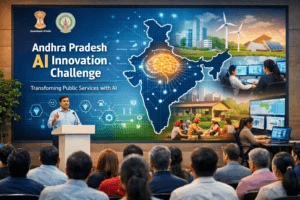
Andhra Pradesh’s AI Leap: How a State-Level Challenge Could Redefine Public Service Delivery Nationwide
In a move that signals a strategic shift from policy discussion to actionable deployment, the Indian government, through its IndiaAI initiative, has launched a high-stakes Innovation Challenge in partnership with the Government of Andhra Pradesh. This isn’t just another hackathon; it’s a meticulously designed, stage-gated program aimed at sourcing and scaling mature AI solutions for some of governance’s most persistent puzzles. With a potential work order of up to ₹50 lakhs per winning solution, the challenge represents a compelling new model for public-private innovation in the GovTech space.
Beyond Pilots: The Strategic Imperative of Applied AI in Governance
For years, the narrative around AI in India has oscillated between boundless potential and cautious skepticism. While proofs-of-concept abound, the journey from a promising pilot to a seamlessly integrated, scaled public utility is fraught with challenges—bureaucratic inertia, data silos, and a mismatch between technological ambition and ground-level need. The IndiaAI Innovation Challenge for Transforming Governance, launched on January 23, 2026, seeks to cut through this complexity.
The partnership with Andhra Pradesh is a masterstroke. The state has consistently been at the forefront of technological adoption in governance, boasting a robust Real-Time Governance Society (RTGS) center. This existing digital infrastructure provides a live, complex, and realistic sandbox. Solutions tested and refined here are not being built in a lab; they are being stress-tested against the vibrant, messy, and demanding reality of governing millions of citizens. This dramatically increases their potential for nationwide replication.
Decoding the Six Problem Statements: Where AI Meets Grassroots Impact
The challenge’s brilliance lies in its specificity. It moves beyond vague mandates to six precise, high-impact problem statements, each championed by a dedicated line department. This ensures that solutions have a clear end-user and a pathway to institutional adoption.
- Smart Market Linkage for SHGs: For decades, Self-Help Groups (SHGs) have been engines of rural women’s empowerment, yet access to profitable and consistent markets remains a hurdle. The envisioned AI platform goes beyond a simple e-commerce listing. It promises market intelligence—analyzing demand trends, pricing fluctuations across regions, and even predicting optimal times to sell. This could transform SHGs from production-centric units to savvy, data-driven micro-enterprises.
- Last-Mile Delivery Optimisation: The delivery of essential supplies—nutritional kits, textbooks, medicines—is the final, most critical mile of any welfare scheme. An AI-based monitoring system could dynamically optimize routes in real-time, accounting for weather, road conditions, and vehicle health. More importantly, it could move from passive tracking to predictive logistics, pre-empting delays and ensuring no beneficiary is left out due to logistical failures.
- Renewable Energy Land Allocation: India’s green energy ambitions are often stalled by land disputes and complex clearance processes. A GIS-based AI tool that automates the identification of conflict-free, technically viable land parcels for solar and wind projects could slash project commissioning times from years to months. This isn’t just about efficiency; it’s about accelerating the national energy transition at a critical juncture.
- Urban Infrastructure Planning: The decision to build a flyover or a bridge is often politically charged or based on outdated traffic surveys. A decision support system leveraging real-time traffic data, mobility patterns, and future urban growth projections can bring objectivity to infrastructure planning. It answers the crucial question: where will this investment deliver the maximum socioeconomic return?
- School Infrastructure Validation: School infrastructure funds are limited, and their allocation must be precisely targeted. An AI model that forecasts requirements—be it classrooms for a growing population, science labs based on student enrollment trends, or toilets based on current usage and deterioration rates—ensures that funds are not just allocated, but allocated wisely. It shifts the paradigm from reactive repair to predictive, needs-based planning.
- Urban Land Use Monitoring: Unauthorized construction and illegal change of land use plague urban planning. Manual monitoring is impossible at scale. An automated system using satellite imagery and AI for change detection acts as a force multiplier for urban bodies, enabling them to identify violations swiftly, enforce zoning laws, and ensure planned, sustainable urban growth.
The “Scale-Ready” Mandate: A Filter for Real-World Viability
A critical, and perhaps most telling, eligibility criterion is that applicants must submit existing solutions with an established AI-enabled product or service. This is not a call for ideas on a napkin. IndiaAI is hunting for “scale-ready” innovations that have already proven their worth in a controlled environment and are now seeking a massive, public-sector deployment to achieve national impact.
This significantly de-risks the project for the government. It also creates a powerful opportunity for mature Indian startups and companies. The incentive structure is strategic: shortlisted teams receive ₹5 lakhs to refine their solution on a shared dataset—a crucial step ensuring all contenders work with the same real-world data from Andhra Pradesh, leveling the playing field. The final prize is not just a grant, but a one-year work order, signaling a genuine commitment to deployment, not just recognition.
A Blueprint for the Future of GovTech Procurement
The IndiaAI-AP Innovation Challenge offers a potential blueprint for how governments can ethically and effectively procure advanced technology.
- Problem-First, Not Tech-First: The process starts with a concrete problem from a department that owns it, ensuring solution relevance.
- De-risked Scaling: Funding is tied to clear milestones, and the state provides the testing ground and data.
- Focus on Interoperability: The requirement for “cross-sectoral and nationwide applicability” forces innovators to build solutions that are modular and adaptable, breaking down the siloed approach that plagues public IT.
- Transparency and Efficiency: Inherently, each winning AI solution aims to inject these very qualities into the department it serves, creating a positive feedback loop.
The Road Ahead: Challenges and the Promise of Inclusive Growth
The path is not without obstacles. Success will hinge on the quality and accessibility of datasets provided by the state departments. The integration of new AI tools with legacy government IT systems will be a technical challenge. Furthermore, building trust among frontline government workers to use and rely on AI-driven recommendations is a human-centric challenge that cannot be coded away.
However, the overarching vision—to leverage AI for inclusive growth—is clear. Whether it’s ensuring a rural artisan gets a fair price, a child receives their nutrition on time, or a new solar plant powers homes without years of litigation, the goal is to make governance more responsive, resource-efficient, and equitable.
The submission deadline of February 22, 2026, marks the start of a compelling experiment. If successful, the outcomes in Andhra Pradesh will not merely be case studies; they will be scalable, replicable modules for transforming the very fabric of public service delivery across India. This challenge is more than a competition; it is a concrete step toward building a responsive, AI-augmented state that works for every citizen.
You must be logged in to post a comment.