
An Inner Universe in Bloom: Tracing Shipra Bhattacharya’s Five-Decade Ode to the Soul
An Inner Universe in Bloom: Tracing Shipra Bhattacharya’s Five-Decade Ode to the Soul
Returning to Delhi after ten years, artist Shipra Bhattacharya does not arrive with loud proclamations or shock-and-awe aesthetics. Instead, she brings a lifetime of quiet observation. Her landmark solo exhibition, In Bloom: A Journey through the Five Decades of Shipra Bhattacharya, on view at CCA, Bikaner House, is a profound retrospective that feels less like a simple art show and more like an invitation to wander through a vast, shared interior world.
For half a century, while the art world often chased the next big -ism, Bhattacharya has remained steadfast in her commitment to the human figure. Her work is a testament to the power of staying the course, proving that true innovation isn’t always about changing your language, but about deepening it. This exhibition is the culmination of that journey—a rare chance to witness the evolution of an artist who has redefined contemporary Indian art not through loudness, but through profound emotional and moral clarity.
The Terrace as a Timeless Stage
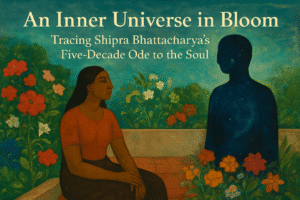
To enter Bhattacharya’s universe is to become acquainted with a specific, recurring space: the terrace. This is her signature motif, a stage set between earth and sky, confinement and freedom. In her early works, the terrace is a sanctuary for the urban woman—a place of solitude and contemplation, a private realm above the bustling city where the inner self can breathe.
But as one moves through the decades in this exhibition, the terrace evolves. It is never an escape hatch from reality. Instead, it becomes a vantage point. It is the place from which one can see the world more clearly, a platform for witnessing. The woman on the terrace is not hiding; she is gathering strength, observing, and preparing to engage. This subtle shift from a space of personal solitude to one of conscious witnessing is key to understanding Bhattacharya’s artistic evolution.
The Evolution of a Gaze: From the Personal to the Political
The exhibition masterfully charts the artist’s expanding circle of empathy.
The 80s & 90s: The Landscape of the Self The early works are intimate, exploring the inner lives of women with a lyrical sensitivity. There is a focus on desire, identity, and the quiet dramas of the domestic and urban interior. A piece like Desire (1998) distills this era—longing is not depicted as frantic, but as a sculptural, elegant force, a fundamental part of the human condition. The focus is on the individual soul navigating its own universe.
The 2000s: Myth and the Archetypal By the turn of the millennium, Bhattacharya’s figures begin to swell with archetypal power. She (2002) is no longer just a woman; she is “cosmic consciousness,” a vessel of primordial feminine energy. The personal expands into the mythic, suggesting that the struggles and desires of a single woman are connected to timeless, universal narratives.
The 2010s: Bearing Witness to the Collective This decade marks a decisive turn outward. The introspective gaze solidifies into a form of poetic resistance. Works like Taposhi, a response to the Singur land acquisition tragedy, and the devastating diptych War and Stop War (2014) reveal an artist grappling directly with collective trauma. Here, her figuration takes on a raw, visceral energy, at times bordering on abstraction, as if the pain of the subject is too immense to be contained by clean lines. The canvas becomes a testament, a moral record of suffering.
Standing Before the Masterworks: A Viewer’s Guide
Walking through the galleries, certain works act as powerful waypoints on this five-decade journey:
- Floating (2023): A monumental canvas that serves as a perfect thesis for her later work. It presents a stunning visual dialogue: on one side, lush, overwhelming botanical life; on the other, skeletal desolation. At the center, a figure bridges these worlds, not with drama, but with “quiet grace.” It’s a powerful meditation on the coexistence of life and decay, hope and despair, within a single frame.
- He (2021) & He (2023): Bhattacharya’s exploration of masculinity is revolutionary in its tenderness. In He (2021), the male form is a “palimpsest of urban memory,” its surface teeming with miniature lives and stories, standing at the edge of sea and city—a symbol of layered, complex identity. In He (2023), masculinity is reimagined as a “nurturing vessel,” a gentle, protective force that challenges stereotypical representations.
- Kolkata (2016): The city itself becomes the subject, not as a skyline, but as a sentient being. Painted with a melancholic palette, it is a landscape steeped in memory, a character with its own emotional weight and history.
- From Canvas to Form: The Sculptures The exhibition reveals another dimension of her genius with works like Floating (2021–22). Here, her intricate, fine-lined narratives escape the two-dimensional plane, wrapping around a fiberglass form. Viewers are invited to walk around it, to engage with the story physically, discovering new angles and intimate details. It translates her painterly language into a tangible, three-dimensional poetry.
The Quietest Voice in the Room is Often the Most Urgent
In an era of digital noise and performative outrage, Bhattacharya’s work offers a different model of engagement. As she herself states:
“I’ve always believed that the quiet spaces within us hold immense power—not as an escape, but as a way of seeing the world more truthfully… In Bloom…. is my way of saying that introspection, too, can be a form of resistance.”
This is the core insight the exhibition offers. Bhattacharya’s art argues that to turn inward, to truly know the landscapes of one’s own soul, is not a narcissistic retreat. It is the first and most necessary step toward genuine empathy and moral action. The woman on the terrace, by understanding her own solitude, becomes capable of understanding the solitude of others. By confronting her own desires, she can recognize the systemic denial of desire around her.
Her work dignifies the everyday—the laborer, the urban dweller, the domestic routine—by infusing it with mythic significance and emotional depth. She shows us that the political is not only in the protest march but also in the quiet act of remembering, of feeling, and of giving form to those feelings on a canvas.
A Journey Worth Taking
In Bloom is more than a retrospective; it is a sanctuary. It offers a pause, a moment of deep reflection in the heart of a bustling city. For aspiring artists, it is a masterclass in developing a unique voice with unwavering integrity. For any viewer, it is a reminder of the profound power of art to connect us to the deepest parts of our humanity—our vulnerabilities, our resilience, our capacity for witness, and our endless, blooming inner worlds.
To see this exhibition is to trace not just the evolution of an artist, but the evolution of a way of seeing. It is to understand that Shipra Bhattacharya hasn’t just been making art for fifty years; she has been building, brushstroke by patient brushstroke, a cosmology of the interior life, and in doing so, has given us all a map to our own.
You must be logged in to post a comment.