
An Early Embrace of Winter: Decoding North India’s Chill and the Southern Rain’s Rhythm
An early and pronounced winter chill has descended across north and central India, driven by a western disturbance that cleared humidity and allowed cold air to settle, with temperatures falling 4-7°C below normal and cold wave conditions in some areas. Simultaneously, southern India is experiencing widespread rain and thunderstorms due to a trough and cyclonic circulation, bringing isolated heavy showers to Tamil Nadu and Kerala.
This stark climatic divide has real-world consequences, prompting the IMD to issue specific advisories for farmers—urging those in the south to manage harvests and drainage carefully, while those in the north are advised to protect crops from cold stress—highlighting how these contrasting weather systems are actively shaping daily life and agriculture across the nation.
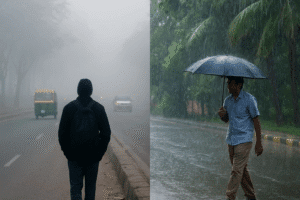
An Early Embrace of Winter: Decoding North India’s Chill and the Southern Rain’s Rhythm
If you stepped outside in Delhi this morning, you were likely met not with the familiar, lingering dampness of late autumn, but with a distinct, crisp bite in the air. This is no fleeting change. The India Meteorological Department (IMD) has officially declared an early onset of winter across north and central India, a shift that is as much a cultural moment as it is a meteorological event. Meanwhile, a thousand miles to the south, the skies tell a different story, preparing to open up with widespread rain and thunderstorms.
This tale of two Indias, one shivering under an unseasonable chill and the other bracing for a drenching, is driven by a complex dance of atmospheric systems. Understanding this dynamic not only satisfies curiosity but reveals the profound impact weather has on our daily lives, from the clothes we wear to the food on our tables.
The Northern Shift: From Humidity to a Winter’s Whisper
For weeks, residents of the northern plains have been waiting for the oppressive humidity to break. That wait is over. The familiar late-year haze has been swept away, replaced by crystalline skies and a sun that offers warmth without wrath. The IMD attributes this dramatic shift to two key factors: a western disturbance over north India and significant changes in wind patterns.
A western disturbance is essentially a storm system that originates in the Mediterranean region and brings moisture-laden winds towards the Indian subcontinent. While in the peak of winter they are notorious for causing rain and snow in the hills and fog in the plains, this early-season disturbance has played a different role. It has effectively scoured the atmosphere, clearing out the moisture and allowing colder, denser air from the higher latitudes to settle in.
The data is telling. Night-time temperatures have plummeted to 4–7°C below the seasonal average in parts of East Rajasthan and West Madhya Pradesh. Isolated areas have even recorded cold wave to severe cold wave conditions, with mercury dipping below 10°C. In the capital, minimums are hovering between 9°C and 11°C, a good 2–4°C below normal, promising chilly mornings that demand a warm cup of tea and a light sweater.
This isn’t just a one-day wonder. The IMD forecasts that these below-normal temperatures will persist for the next six to seven days. For city-dwellers, this means a delightful, extended preview of winter—perfect for evening walks and al fresco dinners. But for the agricultural heartland, this early chill carries a different weight.
The Southern Soaking: A Trough Fuels the Rains
As north India bundles up, the southern peninsula is battening down the hatches. The IMD has identified a trough extending from the southwest Bay of Bengal to central Kerala, coupled with a cyclonic circulation over the Gulf of Mannar. In simpler terms, these are conveyor belts of moisture pumping humid air from the ocean onto the land, creating the ideal conditions for sustained rainfall.
The forecast predicts light to moderate rainfall across most of Tamil Nadu and Kerala, with isolated heavy spells expected in:
- Tamil Nadu: November 8-9 and again from November 12-13.
- Kerala and Mahe: November 8-9.
Accompanying this will be thunderstorms and lightning, a potent reminder of nature’s power. For a region transitioning away from the primary monsoon, this is a significant secondary spell of precipitation.
Beyond the Forecast: The Real-World Impact on Fields and Farms
The true value of a weather forecast lies in its practical application, and the IMD’s advisory to farmers is a masterclass in anticipatory governance. The contrasting advice for the north and south highlights how localized and nuanced agricultural planning must be.
In the Rain-Soaked South:
- Harvest Strategy: Farmers with mature rice and groundnut crops are advised to harvest only during clear weather windows. Harvesting in the rain can lead to fungal growth and spoilage, devastating the yield.
- Water Management: Ensuring proper drainage in fields of paddy, sugarcane, cotton, and maize is critical to prevent waterlogging, which suffocates plant roots.
- Structural Support: Banana plants, vulnerable to strong winds, should be propped up with wooden poles to prevent them from being flattened (a condition known as lodging).
- Post-Harvest Care: The advisory urgently reminds farmers to keep harvested produce in a safe, dry place, protected from the impending rain.
In the Chill-Stricken North & Central India:
- Combating Cold Stress: The unexpected cold wave can stunt plant growth. The recommendation for light irrigation is a clever tactic—the water releases heat slowly during the night, creating a slightly warmer microclimate around the plants.
- Mulching for Warmth: Covering the soil with organic material (mulch) acts like a blanket, insulating the soil and protecting the root systems from the cold.
- Protecting the Young: Vegetable nurseries and young fruit plants are especially vulnerable. Covering them with straw or polythene sheets is a simple, effective way to retain crucial soil warmth.
The advisories extend to livestock and fisheries as well, urging owners in the south to provide shelter and safe fodder, and fish farmers to install netting to prevent stock from being washed away in overflowing ponds. This holistic approach underscores how interconnected our weather and food systems truly are.
The Human Element: A Nation Adapting to the Skies
In Delhi, the early winter has shifted the city’s rhythm. The mornings begin with a shallow fog, reducing visibility as it did at Safdarjung airport, but they give way to brilliant, sunny afternoons that are perfect for the city’s vibrant street life. There’s a collective sigh of relief; the energy-draining humidity is a memory, replaced by an invigorating coolness that makes the bustling metropolis feel momentarily serene.
Conversely, in cities like Chennai and Thiruvananthapuram, life is adjusting to the rhythm of the rain. Commutes are planned around weather updates, umbrellas become constant companions, and the sound of thunder becomes a part of the daily soundtrack. For many, it’s a welcome extension of the rainy season, replenishing water reservoirs and cooling the air. For others, it’s a disruptive force, challenging daily commerce and mobility.
A Connected Climate: The Bigger Picture
This simultaneous occurrence of a chilly north and a wet south is a powerful reminder of India’s diverse and dynamic climate. The two phenomena are not isolated but are linked to the broader pattern of prevailing wind systems and ocean conditions. While not directly attributed to climate change in this specific forecast, such early and intense weather events are consistent with a global pattern of increasing climate volatility.
The IMD’s final note of caution is crucial: forecast accuracy diminishes over time, and the public, especially those in hilly or vulnerable regions, must act promptly on orange (be prepared) and red (take action) warnings. This partnership between forecaster and citizen is the first line of defense against the whims of the weather.
As the week unfolds, the story will continue to evolve. The north will likely enjoy its extended winter preview, a gentle prelude to the sharper cold of January. The south will navigate its rainy spell, with the land drinking in the moisture. In this vast subcontinent, the weather is never just a topic for small talk; it is a active force that shapes the day, the harvest, and the very rhythm of life for over a billion people.
You must be logged in to post a comment.