
America’s Pivot from Idealism to Industrialism: The High-Stakes Bargain Now Facing India
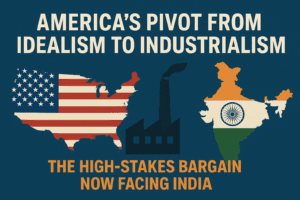
America’s Pivot from Idealism to Industrialism: The High-Stakes Bargain Now Facing India
For decades, the foundation of the U.S.-India strategic partnership was articulated in the language of shared democratic values, a common vision for a free and open Indo-Pacific, and mutual respect between the world’s oldest and largest democracies. This narrative provided a comforting framework, suggesting an alliance built on something deeper than mere convenience. However, the unveiling of the 2025 U.S. National Security Strategy (NSS) signals a profound and unambiguous shift. The poetry of shared ideals has been replaced by the prose of industrial policy. America’s new ask of India is no longer to be a fellow champion of a rules-based order, but to become an integral partner in its project of domestic economic revival and strategic competition with China. For New Delhi, this presents not just a changed atmosphere, but a fundamental recalibration of the relationship’s terms, laden with both significant opportunity and substantial risk.
Decoding the New American Doctrine: Revival Over Rhetoric
The 2025 NSS is less a traditional foreign policy document and more a national economic security manifesto. Its core tenets—onshoring, friend-shoring, supply chain insulation, technology protectionism, and tariff enforcement—reveal a worldview where global engagement is judged primarily by its contribution to rebuilding American manufacturing might. The “China challenge” is framed not just in military terms, but overwhelmingly as an economic and technological rivalry. The goal is to dismantle Beijing’s centrality in global production networks and prevent any single competitor from achieving dominance in critical sectors like semiconductors, clean energy, and critical minerals.
In this blueprint, allies and partners are re-categorized. They are valued less for their democratic credentials and more for their utility as reliable nodes in a re-engineered, de-risked supply chain, or as markets for “Made in America” goods. The lofty language of collective security against authoritarianism is subdued, overshadowed by the imperative of “reshaping global trade in ways that favour American labour.” This represents a decisive move from a strategy of engagement to one of extraction, where foreign policy serves domestic economic renewal first and foremost.
India in the American Calculus: From Strategic Anchor to Supply Chain Node
This shift reframes India’s position in Washington’s eyes. The vision of India as a “natural ally” and the “lodestar of the Indo-Pacific” is backgrounded. Instead, as the NSS notes, the focus is to “improve commercial relations with India” to draw it deeper into the U.S. Indo-Pacific agenda and to “align the actions” of partners. The subtext is clear: India’s strategic value is now heavily contingent on its economic utility.
This presents a double-edged sword for New Delhi.
On the opportunity side: The U.S.’s drive to diversify away from China aligns perfectly with India’s own ambitions under its Production Linked Incentive (PLI) schemes and “Make in India” initiative. Sectors like electronics, pharmaceuticals, defense manufacturing, and clean energy are ripe for collaboration. American capital and technology, combined with India’s production capacity and market, could create powerful synergies. For the U.S., India offers scale, a growing workforce, and a geopolitical counterweight. For India, it offers access to advanced technologies, investment, and a accelerated path to becoming a global manufacturing hub.
Furthermore, a more transactional U.S. might be less preachy on issues India considers matters of domestic sovereignty, from its energy imports from Russia to its regulatory and protectionist economic measures. The relationship could become more pragmatic, with clearer give-and-take.
On the constraint side: The risks are equally stark. First, there is the danger of asymmetric expectations. The U.S. seeks a partner for its factories, but India’s goal is not merely to be a substitute for China in an American-centric supply chain. It aims to build its own industrial and technological sovereignty. A relationship based purely on transaction could see the U.S. lose patience with India’s slower bureaucracy, tariff structures, and insistence on technology transfer. The “China price” and “China speed” are hard benchmarks to meet.
Second, this narrow focus undermines the broader strategic trust that took years to build. If the relationship is stripped of its values-based veneer, it becomes more fragile, subject to the whims of economic cycles and domestic politics in both nations. What happens if a future U.S. administration decides India is not delivering economically efficient enough returns? The partnership could easily unravel.
Most critically, India faces a tightrope walk on strategic autonomy. Deep integration into a U.S.-led supply chain architecture, especially in critical tech, could inevitably draw New Delhi into Washington’s broader tech and trade war with Beijing. This could limit India’s room for maneuver with China, with which it shares a complex, contested border and significant trade ties. India cannot afford to be a mere instrument in a U.S.-led containment strategy; it must engage with China on its own terms. The new U.S. approach, by making economics the frontline of geopolitics, forces that delicate balancing act into almost every bilateral discussion.
The Path Forward: Navigating the Transactional Tide
For India, the response must be equally clear-eyed and pragmatic.
- Negotiate from Strength, Not Supplication: India must enter negotiations emphasizing what it uniquely brings: a massive consumer market, a young demographic, and proven success in IT and digital public infrastructure. The narrative should be of a joint venture, not a subcontracting relationship. India should actively push for co-development and co-production, especially in defense and tech, ensuring the partnership builds domestic capability, not just assembly lines.
- Diversify to Mitigate Risk: While engaging deeply with the U.S., India must redouble efforts to strengthen other economic partnerships—with the EU, Japan, ASEAN, and even cautiously manage ties with China. This diversification is its primary lever to avoid over-dependence and maintain bargaining power with Washington.
- Invest in the Home Front: The ultimate leverage is a strong, competitive, and open domestic economy. Accelerating infrastructure development, simplifying land and labour laws, and investing in education and R&D are non-negotiable. The more India gets its own economic house in order, the more attractive and equitable a partner it becomes.
- Keep the Strategic Dialogue Alive: Even within a more transactional framework, channels on broader Indo-Pacific security, maritime cooperation, and Quad initiatives must be sustained and deepened. These provide the strategic ballast that can prevent the relationship from being purely reduced to a balance sheet.
Conclusion: The End of Illusion, The Beginning of Realpolitik
The 2025 NSS has done a service by stripping away the illusion. The U.S.-India relationship is entering its most mature—and most challenging—phase. It is no longer buoyed by abstract idealism but must be forged in the hard steel of mutual economic benefit and managed geopolitical divergence.
The bargain India can afford is one that recognizes the immense opportunity in America’s industrial pivot but refuses to sacrifice its own strategic autonomy and developmental aspirations at its altar. It must be a bargain where India is a partner in building new systems, not just a participant in relocating old ones. The coming years will test whether this complex, transactional dance can evolve into a truly resilient and reciprocal partnership, or whether the absence of a unifying ideal will expose the fault lines of a relationship built, ultimately, on shared interests that may not always fully align. The stakes for both nations, and for the balance of power in Asia, could not be higher.
You must be logged in to post a comment.