
AISIN’s ₹1,700 Crore India Bet: A Strategic Move to Dominate India’s Growing Automatic Transmission Market
AISIN Corporation is making a strategic ¥32 billion (approx. ₹1,700 crore) investment to dominate India’s fast-growing automatic transmission market by localizing production, with plans to expand its existing plant in Rohtak, Haryana, for CVT manufacturing and establish a new plant in Sambhajinagar, Maharashtra, for ATs and body parts, both slated for 2029 operations; this move directly capitalizes on the accelerating consumer shift from manual to automatic vehicles in India, mitigates supply chain risks, reduces costs through localized production, and is bolstered by a long-term 95-year land lease and Japanese government subsidies, thereby strengthening AISIN’s competitive moat, supporting India’s “Make in India” initiative, and positioning the company to benefit from both current automotive trends and the future electric vehicle transition with its existing local eAxle production.
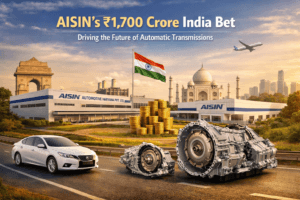
AISIN’s ₹1,700 Crore India Bet: A Strategic Move to Dominate India’s Growing Automatic Transmission Market
In a decisive move that underscores the immense potential of the Indian automobile sector, Japanese automotive titan AISIN Corporation has announced a massive investment of 32 billion yen (approximately ₹1,700 crore) to significantly expand its manufacturing footprint in India . This strategic capital allocation is aimed squarely at localizing the production of automatic transmissions (ATs) and continuously variable transmissions (CVTs), positioning the company to capture a dominant share in a market undergoing a profound transformation. With one plant expansion in Haryana and a brand-new facility in Maharashtra slated to commence operations in 2029, AISIN is not just scaling up—it is embedding itself into the very fabric of India’s future automotive landscape .
A Breakdown of the Mega-Investment: Two Plants, One Strategic Goal
AISIN’s investment is structured as a dual-pronged approach, establishing a formidable production network across North and West India.
- Rohtak, Haryana (Expansion): AISIN will invest roughly 16 billion yen to expand its existing subsidiary, AISIN AUTOMOTIVE HARYANA PRIVATE LIMITED (AHL). The expansion will add 24,000 square meters of production space dedicated exclusively to manufacturing Continuously Variable Transmissions (CVTs) .
- Sambhajinagar, Maharashtra (New Plant): An equal investment of 16 billion yen will establish a sprawling new plant on an 86,000 square meter site. This facility will produce Automatic Transmissions (ATs) and body products, creating a comprehensive manufacturing hub .
This geographic diversification mitigates supply chain risks and places production closer to a diverse set of automotive OEMs (Original Equipment Manufacturers) clustered in these industrial regions.
The Driving Force: India’s Accelerating Shift to Automatic Transmissions
The core logic behind this multi-billion-yen commitment is a fundamental and irreversible change in Indian consumer preference. For decades, the manual transmission was the undisputed king of Indian roads. However, rising urban congestion, increasing affordability, and a demand for enhanced driving comfort are driving a seismic shift.
AISIN’s announcement directly cites this trend, noting that “demand has been shifting from manual-transmission vehicles, which have been the mainstream, to automatic-transmission vehicles” . Localizing production of ATs and CVTs is no longer a luxury but a strategic imperative for any component supplier wishing to remain competitive. Local manufacturing drastically reduces costs, minimizes import duties and logistics complexities, and allows for faster, more responsive supply to Indian carmakers—a critical advantage in a fast-paced market.
Deeper Than a Plant: A Quarter-Century Commitment to “Make in India”
The scale of AISIN’s commitment becomes even clearer when examining the groundwork laid for the Maharashtra plant. In late 2025, the company secured a 95-year industrial lease for a massive 9-lakh-square-foot plot in the Shendra MIDC area of Chhatrapati Sambhajinagar . A lease of this duration is far more than a real estate transaction; it is a statement of intent. It signals a generational commitment to manufacturing in India, aligning perfectly with the Indian government’s long-term “Make in India” and Production Linked Incentive (PLI) initiatives .
The chosen location is strategically significant. Chhatrapati Sambhajinagar (formerly Aurangabad) is already a recognized automotive cluster, hosting plants for Audi, Škoda, Volkswagen, and Bajaj Auto, with Toyota also setting up operations . This ecosystem provides AISIN with inherent logistics advantages, a potential talent pool, and proximity to key customers.
Mitigating Risk with Strategic Government Partnership
AISIN’s confidence in this ambitious localisation project is bolstered by crucial support from the Japanese government. In October 2025, AISIN’s “Overseas Production Demonstration of Japan-Quality Automatic Transmissions in India” project was selected for a subsidy under Japan’s Ministry of Economy, Trade and Industry (METI) Global South Future-Oriented Co-Creation Project .
This subsidy is particularly vital for the CVT production line. AISIN acknowledges that CVTs are “structurally more complex” than other components like eAxles (which they already produce in India), making local production “significantly more challenging” and requiring an “unprecedented large-scale upfront investment” . The METI subsidy helps de-risk this technically and financially demanding endeavor, enabling AISIN to proceed with the commercialization of advanced transmission technology in India ahead of global competitors .
Beyond Gearboxes: A Broader Strategic Vision for the Indian Market
AISIN’s history in India dates to the 1990s with body product manufacturing, and they have since methodically expanded their portfolio . The company currently operates four bases in India, producing brakes, sensors, and, since March 2025, eAxles—the key component for electric vehicles . The new transmission plants must be viewed within this broader context.
- Portfolio Diversification: AISIN is building a complete, localized portfolio for both internal combustion engine (ICE) and electric vehicle (EV) platforms. While ATs and CVTs cater to the current ICE-led automatic shift, the eAxle production positions the company for the future EV wave.
- Competitive Moats: Local production of core, complex components like transmissions creates high barriers to entry. It allows AISIN to offer cost-competitive, high-quality solutions to Indian automakers, potentially squeezing out rivals who rely on imports.
- The “National Gearbox” Phenomenon: As noted by automotive enthusiasts, AISIN’s TF-60SN 6-speed automatic transmission (a torque converter) has become ubiquitous in India, found in vehicles from Maruti Suzuki, Toyota, Kia, MG, and Mahindra . This widespread adoption gives AISIN unparalleled scale and market insight. The new AT plant will solidify this position, while the CVT line will allow it to compete in another popular automatic transmission segment.
Expert and Consumer Perspectives: A Market at an Inflection Point
The strategic importance of this move is echoed by industry observers. Analysts note that AISIN’s scale and forthcoming localization could exert significant “production and manufacturing cost pressure” on competitors offering CVTs, such as Honda and Hyundai . This could reshape the entire transmission landscape, potentially accelerating a market consolidation around a few major suppliers.
Furthermore, experts highlight that AISIN’s transmission is not a single unit but a modular “family” engineered to handle different torque outputs, from 280 Nm to over 450 Nm, making it versatile enough for a wide range of vehicles from compact SUVs to full-size ones . This flexibility is a key asset in a diverse market like India.
The Road to 2029 and Beyond: Implications for India’s Auto Industry
As AISIN gears up for its 2029 operational launch, the implications are vast:
- Supply Chain Strengthening: Local transmission production will make Indian automakers more resilient to global supply chain disruptions.
- Technology Transfer & Employment: The project will involve significant technology transfer and skill development, creating high-value jobs and elevating India’s position in the global auto component map.
- Consumer Benefits: Ultimately, localized production should make automatic vehicles more affordable for the Indian consumer, accelerating the adoption curve and offering more choices. As one industry watcher put it, the expansion of transmission options—from manuals to DCTs, CVTs, and torque converters—gives consumers unprecedented choice across models and variants .
In conclusion, AISIN’s ₹1,700 crore investment is a powerful validation of India’s automotive growth story. It transcends a simple corporate expansion, representing a strategic pivot to secure long-term dominance in a critical component category. By aligning with government initiatives, leveraging strategic subsidies, and betting on a sustained consumer shift, AISIN is not just building factories; it is actively shaping the driving experience of millions of future Indian car owners and, in the process, helping to write the next chapter of “Make in India.” As Mohan Kumar, Head of India Operations for AISIN, stated, this move is a “significant step towards meeting the needs of the Indian market” and aims to “enhance our competitiveness” while contributing to the entire industry . The race for India’s automatic future is on, and AISIN has just shifted into a higher gear.
You must be logged in to post a comment.