
AI’s Market Quake: How One Tech Announcement Ripped Through Software and Legal Industries
On February 5, 2026, a major announcement from AI company Anthropic triggered a severe market sell-off, wiping nearly ₹2 trillion from the value of Indian IT giants like TCS and Infosys, as its new “Claude Cowork” AI agent—equipped with plugins for legal, finance, and data tasks—threatened to automate the core, routine professional work that forms the backbone of the IT services industry’s labor-intensive billing model. While some analysts viewed the panic as an overreaction, citing the irreplaceable role of human judgment for complex, secure systems, the event starkly highlighted an existential shift: AI is evolving from a productivity tool into an autonomous worker capable of executing multi-step business workflows, forcing a fundamental re-evaluation of the economic model for knowledge work and pushing firms toward becoming architects of AI-augmented systems rather than mere providers of human execution.
AI’s Market Quake: How One Tech Announcement Ripped Through Software and Legal Industries
The immediate trigger for this market panic was something that sounded mundane to non-technical ears: AI plugins. Yet these tools represented a fundamental shift from AI as a helpful chatbot to AI as an autonomous worker capable of executing specialized business workflows.
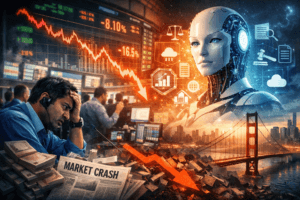
In the early hours of February 5, 2026, the trading floors of Mumbai witnessed a financial tremor that many saw as an omen of profound technological change. Shares of India’s celebrated information technology giants — Tata Consultancy Services (TCS), Infosys, and Wipro — plummeted by as much as 8% in a single session. The Nifty IT index nosedived nearly 6%, its worst intraday fall since the COVID-19 market crash of March 2020, erasing a staggering ₹1.92 trillion (approximately $23 billion) in market capitalisation in mere hours.
This was not an isolated incident. The shockwave originated on Wall Street, where the tech-heavy Nasdaq had fallen 1.4% overnight, shedding roughly $300 billion in value. The catalyst? An announcement from San Francisco-based artificial intelligence startup Anthropic. The company had unveiled 11 new plugins for its “Claude Cowork” agent, tools designed to automate complex professional tasks in legal, finance, sales, and data analysis. For investors, the message was stark: the AI that was supposed to be a tool for these companies was rapidly evolving into a direct competitor for their core business.
The Spark: Claude Cowork and the Plugins That Spooked the Market
To understand the panic, one must move beyond the abstract idea of “AI” and examine the specific capabilities Anthropic demonstrated. Claude Cowork is not a simple chatbot. It is an autonomous agent platform capable of performing multi-step workflows directly within a user’s computer files and web browser. The newly announced plugins transformed this generalist assistant into a team of specialized domain experts.
For example, the legal plugin equips Claude to conduct playbook-based contract reviews. It can load an organization’s standard negotiation positions, analyze material clauses (like limitation of liability or indemnity), identify risks against that playbook, and even generate specific “redline” editing suggestions with professional rationales ready for negotiation. Similarly, a sales plugin can connect to a company’s CRM system, research prospects, and automate follow-up tasks.
This represents a fundamental leap. The AI is no longer just answering questions or generating drafts; it is executing entire business processes that were previously the domain of human professionals or specialized software suites from companies like Salesforce or Thomson Reuters. As analysts at JPMorgan noted, the trend is the evolution “from a chatbot that answers text-based questions to an agent that executes labour”.
Industries in the Crosshairs: A Comparative View
The market reaction highlighted which sectors investors see as most immediately vulnerable. The sell-off was not confined to Indian IT services; it ripped through global software and professional information firms, revealing a broad pattern of perceived disruption.
The table below summarizes the initial impact and core threat for three key sectors:
| Professional Sector | Example Companies Impacted | Nature of Immediate Threat from AI Agents |
| Legal Tech & Publishing | Thomson Reuters, RELX (LexisNexis), Wolters Kluwer | Automation of contract review, compliance monitoring, and legal document analysis—core revenue sources for these firms. |
| IT & Business Process Services | TCS, Infosys, Wipro, HCLTech | Potential decline in billable hours for routine coding, application maintenance, data analysis, and back-office processes as clients automate in-house. |
| Enterprise Software (SaaS) | Salesforce, ServiceNow | AI agents performing tasks (e.g., CRM updates, workflow management) directly, potentially bypassing the need for multiple software subscriptions. |
The panic in legal publishing was particularly acute. Stocks of giants like Thomson Reuters fell 16% following Anthropic’s announcement, as investors grappled with the possibility that a general-purpose AI could replicate specialized—and expensive—legal research and drafting services. Michael McCready, a law firm owner, pointed to the human cost: “If this mundane, routine stuff can now be done by agentic AI… it eliminates that lower level, and it’s going to be more difficult for entry-level attorneys to find positions”.
Beyond the Knee-Jerk: Overreaction or Inevitable Reality?
Amid the sell-off, cooler heads urged perspective. G Chokkalingam of Equinomics Research called the reaction “largely unwarranted,” arguing that markets were overlooking key strengths. He and others noted that core systems in banking, finance, and insurance cannot be easily replaced due to security and regulatory risks. Furthermore, Indian IT firms are themselves major investors in AI, integrating it into their own service offerings.
Anthropic itself sought to temper fears, explicitly clarifying that its legal plugin “does not provide legal advice” and that its analysis should be reviewed by licensed attorneys. This underscores a critical limitation: current AI agents are tools for augmentation and efficiency, not wholesale replacement of professional judgment in high-stakes scenarios.
However, the underlying anxiety speaks to a deeper, more legitimate concern about the future economic model of knowledge work. The traditional Indian IT success story was built on a labor-arbitrage model—providing skilled, cost-effective human capital to global corporations. If AI can automate a significant portion of that work on-demand for a subscription fee, the very foundation of that multi-billion dollar industry is challenged. India’s own Economic Survey 2025-26 warned of this risk, noting AI “risks hollowing out India’s core value proposition if adaptation lags”.
The Human Equation: Productivity Gain vs. Skill Atrophy
Perhaps the most profound insight comes from Anthropic’s own research into how AI affects the humans using it. A January 2026 study by the company found that while AI can speed up some tasks by up to 80%, it also carries a significant trade-off for skill development.
In a controlled experiment with software developers learning a new Python library, participants who used an AI assistant scored 17% lower on a subsequent skills quiz than those who coded by hand. The most significant gap was in debugging skills—the critical ability to understand when and why code fails. This “cognitive offloading” suggests that aggressive, unthinking reliance on AI for task completion can undermine the very expertise needed to guide and oversee the AI in the long run.
This research points to the central dilemma of the AI-augmented workplace. The drive for short-term productivity gains could inadvertently stunt the development of deep, conceptual understanding in the next generation of professionals. The market’s violent reaction may, therefore, be a response not just to displaced tasks, but to a feared erosion of the human skill base that ultimately gives oversight and strategic direction to technology.
Navigating the Transformation
The path forward for industries now in AI’s spotlight is not extinction, but inevitable and difficult transformation.
- For IT Services Giants: The move from being providers of human-powered process execution to becoming architects and orchestrators of AI-augmented systems is essential. Their value will shift towards consulting on AI integration, managing complex hybrid human-AI workflows, and ensuring security and compliance in automated environments.
- For Professionals and Firms: The focus must be on leveraging AI for high-judgment work. As Michael Bennett from the University of Illinois Chicago noted, “The most expert legal practitioners… will now be able to reduce the cost of doing the drudgery”. The winners will use AI to eliminate routine tasks, freeing time for strategic advice, complex negotiation, and creative problem-solving that AI cannot replicate.
- For the Workforce: Cultivating a “comprehension-first” approach to using AI tools is critical. Anthropic’s research showed that developers who used AI to ask conceptual questions and explain generated code retained far more knowledge than those who simply delegated tasks. Continuous learning and the development of skills in AI oversight, prompt engineering, and ethical governance will become paramount.
The market shock of early February 2026 may be remembered not as the day AI killed the IT industry, but as the day the world’s financial markets visibly priced in a seismic shift in the nature of knowledge work. The technology is compelling a move away from models built on repetitive intellectual labor and toward those predicated on unique human judgment, strategic creativity, and sophisticated technological stewardship. The companies—and professionals—that will thrive are those that see AI not as a replacement, but as the most powerful tool yet invented for amplifying uniquely human capabilities.
You must be logged in to post a comment.