
Aid in Peril: How Israel’s NGO Ban Threatens Gaza’s Survival and What It Means for Humanitarian Principles
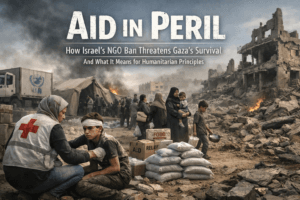
Aid in Peril: How Israel’s NGO Ban Threatens Gaza’s Survival and What It Means for Humanitarian Principles
A major new confrontation is emerging between humanitarian principles and security politics in Gaza. Israel’s decision to ban 37 international aid organizations from operating in Gaza and the West Bank has triggered widespread condemnation from the United Nations, global humanitarian groups, and regional governments, who warn the move will have catastrophic consequences for civilian populations already teetering on the edge of survival. UN Secretary-General António Guterres has called the work of these groups “indispensable to life-saving humanitarian work” and urged Israel to reverse a decision he fears will “further exacerbate the humanitarian crisis”.
The Ban and the Stated Reasons
Israel’s Ministry for Diaspora Affairs and Combating Antisemitism announced the suspensions, stating that the affected NGOs had failed to comply with new registration requirements. These rules, which Israel says are designed to “strengthen and update” oversight, demand that organizations provide “detailed information on their staff members, funding and operations“. Specifically, Israel claims the groups refused to submit lists of their Palestinian employees to allow for security vetting to “rule out any links to terrorism”.
The ministry cited the medical charity Doctors Without Borders (MSF) as an example, accusing it of employing two individuals with alleged links to Hamas and Palestinian Islamic Jihad. It stated, “Despite repeated requests, the organisation failed to fully disclose the identities and roles of these individuals”. In response, MSF told AFP that it “would never knowingly employ people engaging in military activity” as they would “pose a danger to our staff and our patients”.
The banned organizations have been ordered to cease operations by March 1, 2026, following a ten-month period they were given to provide the requested information.
A Pattern of Restricting Aid
This latest move is not an isolated incident but part of a broader pattern of restricting humanitarian access to Palestinian territories.
- Previous UNRWA Ban: In 2024, the Israeli parliament passed a law banning the United Nations Relief and Works Agency for Palestine Refugees (UNRWA) from operating within Israel and, by extension, territories it controls. Israel cited allegations that some UNRWA staff participated in the October 7, 2023, attacks—claims the agency strongly denied and which the International Court of Justice later found to be unsubstantiated.
- Targeting Palestinian NGOs: In 2021, Israel designated six prominent Palestinian human rights and civil society groups as terrorist organizations, a move widely criticized by international human rights observers.
- Weaponization of Aid: More than 100 aid organizations have previously accused Israel of blocking life-saving assistance and “weaponisation of aid”.
Who Is Being Banned and What’s at Stake
The list of 37 organizations reads like a who’s who of global humanitarian response, encompassing groups that provide the fundamental pillars of survival in a shattered territory.
| Organization Category | Examples of Banned Groups | Primary Services Provided in Gaza |
| Medical & Health | Doctors Without Borders (Multiple chapters), Medecins du Monde, Medical Aid for Palestinians | Surgical care, malnutrition treatment, maternal health, primary care |
| Food Security & Nutrition | Action Against Hunger, Oxfam affiliates, CARE | Food distribution, malnutrition screening, clean water |
| Shelter & Infrastructure | Norwegian Refugee Council, Danish Refugee Council, Mercy Corps | Shelter support, non-food items, water/sanitation services |
| Child Protection & Education | War Child Holland, Defense for Children International, Terre des hommes | Child protection, psychological support, education |
| Multi-Sector Relief | International Rescue Committee, World Vision, ActionAid | Comprehensive aid including cash assistance, protection, health, and shelter |
The potential impact is staggering. The Norwegian Refugee Council warned that Israel is blocking life-saving aid at a time when needs “far exceed the available aid and services”. A joint statement from several governments, including the UK and France, estimated that “one in three healthcare facilities in Gaza will close if INGOs’ operations are stopped”. MSF stated that being barred would “deprive hundreds of thousands of people from accessing medical care”.
This comes atop a pre-existing catastrophe. According to UN data, 80% of all buildings in Gaza have been damaged or destroyed, including all hospitals and the vast majority of schools. Over 1.5 million people are displaced, with half the population urgently needing shelter as winter storms batter temporary tents and damaged homes.
The Core Conflict: Security vs. Neutrality
The standoff highlights a fundamental clash between two worldviews.
Israel’s Security Argument: Israel frames the new regulations as a necessary security measure. Diaspora Affairs Minister Amichai Chikli stated that while humanitarian assistance is welcome, “exploitation of humanitarian frameworks for terrorism” is not. The government position is that in a conflict with groups like Hamas, it has a right and duty to ensure aid is not co-opted to support militant activities.
The Humanitarian Principle of Neutrality: Aid groups and the UN counter that the demand for staff lists violates the core humanitarian principles of neutrality, independence, and impartiality. They argue that sharing sensitive personnel data with a party to the conflict endangers their Palestinian staff, who could face targeting, detention, or violence. Furthermore, they contend that submitting to such oversight by one side in a conflict erodes their perceived neutrality, making it harder to operate safely and gain the trust of all communities.
This is not a new tension. The Palestinian NGO Network (PNGO), an umbrella for local civil society groups, has a long history of rejecting donor clauses requiring them to disavow ties to groups labeled as terrorist by foreign governments, arguing this interferes with Palestinian politics and the right to resistance. Conversely, groups like NGO Monitor accuse networks like PNGO of having organizational ties to militant factions such as the Popular Front for the Liberation of Palestine (PFLP).
International Condemnation and Calls to Action
The reaction from the international community has been swift and critical.
- United Nations: Secretary-General Guterres led the criticism, stating the suspension “risks undermining the fragile progress made during the ceasefire”. Philippe Lazzarini, Commissioner-General of UNRWA, said the measures would “reduce life-saving assistance for civilians already struggling to survive”.
- Regional Governments: The foreign ministers of Qatar, Egypt, Jordan, Saudi Arabia, and other nations issued a joint statement warning of “deteriorating” conditions and called on the world to “pressure Israel, as the occupying power, to immediately lift constraints”.
- Western Allies: A coalition including the United Kingdom, Canada, France, and Japan expressed “serious concerns” and urged Israel to ensure NGOs can operate “sustained and predictable” aid deliveries. The European Union’s humanitarian chief stated, “IHL leaves no room for doubt: aid must reach those in need“.
- Civil Society: A statement signed by Oxfam and 52 other international NGOs warned the measures “will impede critical humanitarian action” and called for their reversal. Palestinian human rights groups like Al-Haq called for diplomatic and economic sanctions on Israel.
The Path Forward and How to Help
As the March 1 deadline looms, the immediate future for Gaza’s civilians hangs in the balance. Humanitarian agencies continue to advocate for safe access and the entry of specialized equipment. The debate touches on larger questions about the rules of war, the protection of humanitarian space, and the responsibilities of an occupying power.
For readers moved by this crisis, supporting independent humanitarian journalism that continues to report from the region is crucial. Citizens can also urge their elected representatives to advocate for the protection of humanitarian principles and for aid to flow unimpeded to civilians in need. Reputable humanitarian organizations continue to operate under extreme duress and rely on public awareness and support to fulfill their lifesaving missions.
Ultimately, Israel’s NGO ban represents more than a bureaucratic dispute. It is a critical stress test for the international humanitarian system, challenging whether the principles of neutral, independent aid can be upheld in one of the world’s most politicized and punishing conflicts. The lives of millions depend on the answer.
You must be logged in to post a comment.