
Aid in Crisis: The Human Cost of Israel’s NGO Ban in Gaza
In January 2026, Israel moved to ban 37 international humanitarian organizations, including critical groups like Doctors Without Borders (MSF), from operating in Gaza for refusing to share staff lists, a measure Israel stated was necessary to prevent aid diversion to militant groups. The United Nations, led by Secretary-General António Guterres, urgently called for the reversal of this decision, warning that suspending these indispensable NGOs risks catastrophically exacerbating the humanitarian crisis by cutting off medical care, food, water, and shelter support for Gaza’s population amid a harsh winter. This action, denounced by Israeli and international human rights groups as violating core humanitarian principles, threatens to undermine fragile ceasefire progress and leaves over two million residents facing even greater devastation with most buildings already damaged or destroyed.
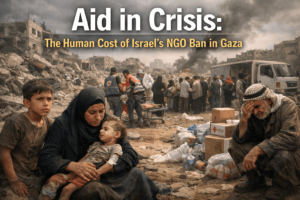
Aid in Crisis: The Human Cost of Israel’s NGO Ban in Gaza
As winter storms lash Gaza’s makeshift shelters, a new bureaucratic storm threatens to sever essential aid lifelines. On January 1, 2026, Israel implemented a ban prohibiting 37 international humanitarian organizations, including Doctors Without Borders (MSF) and the Norwegian Refugee Council, from operating in the Gaza Strip. This move, defended by Israel as a necessary security measure, has drawn condemnation from the United Nations and sparked urgent warnings of a catastrophic deepening of the humanitarian crisis for Gaza’s two million residents.
The organizations affected form the backbone of survival for a population already pushed to the brink. They must cease all operations by March 1, a deadline that looms over Gaza like a death sentence for the most vulnerable.
The Vital Lifelines Under Threat
The banned NGOs are not peripheral actors; they are central to keeping Gaza’s decimated society functioning. Their work spans healthcare, nutrition, shelter, and water provision—services that are a matter of life and death.
Table: Major International NGOs Affected by the Ban
| Organization | Key Role in Gaza | Immediate Impact of Ban |
| Doctors Without Borders (MSF) | Supports ~20% of hospital beds; assists with 1/3 of births; treated over 100,000 patients in 2025. | “Hundreds of thousands” cut off from essential care; major water distributor halted. |
| Norwegian Refugee Council | Provides legal aid, education, and shelter support. | Increased vulnerability for displaced families, especially during winter storms. |
| CARE & Oxfam | Food security, water, sanitation, and hygiene programs. | Deepened risk of famine and disease outbreaks. |
| Caritas Jerusalem | Church-based humanitarian and medical services. | Loss of critical healthcare and support for vulnerable communities. |
The timing could not be worse. Gaza is enduring a harsh winter, with heavy rains destroying the flimsy tents that hundreds of thousands call home. At least 20 people have recently been killed by the collapse of shelters and damaged buildings. According to the UN, over one million people—half of Gaza’s population—still urgently need proper shelter, while shattered sanitation infrastructure has left 740,000 vulnerable to toxic flooding.
As the President of MSF France, Dr. Isabelle Defourny, starkly warned, losing these organizations means a large portion of Gaza’s people will lose access to critical medical care, water, and lifesaving support.
The Stated Reasons and the Pushback
Israel’s government, led by the Ministry of Diaspora Affairs, frames the ban as a straightforward security necessity. The new regulations, announced in March 2025, required NGOs to submit detailed lists of their Palestinian staff members, funding sources, and operational structures. The state argues this is to prevent Hamas and other militant groups from infiltrating aid organizations and diverting resources.
Diaspora Affairs Minister Amichai Chikli stated, “The message is clear: humanitarian assistance is welcome—the exploitation of humanitarian frameworks for terrorism is not”. Israel’s coordination body for Gaza (COGAT) claims the banned groups contributed less than 1% of total aid and that supplies will continue through more than 20 other registered organizations.
However, the banned NGOs, along with UN agencies and human rights groups, present a fundamentally different narrative. They argue that Israel’s demands violate the core humanitarian principles of neutrality and independence. Submitting staff lists to a party to the conflict, they contend, would endanger their employees.
Shaina Low of the Norwegian Refugee Council explains the refusal: “It comes from a legal and safety perspective. In Gaza, we saw hundreds of aid workers get killed”. This fear is not abstract; the UN notes that more than 500 aid workers have been killed in Gaza during the war.
Seventeen Israeli human rights organizations, including B’Tselem and Physicians for Human Rights-Israel, have condemned their own government’s policy. They argue it “undermines principled humanitarian action, endangers staff and communities, and compromises effective aid delivery”. They further assert that as the occupying power, Israel has a legal obligation to ensure supplies for civilians and is instead preventing others from filling the gap.
A Wider Pattern of Restriction and a Complex Local Landscape
This ban does not exist in isolation. UN human rights chief Volker Türk calls it “the latest in a pattern of unlawful restrictions on humanitarian access”. It follows Israel’s earlier ban on UNRWA, the UN’s main Palestinian relief agency, after similar allegations of militant links.
The situation is further complicated by the complex role of local Palestinian NGOs. Figures like Amjad Al-Shawa, Director of the Palestinian NGO Network (PNGO) in Gaza, illustrate this complexity. Al-Shawa is a recognized human rights advocate who coordinates with major UN agencies. Simultaneously, according to watchdog groups, he has attended meetings with Hamas leadership in his role with the Independent Commission for Human Rights, an organization now under investigation by several European donors over concerns of potential fund diversion.
His recent reported appointment by Hamas and the PLO to head a technocratic committee for Gaza underscores how humanitarian and political spheres are deeply intertwined in the territory. For Israel, such ties validate their security fears. For aid agencies, they represent the challenging reality of operating in a territory controlled by a designated terrorist group, where engagement with local authorities is often unavoidable for access.
The International Response and the Path Forward
The global reaction has been one of unified alarm. UN Secretary-General António Guterres led the calls, urging Israel to reverse the ban and warning it “risks undermining the fragile progress made during the ceasefire”. A coalition of ten foreign ministers from countries including Canada, the UK, France, and Japan warned of a “renewed deterioration” toward “catastrophic” conditions.
The European Union warned the rules would block “life-saving aid,” stating they “cannot be implemented in their current form”. Even within Israel, the move faces significant domestic criticism from human rights groups.
The immediate future hinges on a short timeline. The affected NGOs have until March 1 to wind down operations. MSF says it will be forced to completely halt its work in Gaza by then if the decision stands. The ban also threatens to destabilize the fragile, US-brokered ceasefire that began in October 2025, which was predicated on improved humanitarian access.
As former UN humanitarian chief Martin Griffiths poignantly noted, these international agencies are “the last mile”—the essential final link that delivers aid directly into the hands of those who need it. Severing that link, especially as winter deepens, transforms a man-made crisis into a potential catastrophe. The coming weeks will test whether diplomatic pressure can reopen these lifelines or whether Gaza’s besieged population will be left to face the cold with even fewer resources for survival.
You must be logged in to post a comment.