
Aid in Crisis: Israeli Ban Threatens Catastrophe for Gaza’s Vulnerable Population
In late December 2025, Israel moved to suspend 37 international aid organizations, including critical groups like Doctors Without Borders, from operating in Gaza, demanding detailed staff lists it claimed were needed for security vetting—a requirement aid groups rejected as a violation of humanitarian principles and a danger to their personnel. This decision, threatening to collapse the remaining lifeline for over 2.3 million Gazans, coincided with severe winter storms flooding displacement camps and exacerbating a public health crisis, all within the context of a fragile and frequently violated ceasefire. The ban drew swift international condemnation from multiple governments and UN officials as a devastating escalation that weaponized humanitarian access, while parallel Israeli operations in the West Bank involving mass arrests and home demolitions underscored a broader pattern of pressure on Palestinian populations.
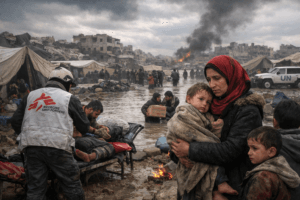
Aid in Crisis: Israeli Ban Threatens Catastrophe for Gaza’s Vulnerable Population
The fragile quiet in Gaza is deceptive. As winter rains flood makeshift tent camps and families huddle in the ruins of their homes, a new crisis is unfolding that threatens to collapse what remains of the humanitarian lifeline. On December 31, 2025, Israel announced it would suspend the operations of 37 international aid organizations, including medical powerhouse Doctors Without Borders (MSF) and global giants like CARE and the Norwegian Refugee Council.
This decision, effective January 1, 2026, comes as over 2.3 million Gazans face the coldest, wettest months in living memory, their bodies weakened by malnutrition and their spirits frayed by relentless trauma. The ban, based on organizations’ refusal to share detailed staff information with Israeli authorities, could dismantle the intricate network delivering everything from emergency medical care to food and shelter. Humanitarian officials warn this move risks creating a catastrophic collapse of services for a population that international law is designed to protect.
The Scope of the Ban: Targeting the Lifelines of Gaza
The Israeli Ministry for Diaspora Affairs and Combating Antisemitism framed the suspensions as a necessary security measure, stating organizations had “failed to cooperate and refused to submit a list of their Palestinian employees in order to rule out any links to terrorism”. Israel’s government spokesperson, Gilad Zwick, told AFP that the NGOs refuse to provide staff lists “because they know, just as we know, that some of them are involved in terrorism or linked to Hamas”.
However, the list of affected agencies reads like a who’s who of global humanitarian response:
- Medical Care: Médecins Sans Frontières (MSF), Médecins du Monde, Medical Aid for Palestinians.
- Food & Nutrition: Action Against Hunger, Oxfam affiliates.
- Shelter & Protection: Norwegian Refugee Council, Danish Refugee Council, International Rescue Committee.
- Child & Family Support: Save the Children, World Vision, War Child Holland.
This suspension is not the first of its kind. It follows Israel’s 2024 ban on the United Nations Relief and Works Agency (UNRWA), the primary provider of aid and services to Palestinian refugees for generations. While Israel cited allegations of staff links to Hamas attacks, the International Court of Justice later found those claims unsubstantiated. This pattern has led critics to argue these measures are part of a broader strategy to dismantle institutional support for Gaza’s civilian population.
The table below summarizes the scale of the crisis and the sectors affected by the aid group suspension:
| Aspect of Crisis | Key Statistic | Impact of Aid Group Suspension |
| Population in Need | 2.3 million people in Gaza | Loss of coordinated aid for hundreds of thousands. |
| Food Insecurity | 1.6 million face Crisis or worse acute food insecurity (IPC Phase 3+). | Organizations like Action Against Hunger and Oxfam provide critical food distribution and malnutrition screening. |
| Shelter & Winter Crisis | Over 1 million need urgent shelter; winter storms have destroyed tents. | Norwegian Refugee Council, IRC, and others lead emergency shelter and winterization programs. |
| Healthcare | Health system decimated; MSF supports ~20% of hospital beds. | Removal of MSF and other medical NGOs would cripple remaining health services. |
| Aid Worker Casualties | 579 aid workers killed since Oct 2023. | Creates climate of fear; NGOs cite safety concerns for staff as reason for not sharing data. |
A Precarious Winter Amidst the Rubble
The timing of this decision is particularly cruel, coinciding with a severe winter storm that has battered the coastal enclave. The UN Office for the Coordination of Humanitarian Affairs (OCHA) reports that heavy rains have triggered flash flooding, with seawater inundating tent camps in areas like Al Mawasi in Khan Younis. Hundreds of thousands are struggling in “makeshift tents damaged by rain, wind and seawater waves or damaged buildings at risk of collapse”.
Yasmine Praz Dessimoz, Director of Operations for the International Committee of the Red Cross (ICRC), recently returned from Gaza and described a landscape of utter devastation. “Entire cities have been flattened,” she said. “Palestinians are wondering whether they’ll survive the winter and the illnesses it brings, with a health system that’s barely functional”. The Palestinian Civil Defense has reported deaths from hypothermia, drownings in wells, and collapsing structures.
Beyond the immediate cold, the sanitation crisis is a ticking time bomb. Damaged sewage systems and uncollected waste, exacerbated by flooding, create a high risk of disease outbreaks in overcrowded displacement sites. The ICRC’s top priority is getting the sewerage system working again, but that requires clearing tons of rubble laced with unexploded ordnance.
The Stalemate Over Staff Lists and Security
The core of the dispute lies in Israel’s new registration requirements, which demand detailed information on Palestinian staff members, funding, and operations. Israel insists this is essential to prevent Hamas from exploiting aid channels. “Humanitarian assistance is welcome — the exploitation of humanitarian frameworks for terrorism is not,” stated Diaspora Affairs Minister Amichai Chikli.
Aid organizations universally reject this framing. They argue that submitting staff lists to a party to the conflict violates the core humanitarian principles of neutrality and independence. Furthermore, they cite grave safety concerns for their employees. During the war, over 500 aid workers have been killed in Gaza. Organizations fear that sharing staff identities could lead to targeting, detention, or violence against their teams.
MSF, explicitly accused by Israel of employing individuals with alleged militant links, stated: “MSF would never knowingly employ people engaging in military activity” as they would “pose a danger to our staff and our patients”. Athena Rayburn of the Association of International Development Agencies (AIDA) noted that NGOs already conduct rigorous internal vetting and had proposed alternative solutions like third-party audits, which Israel rejected.
International Condemnation and a Faltering Ceasefire
The international response to Israel’s decision has been swift and damning. A coalition of foreign ministers from ten countries, including the UK, Canada, France, and Japan, warned that suspending NGOs would have a “severe impact on access to essential services, including healthcare” and that “one in three healthcare facilities in Gaza will close if INGOs’ operations are stopped”.
UN Human Rights Chief Volker Türk condemned the move as “outrageous,” calling it part of a pattern of “unlawful restrictions on humanitarian access”. The European Union’s humanitarian chief, Hadja Lahbib, stated bluntly, “The NGO registration law cannot be implemented in its current form”.
This crisis unfolds against the backdrop of a shaky ceasefire that began in October 2025. While the ceasefire halted large-scale military operations, OCHA reports that airstrikes, shelling, and gunfire continue, resulting in ongoing casualties. Israel maintains control over more than 50% of the Gaza Strip behind a largely unmarked “Yellow Line,” restricting access to farmland and humanitarian sites. The Israeli military chief has stated that 2026 will be a crucial year to ensure Hamas cannot “rebuild its capabilities”.
A Pattern of Pressure Beyond Gaza
The assault on humanitarian infrastructure is not confined to Gaza. A parallel crisis of displacement and demolition is accelerating in the occupied West Bank. In a major report, Human Rights Watch documented that Israel’s “Operation Iron Wall” in early 2025 forcibly displaced 32,000 Palestinians from refugee camps in Jenin, Tulkarem, and Nur Shams.
The report details how Israeli forces used drones with loudspeakers to order people from their homes before systematically demolishing them, actions it classifies as war crimes and crimes against humanity. Satellite imagery analysis shows over 850 homes and buildings destroyed or heavily damaged. Israeli Finance Minister Bezalel Smotrich suggested that if camp residents “continue their acts of ‘terrorism,’” the camps “will be uninhabitable ruins”.
This strategy in the West Bank, occurring while global attention is focused on Gaza, appears to be part of a broader effort to alter facts on the ground through displacement and the expansion of Israeli control.
The Stakes for Gaza’s Future
As Palestinians in Gaza search for firewood in the ruins and aid workers wonder if they can continue their missions, the suspension of these 37 organizations represents more than a bureaucratic hurdle. It is a direct challenge to the international humanitarian system itself. If NGOs cannot operate under the fundamental principles of neutrality and independence, their entire model collapses.
The immediate stakes are measured in lives lost to preventable cold, disease, and hunger. The Norwegian Refugee Council’s Shaina Low put it starkly: “Removing these humanitarian organizations now will deepen exposure, illness, and preventable deaths”. For MSF, being barred from Gaza would “deprive hundreds of thousands of people from accessing medical care”.
The long-term stakes are about what, and who, remains in Gaza. With its social infrastructure—hospitals, schools, water systems—in ruins, the ban on groups capable of early recovery work threatens to cement a permanent state of destitution. The Palestinians, as the ICRC’s Dessimoz observed, “want to rebuild, to be there, to live there. It’s their home”. Whether they are given the tools to do so, or are systematically stripped of their support networks, will define Gaza’s future for generations to come. The international community’s response to this latest crisis will be a decisive test of its commitment to upholding human dignity amidst one of the 21st century’s most profound humanitarian tragedies.
You must be logged in to post a comment.