
AI Impact Summit 2026: Global Ambition Meets Domestic Turmoil as India Charts Its AI Future
The AI Impact Summit 2026 in New Delhi concluded with India positioning itself as a key player in global AI governance, hosting world leaders and tech CEOs who emphasized equitable access, regulation, and international cooperation—highlighted by OpenAI’s Sam Altman warning against centralized AI power, UN chief Antonio Guterres proposing a $3 billion global skills fund, and India signing the Pax Silica semiconductor deal with the US. However, the high-profile event was marked by stark domestic contrasts: the Indian Youth Congress staged a topless protest inside the venue against unemployment and inflation, while an embarrassing incident involving a university passing off a Chinese robodog as indigenous technology drew opposition criticism, underscoring the tensions between India’s technological ambitions and its ground-level socio-political realities.
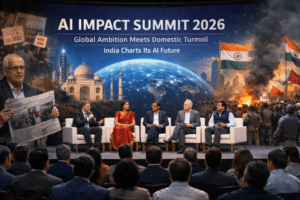
AI Impact Summit 2026: Global Ambition Meets Domestic Turmoil as India Charts Its AI Future
The Paradox of Progress: Inside the Summit That Showcased India’s Tech Dreams and Political Realities
The AI Impact Summit 2026 at New Delhi’s sprawling Bharat Mandapam was always destined to be a study in contrasts. On one hand, it represented India’s boldest declaration yet that it intends to shape—not merely participate in—the global artificial intelligence revolution. On the other, the five-day gathering became an unintentional mirror reflecting the country’s persistent fault lines: between technological aspiration and ground-level discontent, between global statesmanship and domestic political theater.
When the summit’s final gavel falls today, what will remain is not merely a joint declaration on AI governance, but a vivid snapshot of a nation grappling with its own contradictions while racing toward an algorithmic future.
The Vision: India as AI’s Third Pole
Prime Minister Narendra Modi’s opening address set the tone with characteristic ambition. “AI must serve the global common good,” he declared, positioning India not as a follower in the US-China technological rivalry but as a potential bridge—a developing nation that understands both the promise and peril of transformative technology.
This framing resonated deeply with the summit’s unprecedented composition. For the first time, the largest global AI gathering took place in the Global South, and the symbolism was not lost on attendees. Bhutanese Prime Minister Tshering Tobgay captured the sentiment succinctly: “The AI summit being held in India really has global importance, not just for the global south.” His words acknowledged what many in attendance quietly recognized—that India’s demographic dividend, its vast pool of English-speaking STEM graduates, and its rapidly digitizing economy position it uniquely in the AI landscape.
The numbers tell part of the story. With tens of thousands of participants, dozens of world leaders, and a who’s who of global tech executives navigating the crowded corridors of Bharat Mandapam, the summit’s scale matched its ambition. OpenAI CEO Sam Altman’s warning that “centralisation of AI power could be dangerous” found receptive ears in a country that has long advocated for a multipolar world order—in technology as in geopolitics.
The Macron Factor: Franco-Indian Tech Diplomacy
French President Emmanuel Macron’s presence added particular weight to the proceedings, his visit coinciding with what both sides described as India-French relations at their “highest point.” Macron’s praise for India’s digital transformation as a “global gold standard” was more than diplomatic flattery—it reflected genuine European interest in diversifying technology partnerships beyond the US-China axis.
The French leader’s engagement extended beyond the summit’s formal sessions, with bilateral talks covering everything from defense cooperation to joint AI research initiatives. For India, Macron’s enthusiastic participation validated its claim to a seat at the high table of AI governance. For France, it represented a strategic hedge in a world where technological dependencies increasingly translate into geopolitical vulnerabilities.
The Deal-Making: From Semiconductors to Skill Development
Behind the rhetoric of global cooperation, the summit hummed with the machinery of commerce. The signing of the Pax Silica Declaration between India and the United States exemplified this dual track—part geopolitical alignment, part supply chain pragmatism.
Union Minister Ashwini Vaishnaw’s explanation captured the essence: “Our PM Narendra Modi ji has created trust in our country. The entire world trusts India because we respect IP. We have a large talent pool and we have conducted our foreign policy in a way which creates that trust.” The semiconductor agreement, he suggested, would help establish “that entire semiconductor ecosystem well established in our country.”
Meanwhile, Andhra Pradesh’s partnership with IBM to skill one lakh youth in AI, cybersecurity, and quantum computing represented the summit’s promise trickling down to the state level. The initiative’s focus on “industry-aligned, future-ready skills” acknowledged what every developing country now understands—that the AI revolution will create winners and losers, and education systems must adapt or watch their youth fall behind.
L&T Semiconductor Technologies CEO Dr. Sandeep Kumar captured the business community’s enthusiasm: “The AI Summit is fantastic. It is crowded, causing a few problems, but with the number of companies attending and the number of announcements, this is a big start to a big momentum.”
The Warning Notes: Altman’s Caution and Cybersecurity Concerns
Yet the summit’s celebratory tone was repeatedly tempered by sobering reality checks. Sam Altman’s warning about AI power concentration reflected growing anxiety that the technology’s benefits might accrue to a handful of Western tech giants unless deliberate countermeasures are implemented.
Dr. Kumar offered an even more alarming perspective on AI’s dark side. “AI is actually dangerous for cybersecurity,” he cautioned. “Right now, people put their brains extensively into hacking. But AI is a tool for hackers to break into much faster. Now quantum is also about to come, which has so much compute that it can even break into our latest systems.”
His prescription—”ironclad frameworks, predictive defences, and public-private teamwork baked into AI from the ground up”—echoed concerns that have moved from academic papers to ministerial briefings as AI’s capabilities accelerate faster than governance frameworks can adapt.
UN Secretary-General Antonio Guterres’ push for a $3 billion global fund to expand AI skills and computing access added institutional weight to these concerns, framing AI equity as not merely desirable but essential to preventing a new technological divide that could entrench global inequalities for generations.
The Bhutanese Perspective: Hydropower, Mindfulness, and AI
Among the summit’s more intriguing subplots was Bhutanese Prime Minister Tshering Tobgay’s vision of connecting his country’s unique assets to the AI revolution. His proposal to link Bhutan’s “clean green renewable energy” from hydropower to AI development in the planned Gelephu Mindfulness City suggested a model where smaller nations could participate in the AI economy not through competing in algorithm development but by providing the sustainable infrastructure the technology desperately needs.
“Going forward, I see partnerships in two related areas: one, enhancing the development of our partnership to harness our fast-flowing rivers to generate clean green renewable energy and two, using this clean green renewable energy in Bhutan… to achieve our common objectives in terms of artificial intelligence,” Tobgay explained.
His framing—AI not as an end in itself but as a tool for achieving broader societal objectives—offered a counterpoint to the techno-determinism that often dominates such gatherings. And his gratitude toward India—”deeply grateful” for the invitation—underscored New Delhi’s growing soft power among its Himalayan neighbors.
The Robodog Fiasco: When Ambition Collides with Reality
No event of this scale escapes controversy, and the AI Impact Summit’s came in the form of a Chinese-made robodog presented by Galgotias University as indigenous technology. The resulting embarrassment—the stall was shut down, the university apologized for being “ill-informed,” and the government promised “zero tolerance” for misinformation—provided political opponents with ready ammunition.
Congress leader Gurdeep Singh Sappal seized the opportunity, branding the entire summit a “school-level science exhibition” and accusing the administration of “naivety” that “exposed India to ridicule.” The criticism, while opportunistic, touched on a genuine vulnerability: India’s eagerness to project technological prowess can sometimes outpace the underlying reality, creating gaps that critics and competitors alike can exploit.
Yet the episode also demonstrated the ecosystem’s self-correcting mechanisms. That the misrepresentation was detected and addressed suggests a degree of maturity in India’s tech governance—an unwillingness to let nationalist pride override basic fact. Whether this signals genuine institutional health or merely damage control remains to be seen.
The Shirtless Protest: Politics Interrupts the Party
If the robodog incident was an embarrassing footnote, the Indian Youth Congress’s topless protest inside Bharat Mandapam was a deliberate disruption—a reminder that for millions of Indians, the AI revolution remains abstract while unemployment and inflation remain painfully concrete.
The protesters, raising slogans against Prime Minister Modi and the Centre, were quickly detained, but the images of shirtless young men inside India’s premier convention center ricocheted across social media, momentarily drowning out discussions of semiconductor supply chains and quantum computing.
The juxtaposition was almost too perfect: inside the plenary halls, global executives debated how to make AI serve humanity; outside (and briefly inside), young Indians expressed their frustration at being unable to participate in the economy the old-fashioned way. The protest’s symbolism—taking off shirts to draw attention to economic nakedness—was crude but effective, a reminder that technological transitions create dislocation before they deliver dividends.
Congress’s criticism extended beyond the robodog incident to question the summit’s very premise. “The administration’s naivety exposed India to ridicule,” Sappal charged, suggesting that the government’s eagerness to host global events masks fundamental failures in education and employment that make AI’s promise ring hollow for ordinary Indians.
The US Connection: Trump, Modi, and the Future of Tech Diplomacy
US Ambassador to India Sergio Gor’s presence added geopolitical texture to the proceedings. His description of the summit as “very impactful” and his hint that a Modi-Trump meeting would happen “at the right moment” suggested that AI cooperation will feature prominently in bilateral discussions regardless of who occupies the White House.
The Pax Silica Declaration—focusing on semiconductors, digital infrastructure, and advanced technologies—represents the kind of targeted cooperation that can survive electoral cycles. Unlike broader trade agreements that become political footballs, semiconductor partnerships address genuine supply chain vulnerabilities that both countries recognize as strategic imperatives.
Yet the shadow of US domestic politics loomed. With Donald Trump hinting at another presidential run, and with his administration’s “America First” policies having disrupted global technology supply chains, the question of continuity in US-India tech cooperation remains open. Ambassador Gor’s optimism may reflect genuine momentum or diplomatic boilerplate—only time will tell.
The Governance Challenge: Balancing Innovation and Oversight
As the summit moves toward its concluding declaration, the fundamental tension animating global AI discussions remains unresolved: how to regulate powerful technology without stifling the innovation that generates its benefits.
Previous gatherings in France, South Korea, and Britain produced broad commitments but limited concrete action. The New Delhi declaration will likely follow a similar pattern—establishing common language around risks and regulatory thresholds while leaving implementation to individual nations.
This may be less a failure of ambition than a recognition of reality. AI development is proceeding at a pace that governance structures cannot match, and attempting to impose detailed international regulations would likely prove either irrelevant or counterproductive. Establishing shared principles—transparency, accountability, human oversight—creates the foundation upon which more specific rules can later be built.
India’s position in these discussions reflects its broader foreign policy approach: advocating for multipolarity, resisting attempts by any single nation or bloc to dominate, and insisting that developing countries’ perspectives be incorporated into global norms. Whether this approach can translate into actual influence over how AI develops remains to be seen.
The Human Element: Who Speaks for the Affected?
Amid the CEO panels and ministerial statements, one voice stood out: eight-year-old Ranvir Sachdeva, the youngest speaker at the summit, who met with Google CEO Sundar Pichai and OpenAI’s Sam Altman. His presence—carefully curated, certainly, but genuine nonetheless—symbolized the stakes involved.
Today’s eight-year-olds will inherit an world transformed by AI, shaped by decisions made in gatherings like this one. Their education, their employment prospects, their very understanding of what it means to be human will be influenced by how today’s leaders navigate the AI transition.
Yet for all the talk of “human-centric development” and “serving the global common good,” the voices most directly affected by AI’s disruption remain largely absent from these discussions. Workers whose jobs may be automated, communities whose data trains AI models without their consent, young people entering job markets transformed by algorithmic management—they appear in summit rhetoric but not in summit rooms.
The Youth Congress protest, for all its theatrical crudeness, represented an attempt to inject these absent voices into the conversation. That it happened inside Bharat Mandapam, not outside its walls, suggests that even disruptive politics must now engage with the spaces where power actually gathers.
The Investment Story: $200 Billion and Counting
Behind the policy debates, the summit served its primary purpose: showcasing India as an investment destination. The $200 billion in technology investments announced over two years, the major deals with US tech giants, the state-level partnerships with companies like IBM—these represent the tangible outcomes that justify the summit’s scale and expense.
The investment narrative dovetails neatly with India’s broader economic ambitions. As global supply chains reconfigure in response to geopolitical tensions and pandemic lessons, India has positioned itself as an alternative to China—not a perfect alternative, but one with democratic governance, a massive workforce, and improving infrastructure.
Whether the investment translates into broad-based prosperity depends on factors beyond any single summit. Skill development initiatives must actually reach those who need them. Regulatory frameworks must balance openness with strategic autonomy. The education system must produce graduates equipped for AI-augmented workplaces. And the political system must manage the dislocations that technological transition inevitably produces.
The Geopolitical Dimension: AI as the New Chessboard
The summit’s attendance list—world leaders, tech CEOs, international civil servants—reflected AI’s emergence as a central arena of great power competition. Unlike previous technological transitions, which unfolded within established geopolitical frameworks, AI is reshaping those frameworks even as it develops.
For India, this presents both opportunity and challenge. Opportunity, because India’s non-aligned tradition and its relationships with both West and East position it as a potential bridge. Challenge, because the US-China rivalry is increasingly zero-sum, and pressures to choose sides will only intensify as AI becomes more central to national security and economic competitiveness.
The Pax Silica Declaration with the US represents one choice—deepening cooperation with Washington on semiconductors and advanced technologies. But India continues to maintain relationships with Russian tech entities (as evidenced by the RUSSOFT Association panel) and engages cautiously with Chinese technology companies. Managing these competing relationships requires diplomatic dexterity that few nations possess.
Looking Forward: Beyond the Declaration
As delegates pack their bags and Bharat Mandapam returns to its normal functions, the question lingering over the AI Impact Summit is what, if anything, will change as a result of five days of discussion.
The cynic’s answer—nothing substantive—contains some truth. International gatherings produce declarations, not enforcement mechanisms. The forces driving AI development—commercial competition, military imperatives, scientific curiosity—are largely immune to diplomatic exhortation.
Yet the optimist’s answer also contains truth. Establishing common language around AI risks creates the foundation for future cooperation. Building relationships among global AI leaders creates channels through which crises can be managed. Showcasing India’s capabilities and ambitions attracts investment and talent that might otherwise flow elsewhere.
The summit’s true legacy may lie less in its formal outcomes than in its demonstration effect. For tens of thousands of participants—students, entrepreneurs, researchers, officials—the gathering offered a glimpse of an AI-infused future and their potential place within it. For global observers, it signaled India’s determination to be not merely a market for AI but a maker of it.
Conclusion: The Future Waits for No Summit
The AI Impact Summit 2026 will conclude today with speeches, handshakes, and a joint declaration. The Youth Congress protesters will be processed through the legal system and released. The robodog will return to its Chinese factory. The CEOs will board private jets for their next engagements.
But the forces that brought them all to New Delhi—technological acceleration, geopolitical competition, economic ambition, social dislocation—will continue shaping our world with or without summit declarations. AI will keep advancing, jobs will keep transforming, power will keep concentrating unless deliberately diffused.
India’s hosting of this gathering represents a bet that it can influence these forces rather than merely being shaped by them. Whether that bet pays off depends on what happens after the cameras leave and the delegates depart—on whether the investment announcements translate into actual capabilities, whether the skill development initiatives reach those who need them, whether the governance frameworks developed in New Delhi influence how AI actually deploys.
The summit’s paradox—global ambition meeting domestic turmoil, technological promise meeting political reality—is India’s paradox too. A nation of 1.4 billion people, still developing, still democratizing, still discovering what it wants to become, has declared itself a shaper of humanity’s most transformative technology. The declaration is bold. The execution remains to be seen.
What happens next will determine whether the AI Impact Summit 2026 is remembered as a genuine turning point or merely a particularly well-attended photo opportunity. The future, as always, waits for no summit to decide.
You must be logged in to post a comment.