
Africa’s Startup Ambition: Why a Different Path from India Is a Sign of Strength
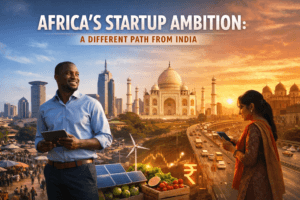
Africa’s Startup Ambition: Why a Different Path from India Is a Sign of Strength
In the global startup theater, the narrative of an emerging economy emulating a successful predecessor is compelling and familiar. Today, Africa, with its youthful dynamism and bold ambitions, looks toward India’s well-charted rise as a tech powerhouse. Yet, a closer look reveals a continent consciously choosing to forge its own destiny. The emerging African venture capital philosophy, exemplified by investors like Zachariah George, is not about replicating India’s playbook but about writing a new one—one built on resilience, local realities, and sustainable growth over the pursuit of mythical unicorns.
This divergence is not a sign of weakness but a strategic adaptation to fundamentally different landscapes. While India’s ecosystem matured with the backing of patient global capital, Africa’s journey is being shaped by local investors solving homegrown problems. The continent’s top venture capitalists are sending a clear message: Africa’s startup success will be defined on its own terms.
The Blueprint and the Fork in the Road
India’s startup story over the past decade is one of extraordinary scale and investor confidence. Between 2014 and mid-2024, the ecosystem attracted over $150 billion in investments, with hubs like Bengaluru, Delhi-NCR, and Mumbai dominating the landscape. In 2025 alone, funding remained robust at approximately $9.8 billion. This growth has been underpinned by deep pools of institutional capital, including U.S. pension funds and endowments managing nearly $1.8 trillion in assets, which are actively seeking to increase their exposure to Indian markets. Major global funds like Canada’s CPPIB have tripled their Indian assets in five years, focusing on real assets like infrastructure and energy.
Africa’s trajectory tells a different story. In 2024, the continent’s venture capital activity saw a 22% decline in deal value and a 28% drop in volume year-on-year. Funding remains concentrated, with the “Big Four” nations—Nigeria, Egypt, Kenya, and South Africa—accounting for more than half of all deals. The continent’s share of global VC funding is still below 1%. This isn’t merely a funding gap; it’s a reflection of a different starting point, different challenges, and a different definition of what success looks like.
The Structural Divide: Why India’s Model Doesn’t Translate
The reasons Africa cannot simply import the Indian VC model are rooted in profound structural differences:
- The Investor Base: Global Giants vs. Local Pioneers India’s ecosystem was built with, and continues to attract, long-term capital from the world’s largest financial institutions. These investors have the appetite and capacity to fund decade-long journeys to profitability. In contrast, Africa’s VC landscape in 2024 marked a significant milestone: local African investors became the most active group, representing 31% of all investors. The capital is often more pragmatic, focused on nearer-term sustainability and tangible unit economics rather than speculative, global-scale dominance.
- Market Realities: Unified Digital Economy vs. Fragmented Frontiers India’s vast, relatively unified market under a single regulatory umbrella allows startups to scale rapidly to hundreds of millions of users. Africa presents a mosaic of 54 countries, each with distinct regulations, currencies, and consumer behaviors. Success requires mastering cross-border expansion amidst regulatory friction and currency volatility—a complexity Indian founders rarely faced at a similar stage.
- The Exit Environment: IPO Highways vs. Uncharted Paths India has developed a vibrant exit landscape, with 2025 witnessing a record number of IPOs that provided crucial liquidity for early investors. This public market validation fuels further private investment. Africa’s exit pathways are less defined, dominated by trade sales, with a more gradual development of robust public market options. This shapes a more cautious, fundamentals-focused investment thesis from the start.
Africa’s Emerging Alternative: Building What Doesn’t Exist
In response to these realities, a distinct African investment philosophy is crystallizing. It moves away from the “blitzscale” model and toward what Zachariah George’s profile hinted at: building an ecosystem from the ground up.
- Quality Over Quantity: Investors are backing fewer startups but writing bigger checks for those with proven traction and sound economics. The median equity round size in Africa increased to $2.5 million in 2024, indicating capital concentration on more mature, de-risked ventures.
- Diversification Beyond Fintech: While fintech still leads, there is significant growth in funding for climate tech, logistics, health-tech, and AI—sectors that address Africa’s most pressing real-world challenges in food security, healthcare, and sustainability.
- Alternative Capital Instruments: With a noted “Series B cliff” creating a funding gap for scaling companies, founders are increasingly turning to venture debt, revenue-based financing, and hybrid structures to extend their runway without excessive dilution.
- Solving for Fundamentals, Not Fantasy: The focus is shifting from chasing unicorn valuations to building “camels”—startups built for endurance, profitability, and resilience in a challenging macroeconomic climate. This means prioritizing revenue generation, positive unit economics, and capital efficiency from an early stage.
India vs. Africa: A Tale of Two Investment Theses
The table below encapsulates the core philosophical differences shaping the two ecosystems:
| Investment Dimension | India’s Investor-Led Model | Africa’s Founder-Focused Alternative |
| Primary Capital Source | Global institutional capital (pension funds, endowments, global VCs) | Rising local investors, diaspora funding, blended finance |
| Growth Imperative | Rapid, often subsidized, scaling to capture a vast unified market. | Sustainable scaling across fragmented markets, with emphasis on unit economics. |
| Sector Focus | E-commerce, fintech, SaaS; now expanding into deep-tech and AI. | Fintech, plus essential infrastructure: climate tech, logistics, health-tech, agri-tech. |
| Exit Expectation | IPO on domestic or international exchanges as a primary goal. | Trade sale, strategic acquisition, or longer-term private growth. |
| Defining Mythology | The Unicorn: A billion-dollar valuation. | The Camel: Resilience, profitability, and endurance through tough conditions. |
The Road Ahead: A Continent Defining Its Own Destiny
Africa’s choice to diverge from the Indian blueprint is a sign of maturity, not inadequacy. It acknowledges that copying a model built for different geology will not work. The challenges—such as persistent gender gaps where female-led startups raised just 2% of funding in Q1 2025, and the need for regulatory harmonization—remain substantial.
However, the continent is leveraging its unique advantages: the world’s youngest population, rapid digital adoption, and immense, unmet market needs. The rise of local investors who understand these nuances is perhaps the most promising development, ensuring capital is deployed with contextual intelligence.
The story of African startups is no longer about “catching up” to India or Silicon Valley. It is about pioneering a viable, sustainable, and impactful path to building businesses that solve Africa’s problems, create value for its people, and ultimately, export solutions born of its unique experience to the world. In rejecting mere emulation, Africa is not settling for less; it is ambitiously striving for a form of success that is authentically and sustainably its own.
You must be logged in to post a comment.